Politics
Pennsylvania Should Legalize Marijuana Under New Democratic Control, Philadelphia City Council Resolution Says


Local officials in Pennsylvania’s most populous city are calling on state lawmakers to pass a bill to legalize marijuana now that Democrats have full control of the legislature.
“Over the past decade, repeated efforts to legalize adult-use cannabis have stalled in the Senate under divided government,” a resolution passed in a voice vote by the Philadelphia City Council on Thursday says. The majority that Democrats won in the chamber in this month’s midterm elections “presents a rare opportunity to enact comprehensive adult-use cannabis legislation.”
“The Commonwealth is now surrounded by states that have legalized adult use,” it says. “Continuing to keep adult-use cannabis illegal in Pennsylvania would be continuing to lose out on millions of dollars in revenue to our neighboring states who have already allowed for the legalization of adult-use cannabis.”
“The legalization of adult-use cannabis has various other benefits. It introduces a new market for full-time and ancillary jobs, including cultivation, processing, lab testing, retail, compliance, and real estate,” the resolution sponsored by Councilmember Jim Harrity (D), along with Council President Kenyatta Johnson (D) and eight other members of the City Council, says. “Legalization also moves production and sales from illicit networks into regulated, tested business environments, reducing violent drug-trafficking pressures.”
Legalizing marijuana would also help to “reduce the over policing of historically marginalized communities, particularly Black and Brown communities and individuals experiencing mental health challenges,” the legislation says, and can additionally “redirect law enforcement resources toward more serious offenses, promote community reinvestment, and encourage responsible cultivation practices.”
One of the clauses of the proposal notes that the City Council previously enacted a local reform to decriminalize marijuana possession and that voters separately approved a ballot measure calling on state officials to legalize cannabis.
“Given the newly elected Democratic majorities in both the PA House and PA Senate, it is more relevant than ever that the Assembly include the legalization of adult-use cannabis on its upcoming agenda, among its other priorities,” the new resolution says.
“RESOLVED, THAT THE COUNCIL OF THE CITY OF PHILADELPHIA, Hereby calls upon the General Assembly of the Commonwealth of Pennsylvania to enact legislation regarding adult-use cannabis given the new Democratic majorities in both the Pennsylvania Senate and Pennsylvania House of Representatives, encouraging the responsible development of regulations to promote public health and consumer safety and ensure that the economic benefits of legalization are reinvested in Pennsylvania communities.”
While advocates have expressed optimism that the state is teed up to legalize cannabis under the new Democratic governing trifecta, presumptive Senate President Pro Tempore Jay Costa (D) said recently that marijuana reform in Pennsylvania isn’t a “high priority” and he doesn’t expect his party to focus on the issue “right away.”
“I think that’ll be one of the things that we that we discuss over the course of the coming months,” he said. “It’s not maybe necessarily one of the high priority items that we feel like we’ve been given a clear responsibility to address. But I do think it’s something we will talk about in the coming months—but not necessarily right away.”
Meanwhile, Gov. Josh Shapiro (D), who has long supported legalization and has regularly included the reform in his budget proposals to the legislature, has not mentioned cannabis reform as a priority item in social medial posts and interviews following this month’s midterm elections in which Democrats took control of the state Senate and maintained a majority in the House of Representatives.
In September, House Speaker Joanna McClinton (D) said at a cannabis event that Pennsylvania would be poised to legalize marijuana if Democrats gained Senate control, arguing that the state still has “a ways to go” to catch up with its neighbors that have already “moved in the right direction” by enacting legalization.
While McClinton’s chamber passed a bill to legalize cannabis last year, it has stalled in the Senate, where Republican have had a narrow majority.
House Appropriations Committee Chair Jordan Harris (D) also spoke alongside McClinton on the Black Cannabis Week panel, noting that “attitudes are changing in Pennsylvania with regards to cannabis” but that “one of the reasons why we don’t have full adult use legalized here is because of the attitudes of a handful of members of the Pennsylvania State Senate.”
“If we had those attitudes changed and/or the attitudes of their constituency, we would pass a bill out of the House, we would send it to the Senate and they would be able to run it,” he said.
Sen. Sharif Street (D), who has sponsored legislation to legalize marijuana for several sessions, said that if Democrats took a majority in the Senate, “we may be helping to move this process forward and having a different kind of say” as compared to his ability to advance legislation in the minority caucus.
The Black Cannabis Week panel came ahead of a hearing on marijuana legalization that the Pennsylvania Senate Democratic Policy Committee held later in the day where lawmakers highlighted the need for reform.
Democratic lawmakers in Pennsylvania have continually pushed for marijuana legalization, including with a discharge resolution that Street filed seeking to bring a bipartisan cannabis bill out of committee.
The measure, which was signed by every Democratic senator, aimed to increase pressure on the chamber’s Republican majority to allow a vote on legalizing cannabis.
The bill in question is sponsored by Street along with Sen. Dan Laughlin (R), who chairs the Senate Law & Justice Committee but hasn’t called the legislation up for consideration in the panel.
The GOP chairman has instead focused on moving a separate bill to create a new Cannabis Control Board to regulate medical marijuana and hemp. That measure failed on the Senate floor in June amid partisan fighting about the best way forward for cannabis in the state.
The marijuana legalization bill that Street wants to advance, SB 120, would allow adults aged 21 and older to possess up to 30 grams of cannabis flower, 1,000 milligrams of THC in edible products and 5 grams of concentrate.
It would also create a process to expunge prior marijuana-related criminal records.
If enacted, there would be an 8 percent excise tax on cannabis sales, alongside the state’s regular sales tax of 6 percent.
The legislative maneuvering around the bill came as a recent poll showed that Pennsylvania voters overwhelmingly support marijuana legalization—and that the largest share put the blame on Republican lawmakers for the fact that the state has not yet enacted the reform.
Republican gubernatorial nominee Stacy Garrity, who lost to Shapiro in the November election, had pledged to veto a marijuana legalization bill if lawmakers ever sent one to her desk—though she added that she doesn’t think the reform stands a chance of making it that far in the state.
Her running mate for lieutenant governor, Jason Richey, claimed that legalizing marijuana would be “catastrophic” for the state, arguing it would increase the size of the illegal market, undermine job creation and harm public health.
The governor earlier this year, as he has in past years, included cannabis legalization and the resulting expected revenue in his budget request.
The House last year passed a bill to legalize marijuana and put sales in state-owned dispensaries, but the Republican Senate majority has criticized that plan while also not advancing a cannabis legalization model of its own.
The state’s Independent Fiscal Office (IFO) reported in February that legalizing cannabis in Pennsylvania would generate nearly half a billion dollars in annual revenue by 2028, an estimate that is a significantly larger cash windfall compared to projections from Shapiro’s own office.
A spokesperson in the governor’s office said the Trump administration’s federal marijuana rescheduling move is an “important step” that “adds support” to his push to legalize cannabis. A GOP senator also said that federal reform will make it easier to legalize marijuana in the state.
—
Marijuana Moment is tracking hundreds of cannabis, psychedelics and drug policy bills in state legislatures and Congress this year. Patreon supporters pledging at least $25/month get access to our interactive maps, charts and hearing calendar so they don’t miss any developments.
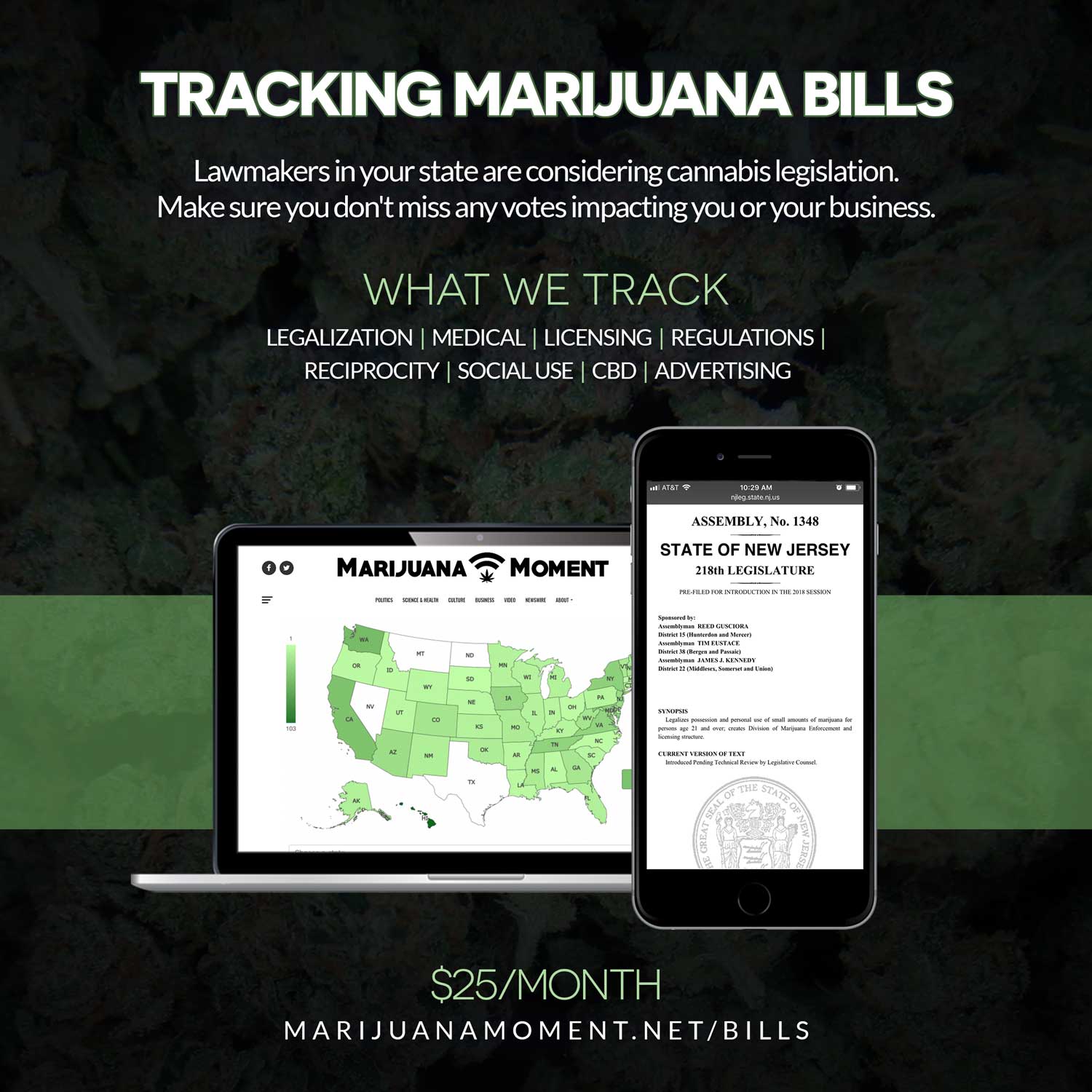
Learn more about our marijuana bill tracker and become a supporter on Patreon to get access.
—
Meanwhile, Laughlin is blaming the governor for the defeat of his bill to create a new Cannabis Control Board (CCB) to oversee the state’s medical marijuana program and intoxicating hemp products and that could also one day oversee recreational cannabis if it is legalized.
Most GOP senators in the Republican-controlled chamber voted for the legislation from Laughlin, and all but two Democrats opposed it—with even some lawmakers who signed onto the measure as cosponsors ultimately voting against it.
The measure would transfer regulatory authority for the state’s existing medical cannabis program from the Department of Health to a new seven-member CCB. The body would oversee cannabis permits, enforcement, seed-to-sale tracking, advertising, labeling, testing and other aspects of the legal industry.
Moments after the bill’s defeat on the Senate floor, the chamber adopted a motion to reconsider—but it’s not yet clear when or if the legislation will get another vote.
Laughlin’s legislation would also significantly restrict most hemp THC products, aligning the state with a new federal policy that is set to take effect later this year recriminalizing preparations with total THC content of more than 0.3 percent on a dry-weight basis or more than 0.4 milligrams of THC per container.
The action on the cannabis regulatory bill, SB 49, came shortly after the House of Representatives passed a bill to allow terminally ill patients to use medical cannabis in hospitals and other healthcare facilities. A companion bill on medical marijuana access in healthcare facilities is also advancing in the Senate.
Meanwhile, a Republican senator recently announced plans to file legislation to keep hemp THC products legally available while enacting new regulations.