Politics
Pennsylvania Can Legalize Marijuana Next Year If Democrats Flip Three Legislative Seats, House Speaker Says

Pennsylvania is poised to legalize marijuana as soon as next year if Democrats can win a handful of key state legislative races in the November elections, a top lawmaker says.
House Speaker Joanna McClinton (D) said at a Black Cannabis Week event on Friday that the state still has “a ways to go” to catch up with its neighbors that have already “moved in the right direction” by enacting marijuana legalization.
While McClinton’s chamber passed a bill to legalize cannabis last year, it has stalled in the Senate, where Republican have a narrow majority.
However, the “exciting thing” is that “Pennsylvania voters may go a different direction” by electing Democrats in November and helping them flip the three seats the party needs to take a majority in the Senate, the speaker said.
“What it looks like for us to have change is we have to change who is making the laws in that chamber,” she said, urging voters to “do the best thing for people to have business opportunities, health improvement, community empowerment, restorative justice—things that are long overdue.”
House Appropriations Committee Chair Jordan Harris (D) also spoke alongside McClinton on the Black Cannabis Week panel, noting that “attitudes are changing in Pennsylvania with regards to cannabis” but that “one of the reasons why we don’t have full adult use legalized here is because of the attitudes of a handful of members of the Pennsylvania State Senate.”
“If we had those attitudes changed and/or the attitudes of their constituency, we would pass a bill out of the House, we would send it to the Senate and they would be able to run it,” he said.
Harris, who oversees fiscal issues in his committee leadership capacity, said “it is the finances that’s going to finally drive the conversation, regardless of how we personally feel.”
“At the end of the day, it’s going to be about the money, and I think that money is going to drive us to actually legalizing adult use very soon in the commonwealth,” he said.
“Our friends in the bordering states are benefiting from us not legalizing cannabis,” Harris said, noting that Pennsylvania residents are crossing the border to buy marijuana. “We are missing out on that tax revenue here, and so for me, it would be a real boom to our economy here in Pennsylvania for us to legalize it.”
Sen. Sharif Street (D), who has sponsored legislation to legalize marijuana for several sessions, said that if Democrats take a majority in the Senate, “we may be helping to move this process forward and having a different kind of say” as compared to his ability to advance legislation in the minority caucus.
“Pennsylvanians in 39 days could put us in a position where we can have that,” he said.
The Black Cannabis Week panel came ahead of a hearing on marijuana legalization that the Pennsylvania Senate Democratic Policy Committee held later in the day.
Democratic lawmakers in Pennsylvania are continuing to push for marijuana legalization, including with a discharge resolution that Street filed seeking to bring a bipartisan cannabis bill out of committee.
The measure, which was signed by every Democratic senator, aims to increase pressure on the chamber’s Republican majority to allow a vote on legalizing cannabis.
The bill in question is sponsored by Street along with Sen. Dan Laughlin (R), who chairs the Senate Law & Justice Committee but hasn’t called the legislation up for consideration in the panel.
The GOP chairman has instead focused on moving a separate bill to create a new Cannabis Control Board to regulate medical marijuana and hemp. That measure failed on the Senate floor in June amid partisan fighting about the best way forward for cannabis in the state.
The marijuana legalization bill that Street wants to advance, SB 120, would allow adults aged 21 and older to possess up to 30 grams of cannabis flower, 1,000 milligrams of THC in edible products and 5 grams of concentrate.
It would also create a process to expunge prior marijuana-related criminal records.
If enacted, there would be an 8 percent excise tax on cannabis sales, alongside the state’s regular sales tax of 6 percent.
The legislative maneuvering around the bill comes as a recent poll shows that Pennsylvania voters overwhelmingly support marijuana legalization—and that the largest share put the blame on Republican lawmakers for the fact that the state has not yet enacted the reform.
Gov. Josh Shapiro (D) has repeatedly called on lawmakers to send him a marijuana legalization bill and for the last several years has included the reform in his budget requests to the legislature.
Republican gubernatorial nominee Stacy Garrity, who is running against Shapiro, recently pledged to veto a marijuana legalization bill if lawmakers ever sent one to her desk—though she added that she doesn’t think the reform stands a chance of making it that far in the state.
Her running mate for lieutenant governor, Jason Richey, claimed that legalizing marijuana would be “catastrophic” for the state, arguing it would increase the size of the illegal market, undermine job creation and harm public health.
The governor earlier this year, as he has in past years, included cannabis legalization and the resulting expected revenue in his budget request.
The House last year passed a bill to legalize marijuana and put sales in state-owned dispensaries, but the Republican Senate majority has criticized that plan while also not advancing a cannabis legalization model of its own.
The state’s Independent Fiscal Office (IFO) reported in February that legalizing cannabis in Pennsylvania would generate nearly half a billion dollars in annual revenue by 2028, an estimate that is a significantly larger cash windfall compared to projections from Shapiro’s own office.
A spokesperson in the governor’s office said the Trump administration’s federal marijuana rescheduling move is an “important step” that “adds support” to his push to legalize cannabis. A GOP senator also said that federal reform will make it easier to legalize marijuana in the state.
—
Marijuana Moment is tracking hundreds of cannabis, psychedelics and drug policy bills in state legislatures and Congress this year. Patreon supporters pledging at least $25/month get access to our interactive maps, charts and hearing calendar so they don’t miss any developments.
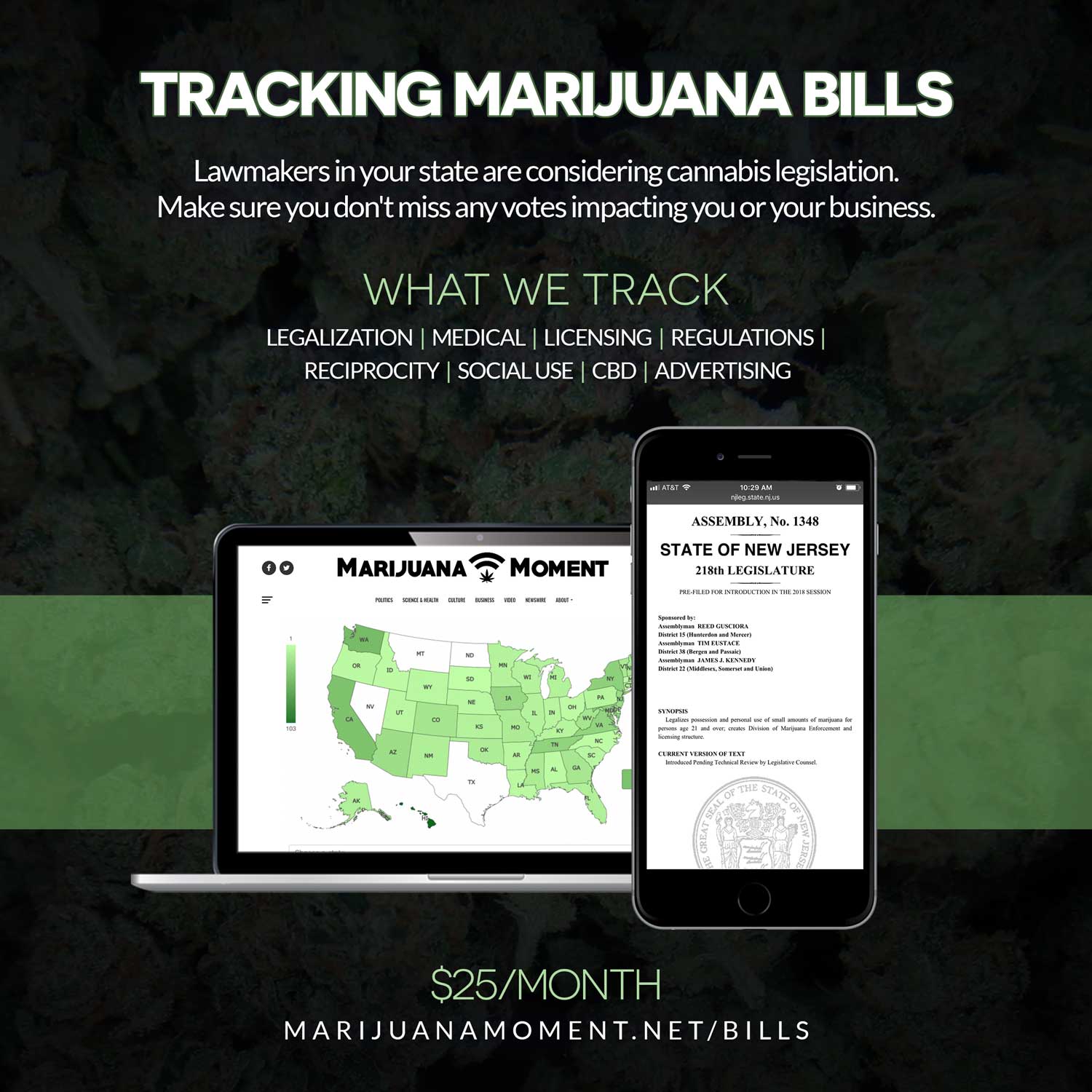
Learn more about our marijuana bill tracker and become a supporter on Patreon to get access.
—
Meanwhile, Laughlin is blaming the governor for the defeat of his bill to create a new Cannabis Control Board (CCB) to oversee the state’s medical marijuana program and intoxicating hemp products and that could also one day oversee recreational cannabis if it is legalized.
Most GOP senators in the Republican-controlled chamber voted for the legislation from Laughlin, and all but two Democrats opposed it—with even some lawmakers who signed onto the measure as cosponsors ultimately voting against it.
The measure would transfer regulatory authority for the state’s existing medical cannabis program from the Department of Health to a new seven-member CCB. The body would oversee cannabis permits, enforcement, seed-to-sale tracking, advertising, labeling, testing and other aspects of the legal industry.
Moments after the bill’s defeat on the Senate floor, the chamber adopted a motion to reconsider—but it’s not yet clear when or if the legislation will get another vote.
Laughlin’s legislation would also significantly restrict most hemp THC products, aligning the state with a new federal policy that is set to take effect later this year recriminalizing preparations with total THC content of more than 0.3 percent on a dry-weight basis or more than 0.4 milligrams of THC per container.
The action on the cannabis regulatory bill, SB 49, came shortly after the House of Representatives passed a bill to allow terminally ill patients to use medical cannabis in hospitals and other healthcare facilities.