Politics
Pennsylvania Senate Rejects Bill To Regulate Marijuana And Restrict Hemp THC Products, But It May Be Revived

The Pennsylvania Senate has rejected a bill to create a new Cannabis Control Board (CCB) to oversee the state’s medical marijuana program and intoxicating hemp products—though lawmakers made an immediate motion to revive the proposal. The body contemplated under the legislation could also one day oversee recreational cannabis if it is legalized in the state.
The measure from Sen. Dan Laughlin (R), which would also recriminalize many hemp THC products, was defeated in a 27-23 vote on Wednesday. Shortly thereafter, however, a motion to reconsider the proposal was approved in a vote of 29-21. It’s not yet clear when the body will take the bill back up.
“This legislation is about protecting Pennsylvania families, consumers, patients and, most importantly, our children,” Laughlin said ahead of the initial vote. “Today, intoxicating hemp products are sold throughout every corner of Pennsylvania, in every Senate district, with zero oversight. These dangerous and psychoactive products can be found in convenience stores, smoke shops, gas stations and online marketplaces with no testing standards, no labeling, or safeguards to prevent access by children.”
The senator argued that creation of a new CCB is “necessary” because management of the medical cannabis program by the Department of Health “has too often been marked by inconsistency and delay.”
“The department has allowed Pennsylvania’s medical marijuana program to drift further and further from its original purpose,” he said, citing “lax oversight and ever-expanding interpretation of qualifying conditions.”
“The program has increasingly operated as a de facto tax-free adult use market without the transparency, accountability or statutory framework,” Laughlin said. “Businesses and patients have experienced slow approvals, conflicting guidance, years-long delay in remediation reviews, uncertainty regarding workplace policies and regulatory decisions that have ultimately been overturned by the courts.”
“These inconsistencies undermine confidence in the system and distract from what should be our primary mission: serving and protecting our patients. A dedicated Cannabis Control Board will provide focused expertise, consistent enforcement and transparent decision making.”
Sen. Sharif Street (D), who has partnered with Laughlin on separate legislation to legalize recreational marijuana, said “we should not let the perfect be the enemy of the good.”
“My colleague has outlined many really good things that are addressed in this bill. Are there other things that are not sure? Are there other things that we could be doing in the space of cannabis? Absolutely,” he said. “But that doesn’t mean that today this legislation isn’t worthy of a positive vote… Should we pass it today, it would go to the House and there will be opportunity for additional work to be done in the legislation.”
Sen. Jay Costa (D), the minority floor leader, however, urged colleagues to oppose the legislation.
The Law & Justice Committee, which is chaired by the bill’s sponsor, had taken up and amended the measure several times this session before it came to the floor. The body’s Appropriations and Rules & Executive Nominations Committees also signed off on the legislation this week ahead of its consideration by the full chamber.
In its current form, the measure, would transfer regulatory authority for the state’s existing medical cannabis program from the Department of Health to a new seven-member CCB.
The governor would appoint three members—one with law enforcement experience, another with expertise in dealing with addiction and a third with experience in “cannabis matters.” The Senate president pro tempore, Senate minority leader, House speaker and House minority leader would also each get to make one appointment.
The body would oversee cannabis permits, enforcement, seed-to-sale tracking, advertising, labeling, testing and other aspects of the legal industry.
The legislation would also significantly restrict most hemp THC products, aligning the state with a new federal policy that is set to take effect later this year recriminalizing preparations with total THC content of more than 0.3 percent on a dry-weight basis or more than 0.4 milligrams of THC per container.
The bill would also create new types of medical cannabis permits for warehousing/distribution and third-party transporters, and would require regulars to issue an additional permit to an independent grower/processor.
It would additionally add a new requirement for dispensaries to have a physician, pharmacist, physician assistant or certified nurse practitioner available at all times during hours of operation.
A new Cannabis Regulation Fund would be established, supported by fees from the program. Forty percent of revenue would fund CCB’s operations, 15 percent would help patients pay for medical marijuana, 10 percent would support drug misuse prevention and treatment, 10 percent would go to local police departments and the remainder would go into the state’s general fund.
Laughlin, who is also sponsoring bipartisan legislation to legalize adult-use marijuana previewed the regulatory measure last year, writing that Pennsylvania should take initial steps to make sure the state is “ready to act when legalization becomes law” by establishing a CCB now.
In a cosponsorship memo, Laughlin said his bill would “transfer regulatory control of the Medical Marijuana Program to the CCB, ensuring continuity, efficiency, and improved oversight of medical cannabis businesses and patient access.” It would further “establish uniform safety standards to protect consumers from untested and potentially harmful products.”
The bill text itself would not enact recreational marijuana legalization on its own. But the description indicates that the sponsor feels the current regulatory regime under the Pennsylvania Department of Health should be replaced with a more targeted agency that would ostensibly be suited to oversee an adult-use market if lawmakers move to end prohibition.
“By consolidating oversight under a single regulatory board, we can eliminate inconsistencies, enhance transparency, and provide the structure needed to responsibly manage this industry,” the memo says.
The action on the cannabis regulatory bill, SB 49, comes shortly after the House of Representatives passed a bill to allow terminally ill patients to use medical cannabis in hospitals and other healthcare facilities.
—
Marijuana Moment is tracking hundreds of cannabis, psychedelics and drug policy bills in state legislatures and Congress this year. Patreon supporters pledging at least $25/month get access to our interactive maps, charts and hearing calendar so they don’t miss any developments.
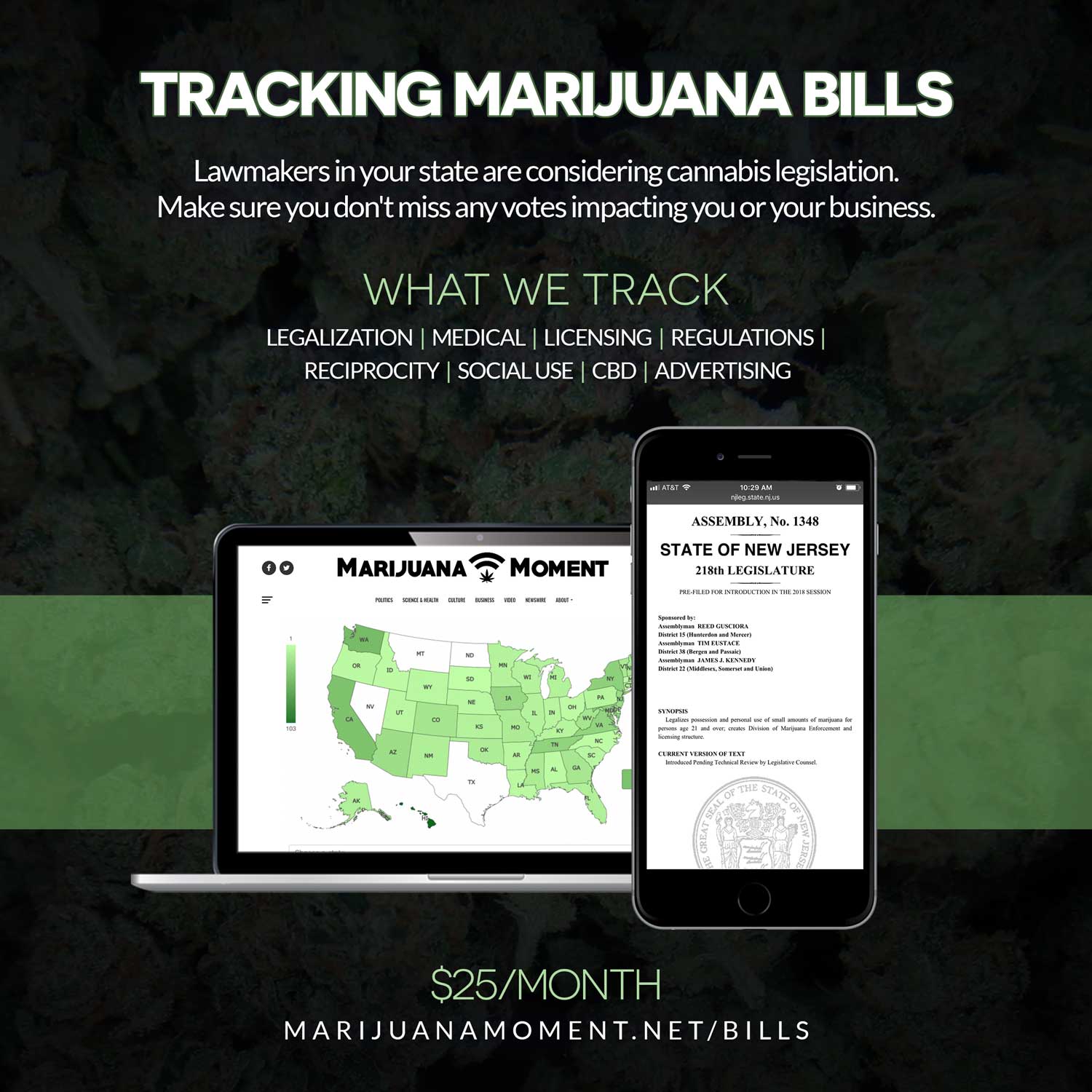
Learn more about our marijuana bill tracker and become a supporter on Patreon to get access.
—
It also comes as lawmakers in Pennsylvania continue to consider broader recreational marijuana legalization—a reform that a state senator recently said will be easier to achieve now that the Trump administration has rescheduled cannabis at the federal level.
Gov. Josh Shapiro (D) has repeatedly called on lawmakers to send him a marijuana legalization bill and for the last several years has included the reform in his budget requests to the legislature.
The Democratic-controlled House of Representatives passed a bill last year to end prohibition, but the Republican-controlled Senate has not followed suit.
Republican gubernatorial nominee Stacy Garrity, who is running against Shapiro, recently pledged to veto a marijuana legalization bill if lawmakers ever sent one to her desk—though she added that she doesn’t think the reform stands a chance of making it that far in the state.
“I don’t support legalizing recreational marijuana,” she said. “Recreational marijuana will not end up in the budget. They’re never going to pass it…not as long as Senate Republicans are in control of the Senate.”
Her running mate for lieutenant governor, Jason Richey, claimed that legalizing marijuana would be “catastrophic” for the state, arguing it would increase the size of the illegal market, undermine job creation and harm public health.
A spokesperson in the governor’s office said the Trump administration’s federal marijuana rescheduling move is an “important step” that “adds support” to his push to legalize cannabis in the state.
The governor also used this year’s unofficial cannabis holiday 4/20 as an opportunity to press lawmakers once again to send him a bill to legalize marijuana.
“Pennsylvanians who want to buy recreational marijuana are already driving across the border to one of our neighboring states who’ve legalized it,” Shapiro said in a social media post that day. “That’s hundreds of millions in revenue going out of state instead of being spent here in Pennsylvania.”
In April, the Pennsylvania House of Representatives passed budget legislation proposed by Shapiro that relies on revenue that would be generated from recreational marijuana sales, which has yet to be legalized in the state.
The governor earlier this year, as he has in past years, included cannabis legalization and the resulting expected revenue in his budget request. The $53.2 billion budget legislation, which doesn’t itself include provisions to actually legalize marijuana even as it contemplates allocating money that would result from it, now heads to the Senate for consideration.
The House of Representatives last year passed a bill to legalize marijuana and put sales in state-owned dispensaries, but the Republican Senate majority has criticized that plan while also not advancing a cannabis legalization model of its own.
Separately this session, lawmakers have advanced a bill to allow terminally ill patients to use medical cannabis in hospitals and other healthcare facilities
The legislative developments come as a recent poll shows that seven out of ten Pennsylvania likely voters support legalizing adult-use marijuana—including majority backing for the reform across party lines.
When asked whether they “support or oppose the regulation and taxation of legal cannabis for use by adults 21 and older in Pennsylvania,” 69 percent of respondents said yes. Support was strongest from Democrats, at 72 percent, but also includes 67 percent of Republicans and 64 percent of independents.
Meanwhile, Shapiro is continuing to pressure on lawmakers to send him a bill to legalize marijuana in the state, saying that doing so would generate new revenue that could be invested in key programs.
“While some in Harrisburg claim we can’t afford to make bigger investments in our kids, public safety, and our economy, know this: If we legalized and regulated adult-use cannabis, we’d bring in $1.3 BILLION in revenue for our Commonwealth over the first five years,” the governor said in another recent social media post.
“Those are dollars that can be invested back into our people and our communities,” he said. “Stop with the excuses. Let’s get this done.”
The state’s Independent Fiscal Office (IFO) reported in February that legalizing cannabis in Pennsylvania would generate nearly half a billion dollars in annual revenue by 2028, an estimate that is a significantly larger cash windfall compared to projections from Shapiro’s own office.
With a proposed 20 percent wholesale cannabis excise tax, 6 percent state sales tax for retail and licensing fees, IFO said the governor’s legalization plan would generate $140 million in tax revenue in the first year of implementation from 2027-2028 and increase to $432 million by 2030-2031.
That’s a much higher revenue estimate than what the governor’s office put forward in the latest executive budget. According to his office’s analysis, legalization would generate about $36.9 million in tax dollars in its first year from a 20 percent wholesale tax on marijuana—rising gradually to $223.8 million by 2030-2031.
In February, a coalition of drug policy and civil liberties organizations urged Shapiro to play a leadership role in convening legislative leaders to get the job done on cannabis legalization this session.