Politics
Pennsylvania GOP Senator Announces New Bill To Regulate Hemp THC Products With Age Limits And Testing Requirements

A Pennsylvania Republican senator is asking colleagues to support a forthcoming bill she plans to introduce to keep hemp THC products legal in the state while adding age limits as well as new requirements for registration, testing and labeling.
Sen. Dawn Keefer (R) announced the Pennsylvania Hemp and Cannabinoid Act in a cosponsorship memo on Friday.
“The bill gives responsible hemp businesses a clear state framework and keeps intoxicating products out of the hands of children while federal hemp policy remains unsettled,” she wrote.
While federal hemp policy remains in flux, there is no statewide system for consumable hemp products—with “no Pennsylvania age gate, no uniform testing or labeling standard, and no retail accountability,” the senator said.
“Those products are sold next to candy and snacks,” she said. “Some are packaged and flavored to appeal to children.”
Keefer said that while her bill would protect “responsible Pennsylvania farmers, manufacturers, and retailers” who have “built a lawful market,” it is “not adult-use marijuana legalization.”
The legislation, which has not yet been filed, would not create a new regulatory body to oversee products or alter existing rules for medical cannabis.
“What it does is protect the responsible consumable hemp industry and keep harmful products away from children,” the senator’s cosponsorship memo says. “It requires Department of Agriculture registration, independent testing and truthful labels, 21-and-over sales with ID checks, and a ban on candy-style packaging and youth-targeted marketing. It also grandfathers existing Pennsylvania operators who can document lawful pre-enactment operations.”
Hemp derivatives with less than 0.3 percent delta-9 THC on a dry-weight basis were federally legalized under the 2018 Farm Bill that President Donald Trump signed during his first term in office. But late last year, the president signed new legislation containing provisions that redefined hemp to make it so only products with 0.4 milligrams of total THC per container would remain legal after November 12.
Now, however, under provisions included in a funding bill Trump signed this month, the effective date of the ban for most products is being pushed back to December 11 to give lawmakers more time to craft regulations for hemp derivatives. There is a carve-out, however, to allow the recriminalization on November 12 of synthetic cannabinoids “that are not capable of being naturally produced by a Cannabis sativa L. plant.”
Keefer said that “federal delay is not a reason for Pennsylvania inaction.”
“If Congress lets the federal cap take effect, our state still needs age limits, testing, and a public registry so responsible operators can comply,” she said. “If Congress replaces the cap with a regulated federal market, Pennsylvania still needs its own 21-and-over retail rules.”
The senator is asking her colleagues cosponsor the forthcoming bill “to protect Pennsylvania’s responsible consumable hemp industry, give law enforcement a clear state standard, and keep harmful intoxicating products out of the hands of children.”
A separate bill that has already been introduced in the Pennsylvania Senate would create a new Cannabis Control Board (CCB) to oversee the state’s medical marijuana program and significantly restrict most hemp THC products.
That legislation, from Sen. Dan Laughlin (R), was defeated on the Senate floor in June, though it is pending reconsideration.
Meanwhile, Democratic lawmakers in Pennsylvania are stepping up the call for broader marijuana legalization.
The speaker of the Democratic-controlled House said last week that the state could legalize recreational marijuana next year if her party wins a handful of seats in the November elections and takes a Senate majority.
The House last year passed a bill to legalize marijuana and put sales in state-owned dispensaries, but the Republican Senate majority has criticized that plan while also not advancing a cannabis legalization model of its own.
A Democratic senator recently filed a discharge resolution seeking to bring a bipartisan cannabis bill out of committee.
—
Marijuana Moment is tracking hundreds of cannabis, psychedelics and drug policy bills in state legislatures and Congress this year. Patreon supporters pledging at least $25/month get access to our interactive maps, charts and hearing calendar so they don’t miss any developments.
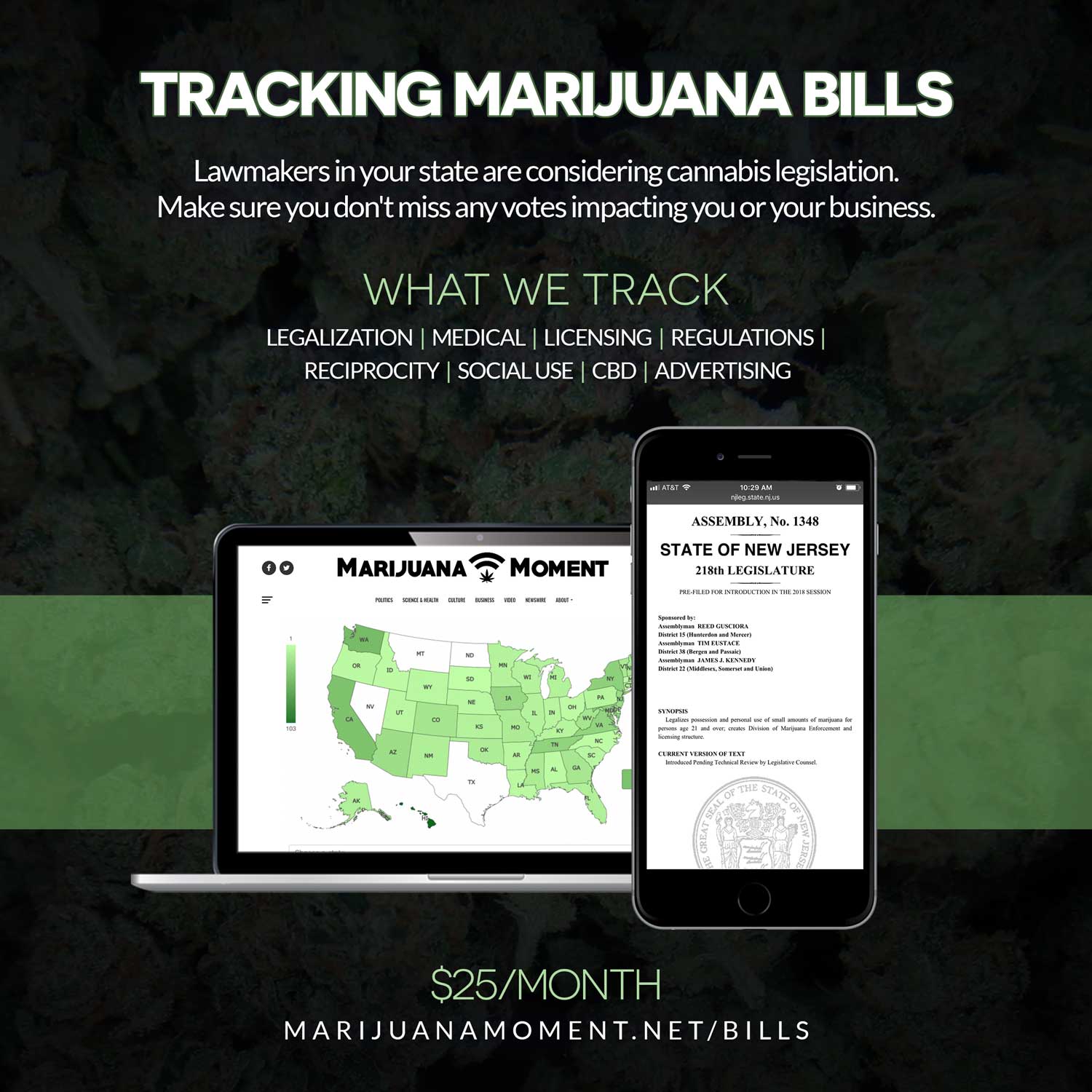
Learn more about our marijuana bill tracker and become a supporter on Patreon to get access.
—
The legislative maneuvering around cannabis as a recent poll shows that Pennsylvania voters overwhelmingly support marijuana legalization—and that the largest share put the blame on Republican lawmakers for the fact that the state has not yet enacted the reform.
Gov. Josh Shapiro (D) has repeatedly called on lawmakers to send him a marijuana legalization bill and for the last several years has included the reform in his budget requests to the legislature.
Republican gubernatorial nominee Stacy Garrity, who is running against Shapiro, recently pledged to veto a marijuana legalization bill if lawmakers ever sent one to her desk—though she added that she doesn’t think the reform stands a chance of making it that far in the state.
Her running mate for lieutenant governor, Jason Richey, claimed that legalizing marijuana would be “catastrophic” for the state, arguing it would increase the size of the illegal market, undermine job creation and harm public health.
The governor earlier this year, as he has in past years, included cannabis legalization and the resulting expected revenue in his budget request.
The state’s Independent Fiscal Office (IFO) reported in February that legalizing cannabis in Pennsylvania would generate nearly half a billion dollars in annual revenue by 2028, an estimate that is a significantly larger cash windfall compared to projections from Shapiro’s own office.
A spokesperson in the governor’s office said the Trump administration’s federal marijuana rescheduling move is an “important step” that “adds support” to his push to legalize cannabis. A GOP senator also said that federal reform will make it easier to legalize marijuana in the state.
In June, the House of Representatives passed a bill to allow terminally ill patients to use medical cannabis in hospitals and other healthcare facilities. Similar legislation is up for consideration in a Senate committee this week.