Politics
North Carolina Officials Reveal Plan For State-Controlled Marijuana Dispensaries

The North Carolina governor’s cannabis council is revealing more details about its draft proposal to legalize marijuana sales through a system of state-controlled dispensaries.
Members of the North Carolina Advisory Council on Cannabis met publicly last week to discuss the draft recommendations but at the time only provided a basic overview of the plan.
A 19-page draft recommendation document shared with Marijuana Moment after the meeting describes the framework—which would be modeled after the way the state handles liquor, beer and wine through the Alcoholic Beverage Control Commission (ABC)—as “the most restrictive and conservative adult-use plan.”
“Under this model, the regulatory agency would license one or more qualified private contractors to operate retail stores and perform other designated functions on its behalf, while retaining ultimate operational and regulatory control,” it says. “The state, through the independent regulatory agency, would retain authority over the procurement, distribution, and sale of cannabis and cannabis products.”
State officials would “have authority to determine which products may be sold, establish statewide product standards, oversee centralized purchasing and inventory management, set retail pricing and tax collection requirements, and determine the number, type, and location of retail stores, subject to applicable local approval,” the draft proposal says.
The council, which was appointed by Gov. Josh Stein (D) last year, has not yet finalized the recommendation—but members are expected to vote on the plan in coming weeks ahead of the due date for their final report at the end of next month.
The draft document contrasts the state-controlled framework with what it calls the “conventional private retail model” that other U.S. states have used—saying that “retail operations should not promote or encourage cannabis consumption” and that regulatory systems “should not create financial incentives to increase consumption through advertising, promotions, discounts, or other inducements.”
“A state-controlled model would provide greater consistency and accountability in the cannabis marketplace, limit commercial incentives to increase consumption, reduce opportunities for corruption and diversion, strengthen protections against youth access, and allow the state to prioritize public health and safety over commercial interests,” it says.
Under the plan, cultivation and processing would be handled by private, state-licensed businesses.
James Werner, a spokesperson for the North Carolina Department of Health and Human Services, told Marijuana Moment that the panel has been “studying several models to develop recommendations.”
“The Advisory Council continues its work and is scheduled to make its official recommendations on best practices by the end of the year,” he said.
Broadly, the draft document says that the council recommends the state “establish a regulated adult-use cannabis market for individuals who are at least 21 years of age.”
“Under this framework, adults would be permitted to legally purchase, possess, and use cannabis through state-licensed retail outlets, subject to the limitations established by state law, including restrictions governing public consumption, driving while impaired, consumption in vehicles, and other conduct necessary to protect public health and safety. The creation of an adult-use market should be accompanied by a comprehensive regulatory system governing cultivation, processing, testing, distribution, retail sales, product standards, advertising, taxation, and enforcement.”
Rather than create separate systems for recreational marijuana, medical cannabis and hemp products, the council is focused on regulating the intoxicating molecule of THC through the creation of a new regulatory body to oversee the overall industry.
The document says that officials should ban synthetic cannabinoids and establish “distinct medical cannabis protections within the regulated cannabis framework without creating a distinct medical cannabis program.”
It also suggests that regulators be given the authority to set potency limits for cannabis products, “such as a maximum percentage of THC in vapor products and maximum milligrams of THC per serving and per package for consumables, with particular consideration given to products containing high amounts of total THC.”
“The goal is to set reasonable, practical limits that protect public health and safety without driving consumers to dangerous, unregulated markets,” it says.
The panel’s draft document also discusses the important of creating a process to expunge past convictions for marijuana-related activity that would no longer be a crime under legalization.
“At a minimum, individuals with convictions solely for simple possession of marijuana should be eligible for expungement or equivalent relief, subject to clearly defined statutory eligibility criteria,” it says. “The state should design the expungement process to minimize the burden on eligible individuals. Where feasible, relief should be initiated or implemented automatically through state records rather than requiring individuals to retain counsel, file individual petitions, or pay fees.”
The draft recommendations also include provisions concerning advertising restrictions, rules for packaging and labeling, standards for product potency and testing, banning public smoking and vaping, youth prevention efforts, law enforcement resources and impaired driving prevention.
When it comes to taxation, the council appears to be preparing to recommend that lawmakers choose between taxing marijuana by price, as most other states have done, or applying a tax by based on products’ THC potency.
The council’s consideration of the draft recommendations comes shortly after Democrats took control of the state House of Representatives in this month’s midterm elections and narrowed Republicans’ majority in the Senate to just one seat—which advocates believe better positions the state to move ahead with marijuana reform than ever before.
House Speaker-elect Robert Reives (D) said following the election that “decriminalization of marijuana has been on top of everybody’s minds.”
The incoming top House official also spoke about the benefits of medical cannabis, particularly for military veterans.
“I’ve got a veteran family,” he said. “My dad served. My uncle served, and all that. And it’s just, I want everything we can to help our veterans, and that is one of the top items that people have talked about.”
The North Carolina Senate under GOP control has already approved legislation to legalize medical cannabis several times during recent sessions, though House Republican leadership has refused to allow the reform to advance.
Stein, meanwhile, supports broader marijuana legalization and convened the state council last year to evaluate options for updating cannabis laws.
The governor-appointed cannabis commission in North Carolina issued an interim report in April initially recommending that the state move away from a criminalization-based approach to the plant and toward a system of “robust” regulations that provide for adults’ legal access to THC products.
The North Carolina Advisory Council on Cannabis said in the initial report that that the current “absence of regulation for North Carolina’s intoxicating cannabis market raises numerous concerns,” noting that hemp products are readily available yet largely unregulated and that marijuana remains prohibited altogether in the state, even for medical use.
“Compared to regulated marijuana frameworks in other states, this environment presents identifiable risks,” the interim report says. “While some operators voluntarily implement consumer protection protocols, these safeguards are not required under state law.”
Stein, for his part, thanked the group for its “expertise, hard work, and thoughtful deliberation” put into the initial report and reiterated his support for legalizing marijuana.
Members are tasked with developing and submitting initial recommendations on a “comprehensive cannabis policy, including any proposed legislation,” with a final report due by December 31.
Meanwhile, the governor has continually pressured the GOP-controlled legislature to advance marijuana reform.
In August, Stein called on lawmakers to broadly legalize and regulate cannabis in a way that “protects kids” while they were considering a narrower bill to restrict hemp THC and kratom products.
—
Marijuana Moment is tracking hundreds of cannabis, psychedelics and drug policy bills in state legislatures and Congress this year. Patreon supporters pledging at least $25/month get access to our interactive maps, charts and hearing calendar so they don’t miss any developments.
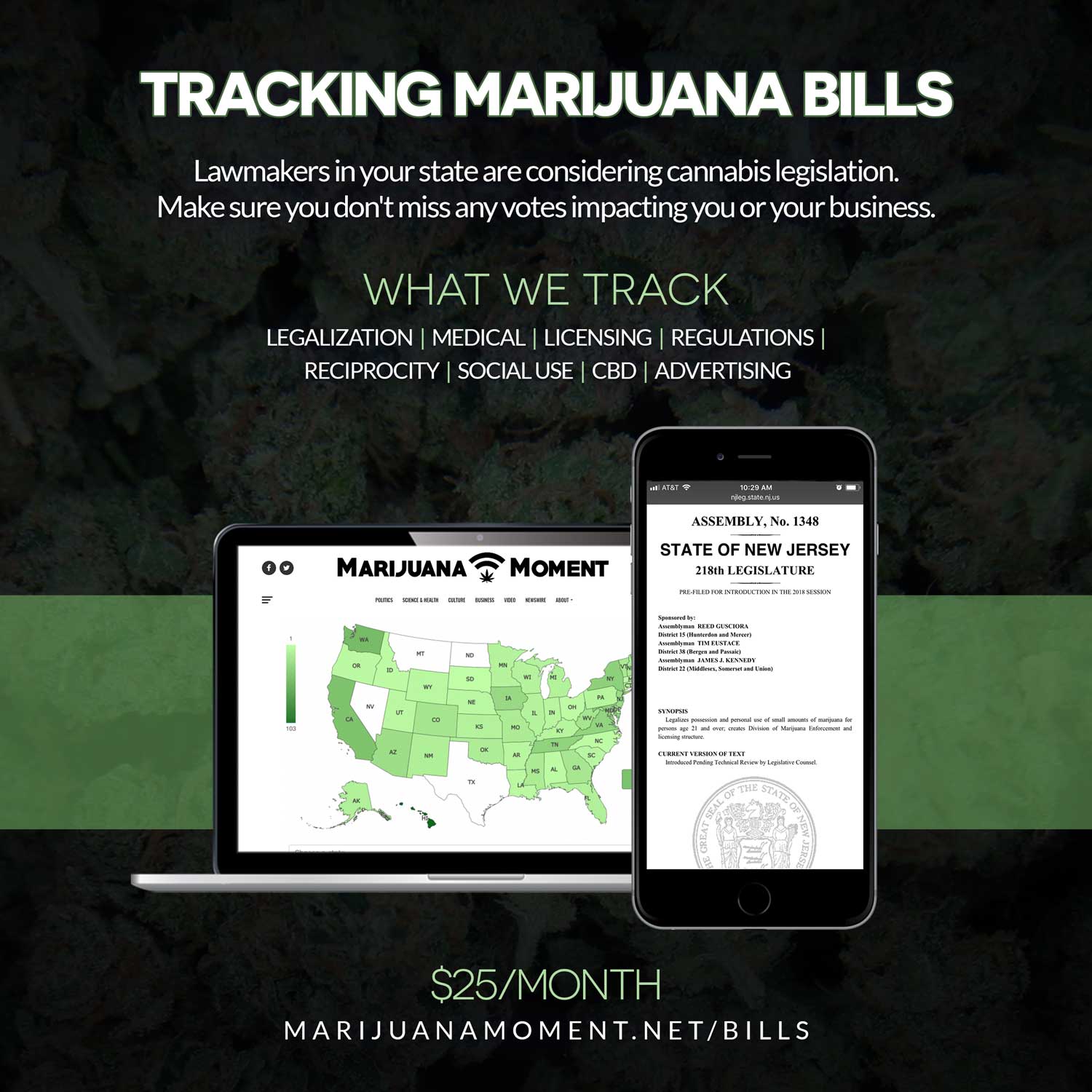
Learn more about our marijuana bill tracker and become a supporter on Patreon to get access.
—
In September, a poll showed that North Carolinians strongly support legalizing medical marijuana, and that a majority wants to go even further by legalizing cannabis for recreational use.
During his time as the state’s attorney general, Stein led a separate task force under then-Gov. Roy Cooper (D) that examined racial injustice issues and ultimately recommended decriminalizing marijuana and studying broader legalization in response to racially disparate enforcement trends.
A tribe in North Carolina, the Eastern Band of Cherokee Indians, launched the state’s first marijuana dispensary in 2024—despite the protests of certain Republican congressional lawmakers.
Democratic lawmakers recently filed legislation to allow voters to decide whether to legalize marijuana for personal or medical use at the ballot box this November, though that did not advance.
Meanwhile, bipartisan North Carolina lawmakers have been stepping up the push for psychedelics reform legislation.
Read the North Carolina cannabis council’s draft recommendations below:
https://www.documentcloud.org/documents/28932046-draft-recommendations-november-17-meeting-copy/
Photo courtesy of Philip Steffan.