Politics
North Carolina Governor’s Cannabis Council Weighs Recommendations For Legally Regulating THC, Including State-Controlled Dispensaries

A North Carolina governor-appointed cannabis commission is reviewing draft recommendations as it prepares to issue its final report next month on how the state should legally regulate THC—including state control of marijuana dispensaries.
Members of the North Carolina Advisory Council on Cannabis have been meeting regularly since Gov. Josh Stein (D) formed the body last year, including in subcommittees focused on market structure, taxation and public safety—and the full panel came together on Tuesday to discuss a set of recommendations that will inform a final report that is due by the end of the year.
Among other issues, the panel appears to be settling on recommending that lawmakers create a regulated adult-use marijuana program allowing possession by and sales to adults over 21 years of age that would include specific protections for patients without creating a separate and distinct medical cannabis program.
One of the more notable draft recommendations surrounds the structure of the legal market. While private businesses would be licensed to cultivate and process marijuana products, the state would play a more active role in controlling cannabis retail outlets similar to how it handles liquor, beer and wine through the Alcoholic Beverage Control Commission (ABC).
Lawrence H. Greenblatt, the state health director and chief medical officer at the North Carolina Department of Health and Human Services, said at the meeting that the state would “rather tightly” oversee sales to consumers, which would “allow for retail outlets that essentially are not promoting more use of cannabis products.”
“It’d be essentially kind of clean, no posters, no advertising,” he said, noting it would be similar to the cannabis sales model in Quebec, Canada.
“The state would contract that out to a vendor or vendors, and wouldn’t actually own the product,” Greenblatt said, suggesting that the model wouldn’t run afoul of federal laws.
Rather than create separate systems for recreational marijuana, medical cannabis and hemp products, the council is focused on regulating the intoxicating molecule of THC through the creation of a new regulatory body to oversee the overall industry.
The draft recommendations discussed at Tuesday’s meeting include provisions concerning advertising restrictions, rules for packaging and labeling, standards for product potency and testing, expungements for prior convictions, banning public smoking and vaping, youth prevention efforts, law enforcement resources and impaired driving prevention.
When it comes to taxation, the panel appears to be preparing to recommend that lawmakers choose between taxing marijuana by price, as most other states have done, or applying a tax by based on products’ THC potency.
Greenblatt said that the council has undertaken a “tremendous lift” in recent months.
“This is really hard, complicated material. We’ve asked a lot of you, a lot of reading, meetings, listening to speakers, thinking—some great conversation and insights,” he said. “And this is a really important issue for the state—important for public health and public safety.”
“As we all know, North Carolina is facing a public safety and public health problem,” Greenblatt said. “Cannabis with intoxicating levels of THC is widely available and unregulated. Concurrent lack of regulation, including no minimum age for sale, no labeling requirements or testing standards, poses a threat to all North Carolinians, particularly our youth.”

Members of the council did not vote on the recommendations at Tuesday’s meeting but will do so in the coming weeks ahead of the final report being issued.
The council’s consideration of the draft recommendations comes shortly after Democrats took control of the state House of Representatives in this month’s midterm elections and narrowed Republicans’ majority in the Senate to just one seat—which advocates believe better positions the state to move ahead with marijuana reform than ever before.
House Speaker-elect Robert Reives (D) said following the election that “decriminalization of marijuana has been on top of everybody’s minds.”
The incoming top House official also spoke about the benefits of medical cannabis, particularly for military veterans.
“I’ve got a veteran family,” he said. “My dad served. My uncle served, and all that. And it’s just, I want everything we can to help our veterans, and that is one of the top items that people have talked about.”
The North Carolina Senate under GOP control has already approved legislation to legalize medical cannabis several times during recent sessions, though House Republican leadership has refused to allow the reform to advance.
Stein, meanwhile, supports broader marijuana legalization and convened the state council last year to evaluate options for updating cannabis laws.
The governor-appointed cannabis commission in North Carolina issued an interim report in April initially recommending that the state move away from a criminalization-based approach to the plant and toward a system of “robust” regulations that provide for adults’ legal access to THC products.
The North Carolina Advisory Council on Cannabis said in the initial report that that the current “absence of regulation for North Carolina’s intoxicating cannabis market raises numerous concerns,” noting that hemp products are readily available yet largely unregulated and that marijuana remains prohibited altogether in the state, even for medical use.
“Compared to regulated marijuana frameworks in other states, this environment presents identifiable risks,” the interim report says. “While some operators voluntarily implement consumer protection protocols, these safeguards are not required under state law.”
Stein, for his part, thanked the group for its “expertise, hard work, and thoughtful deliberation” put into the initial report and reiterated his support for legalizing marijuana.
Members are tasked with developing and submitting initial recommendations on a “comprehensive cannabis policy, including any proposed legislation,” with a final report due by December 31.
Meanwhile, the governor has continually pressured the GOP-controlled legislature to advance marijuana reform.
In August, Stein called on lawmakers to broadly legalize and regulate cannabis in a way that “protects kids” while they were considering a narrower bill to restrict hemp THC and kratom products.
—
Marijuana Moment is tracking hundreds of cannabis, psychedelics and drug policy bills in state legislatures and Congress this year. Patreon supporters pledging at least $25/month get access to our interactive maps, charts and hearing calendar so they don’t miss any developments.
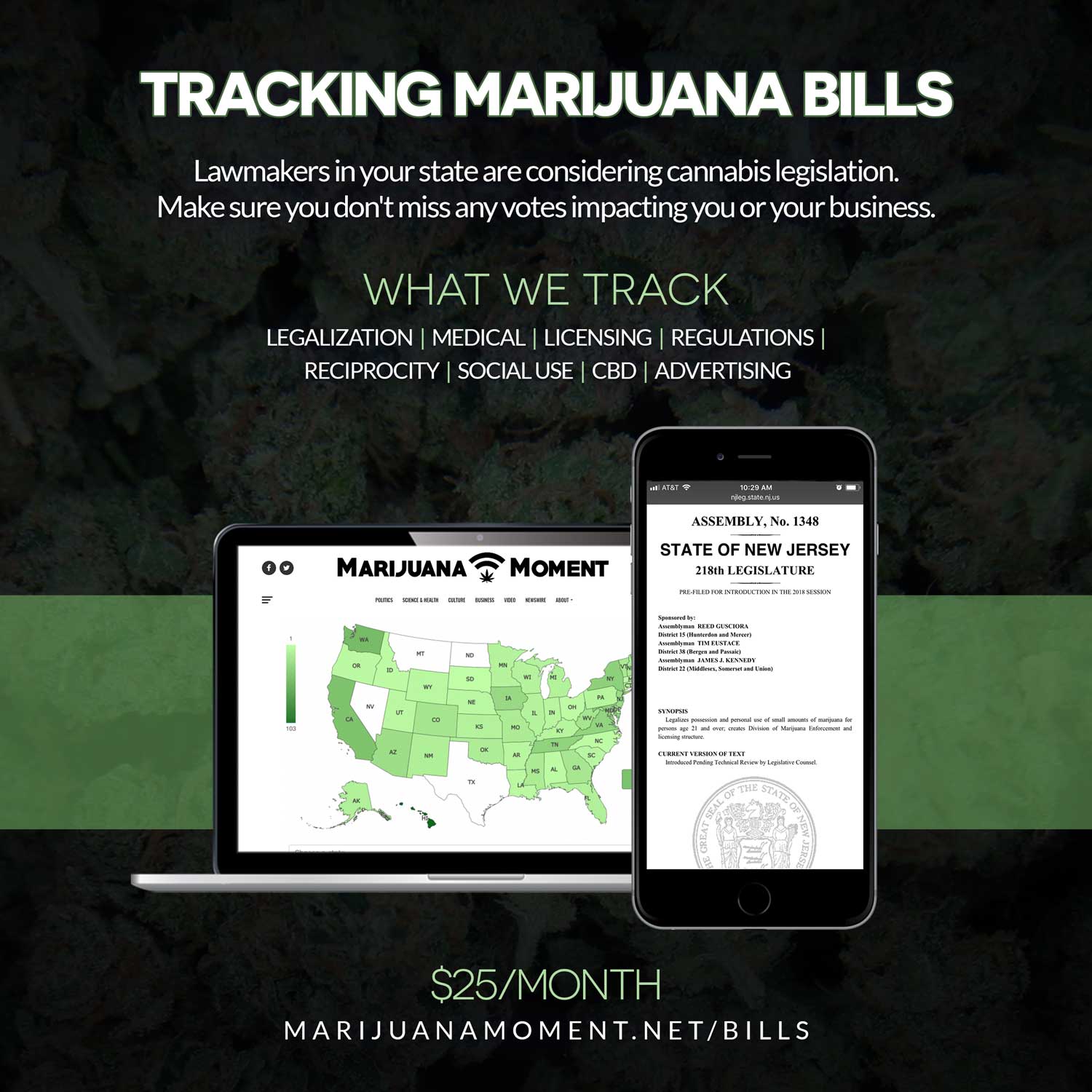
Learn more about our marijuana bill tracker and become a supporter on Patreon to get access.
—
In September, a poll showed that North Carolinians strongly support legalizing medical marijuana, and that a majority wants to go even further by legalizing cannabis for recreational use.
During his time as the state’s attorney general, Stein led a separate task force under then-Gov. Roy Cooper (D) that examined racial injustice issues and ultimately recommended decriminalizing marijuana and studying broader legalization in response to racially disparate enforcement trends.
A tribe in North Carolina, the Eastern Band of Cherokee Indians, launched the state’s first marijuana dispensary in 2024—despite the protests of certain Republican congressional lawmakers.
Democratic lawmakers recently filed legislation to allow voters to decide whether to legalize marijuana for personal or medical use at the ballot box this November, though that did not advance.
Meanwhile, bipartisan North Carolina lawmakers have been stepping up the push for psychedelics reform legislation.