Politics
North Carolina Governor Pushes Lawmakers To Create A ‘Well-Regulated’ Legal Marijuana Market Instead Of Passing A Limited Hemp Bill


North Carolina’s Democratic governor is calling on the Republican-controlled legislature to legalize and regulate marijuana in a way that “protects kids” while lawmakers this week are considering a bill to restrict hemp THC products.
Gov. Josh Stein (D) noted in a social media post on Monday that the House of Representatives is expected to take up legislation that “aims to eliminate the Wild West that is North Carolina’s THC market.”
“The legislature should be focused on creating a safe and well-regulated adult THC market that protects kids,” he said.
The governor also said that “for some reason, the bill also legalizes kratom, an opioid-like substance sometimes called gas station heroin, and fails to include any meaningful age restrictions.”
In separate comments to reporters on Tuesday, Stein suggested that the hemp restriction bill’s provision’s would not sufficiently regulate or age-gate THC products.
“What’s going on out there today in the market is wrong,” he said, The Carolina Journal reported. “There are no protections for kids. There are no protections for adults who choose to use these products.”
“Either it has too much THC then it says it has or has less THC than it has, and it has all kinds of bacteria in it,” the governor said. “This stuff that is bad for people.”
“What we need to do is have a well-regulated THC market for adults to do whatever they want to do, where they know what they’re buying, they know the quantity and they know what the ingredients are and we need to completely protect kids,” Stein said. “That is not happening with the law today and unfortunately, that bill that the legislature is thinking about doesn’t get us there either.”
“We have this in the law for alcohol and cigarettes,” he said. “Why do we make it easy for them to sell hemp and kratom to kids? There’s no reason. If they have good intention, they would have real age gating and they don’t have real age gating in this bill.”
Meanwhile, the North Carolina State Bureau of Investigation and other law enforcement officials are pushing lawmakers to pass the hemp restriction bill as-is.
The governor has repeatedly called on lawmakers to broadly legalize and regulate cannabis, though GOP legislative leaders have been more interested in focusing on the narrower hemp issue.
The bill to restrict hemp and kratom products was recently approved by the Senate now awaits potential action in the House, with expectations that it could be taken up this week.
Stein said earlier this month that “we need to have a well-regulated market that puts public safety and public health at its center.”
“It protects kids, and it is available for adult use—because adults are using it, and we can’t put our heads in the sand any longer,” he said.
House Speaker Destin Hall (R), however, said, “I know our caucus has no interest in doing any sort of marijuana, medicinal or otherwise.”
Both leaders’ comments were reported by local news outlet The Assembly, which has been tracking efforts this session to pass legislation to regulate intoxicating hemp products.
A commission that Stein empaneled last year recently issued a report recommending that rather than have separate frameworks for hemp and marijuana, the state should regulate THC as a molecule.
“There actually used to be a distinction in the law,” the governor said. “The two plants, naturally grown, had different THC levels. You’d smoke hemp, it would take a whole lot to get you high—and it might not. Once hemp was legalized, both growers and sellers realized you could genetically modify hemp plants and increase the level of THC.”
“Cannabis is cannabis,” he said. “It doesn’t make sense to try to distinguish between two varieties of the same plant, and what we really care about is, is this product going to get you high or not? That’s why we must regulate the THC molecule.”
Meanwhile, lawmakers in North Carolina have been considering legislation to legalize medical cannabis for the last several sessions—with the Senate approving several proposals and the House refusing to follow suit.
North Carolina’s Senate president pro tempore recently said that lawmakers will take a more serious look at legalizing medical marijuana following the Trump administration’s move to reschedule cannabis at the federal level.
—
Marijuana Moment is tracking hundreds of cannabis, psychedelics and drug policy bills in state legislatures and Congress this year. Patreon supporters pledging at least $25/month get access to our interactive maps, charts and hearing calendar so they don’t miss any developments.
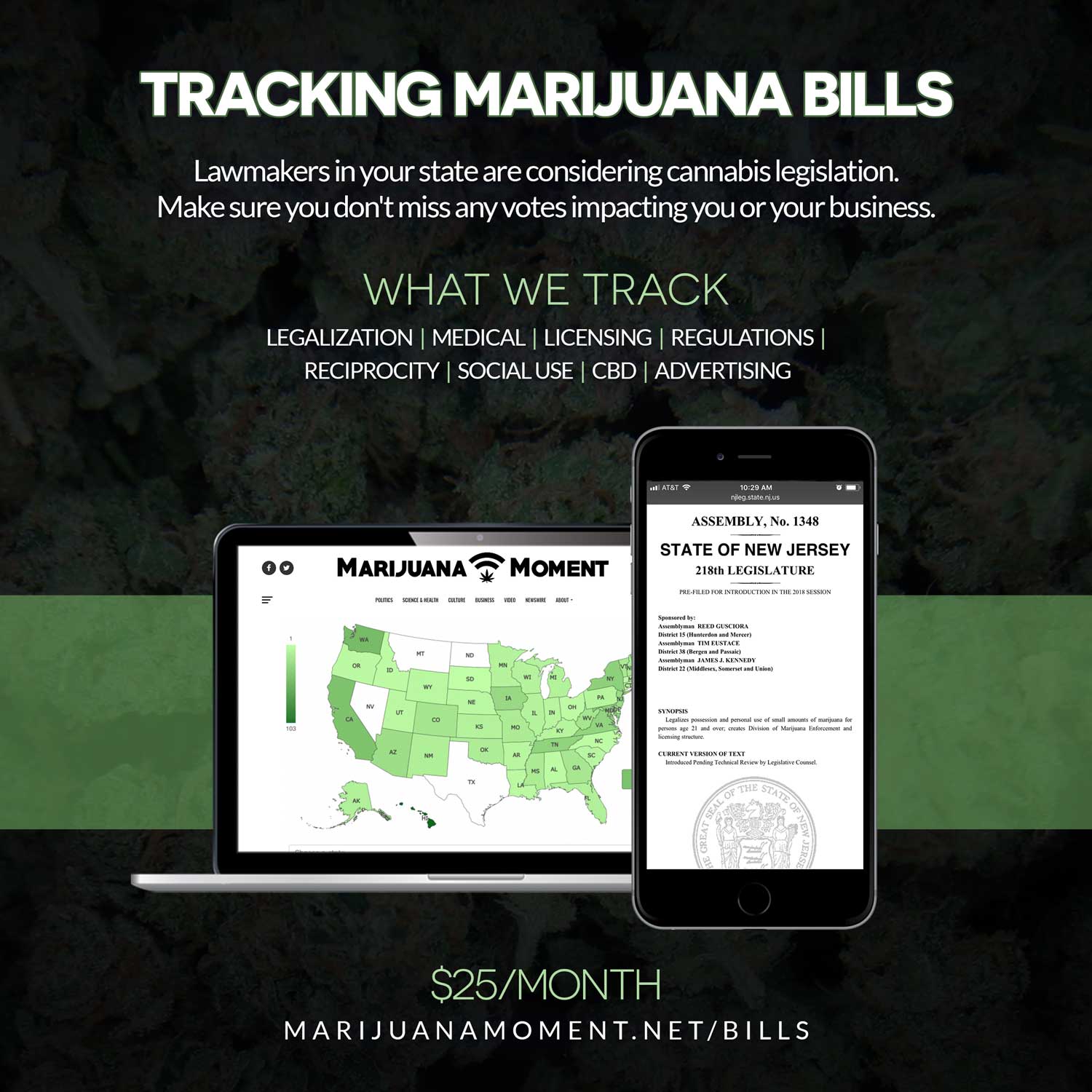
Learn more about our marijuana bill tracker and become a supporter on Patreon to get access.
—
The governor-appointed cannabis commission in North Carolina issued a report in April recommending that the state move away from a criminalization-based approach to the plant and toward a system of “robust” regulations that provide for adults’ legal access to THC products.
The North Carolina Advisory Council on Cannabis, which Stein convened last year, says in the new document approved in April that the current “absence of regulation for North Carolina’s intoxicating cannabis market raises numerous concerns,” noting that hemp products are readily available yet largely unregulated and that marijuana remains prohibited altogether in the state, even for medical use.
“Compared to regulated marijuana frameworks in other states, this environment presents identifiable risks,” the interim report says. “While some operators voluntarily implement consumer protection protocols, these safeguards are not required under state law.”
Stein, for his part, thanked the group for its “expertise, hard work, and thoughtful deliberation” in a press release and reiterated his support for legalizing marijuana.
Members are tasked with developing and submitting initial recommendations on a “comprehensive cannabis policy, including any proposed legislation,” with a final report due by December 31 of this year.
During his time as the state’s attorney general, Stein led a separate task force under then-Gov. Roy Cooper (D) that examined racial injustice issues and ultimately recommended decriminalizing marijuana and studying broader legalization in response to racially disparate enforcement trends.
A tribe in North Carolina, the Eastern Band of Cherokee Indians, launched the state’s first marijuana dispensary in 2024—despite the protests of certain Republican congressional lawmakers.
Democratic lawmakers recently filed legislation to allow voters to decide whether to legalize marijuana for personal or medical use at the ballot box this November—though Senate President Pro Tem Phil Berger (R) said the bill is unlikely to advance.
Meanwhile, bipartisan North Carolina lawmakers have been stepping up the push for psychedelics reform legislation.
Photo courtesy of Mike Latimer.