Politics
North Carolina State Panel Considers Government-Run Marijuana Dispensaries And Centralized Warehouse

A North Carolina government commission that was appointed by the governor is considering recommending lawmakers legalize marijuana sales through a system of state-run stores that could be supplied by a “central cannabis warehouse”—while leaving cultivation and manufacturing to private businesses.
The North Carolina Advisory Council on Cannabis, which Gov. Josh Stein (D) convened last year, has been holding an ongoing series of meetings, including via subcommittees focused on specific aspects of marijuana reform.
The body’s Market and Regulatory Subcommittee convened on Friday to discuss options for how to structure a legal marijuana industry, including its production, distribution and retail tiers.
While the panel has not yet made a formal recommendation to the legislature, a document accompanying the subcommittee meeting agenda shows that it is weighing a model where the “state exclusively controls the retail channel while private businesses remain responsible for cultivation, manufacturing/processing, and wholesale distribution.”
The approach, it says, is a hybrid that combines North Carolina’s current “regulatory architecture and experience with state-controlled liquor retail” and Quebec, Canada’s “exclusive cannabis retail channel” and “explicit objective of moving consumers into the regulated market.”
For cultivation and manufacturing, there would be multiple license types, including one for small-scale craft farms, as well as a standard licensed for larger commercial operations. Another license would cover manufacturers and processors who purchase cannabis from cultivators.
At the wholesale tier the panel is weighing several options. One would involve licensing private entities that compete for businesses from producers for the right to supply a state retail system. Another contemplates the state itself operating a “central cannabis warehouse” that would be analogous to one currently run by the North Carolina Alcoholic Beverage Control Commission (NC ABC). A third hybrid option would involve regulated private wholesale, an option state central warehouse and state-controlled retail.
When it comes to retail, the panel is considering recommending that the state create a new North Carolina Cannabis Control Commission or assign retail control functions to an existing state entity with a separate state cannabis retail corporation/system, according to the document.
The objective is “bringing consumers into and keeping them in the legal market without encouraging cannabis consumption,” it says.
The document lists two options for how the state-controlled stores could work. The first involves centralized state retail with a state-run corporation and stores, and the other contemplates decentralized control, similar to how the state handles alcohol, with a state commission, local boards and stores.
The document for the meeting, which involved a presentation from NC ABC’s Renee Metz, also lists several “important elements” for consideration. Those include protecting the three-tier system from vertical integration, requiring state product approval, craft farms, control of the retail footprint, a role for local governments and a closed-loop financial model.
It also specifies that “state-controlled does not have to mean state-set pricing.”
The document additionally lists a number of questions for discussion, including:
1. Should NC’s cannabis system use a three-tier structure modeled on the state’s alcohol system?
2. Should cultivation/manufacturing, wholesale distribution and retail ownership be separated?
3. Should retail cannabis be sold exclusively through state-controlled stores?
4. Should NC use a centralized state warehouse, private licensed wholesalers, or a hybrid?
5. How should the Craft Farm License be structured so small farmers can participate without creating regulatory loopholes?
6. What forms of vertical integration and common ownership should be prohibited?
7. How should the state determine retail prices and adjust them in response to the illicit market?
8. What role should local governments have in determining where state cannabis stores operate?
The panel’s consideration of state-run cannabis stores comes as a new poll shows that North Carolinians strongly support legalizing medical marijuana, and that a majority wants to go even further by legalizing cannabis for recreational use.
Meanwhile, the governor is continuing to pressure the GOP-controlled legislature for marijuana reform.
Last month, the governor called on lawmakers to legalize and regulate cannabis in a way that “protects kids” while lawmakers this week are considering a bill to restrict hemp THC products.
In a social media post he noted that lawmakers are considering legislation that “aims to eliminate the Wild West that is North Carolina’s THC market.”
The governor has repeatedly called on lawmakers to broadly legalize and regulate cannabis, though GOP legislative leaders have been more interested in focusing on the narrower hemp issue.
A bill to restrict hemp and kratom products that was recently approved by the Senate now awaits potential action in the House.
Meanwhile, lawmakers in North Carolina have been considering legislation to legalize medical cannabis for the last several sessions—with the Senate approving several proposals and the House refusing to follow suit.
North Carolina’s Senate president pro tempore recently said that lawmakers will take a more serious look at legalizing medical marijuana following the Trump administration’s move to reschedule cannabis at the federal level.
—
Marijuana Moment is tracking hundreds of cannabis, psychedelics and drug policy bills in state legislatures and Congress this year. Patreon supporters pledging at least $25/month get access to our interactive maps, charts and hearing calendar so they don’t miss any developments.
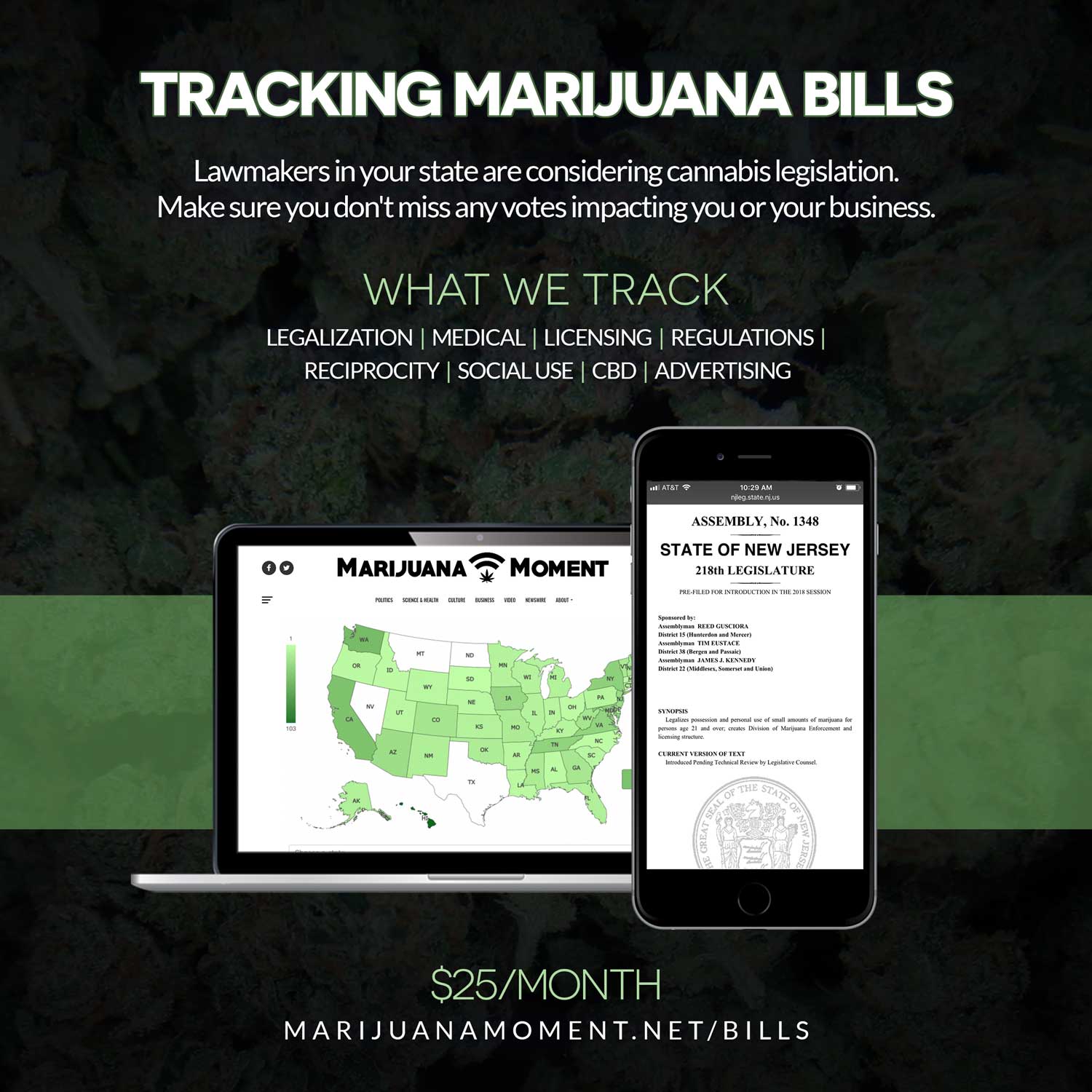
Learn more about our marijuana bill tracker and become a supporter on Patreon to get access.
—
The governor-appointed cannabis commission in North Carolina issued a report in April initially recommending that the state move away from a criminalization-based approach to the plant and toward a system of “robust” regulations that provide for adults’ legal access to THC products.
The North Carolina Advisory Council on Cannabis, which Stein convened last year, said that the current “absence of regulation for North Carolina’s intoxicating cannabis market raises numerous concerns,” noting that hemp products are readily available yet largely unregulated and that marijuana remains prohibited altogether in the state, even for medical use.
“Compared to regulated marijuana frameworks in other states, this environment presents identifiable risks,” the interim report says. “While some operators voluntarily implement consumer protection protocols, these safeguards are not required under state law.”
Stein, for his part, thanked the group for its “expertise, hard work, and thoughtful deliberation” in a press release and reiterated his support for legalizing marijuana.
Members are tasked with developing and submitting initial recommendations on a “comprehensive cannabis policy, including any proposed legislation,” with a final report due by December 31 of this year.
During his time as the state’s attorney general, Stein led a separate task force under then-Gov. Roy Cooper (D) that examined racial injustice issues and ultimately recommended decriminalizing marijuana and studying broader legalization in response to racially disparate enforcement trends.
A tribe in North Carolina, the Eastern Band of Cherokee Indians, launched the state’s first marijuana dispensary in 2024—despite the protests of certain Republican congressional lawmakers.
Democratic lawmakers recently filed legislation to allow voters to decide whether to legalize marijuana for personal or medical use at the ballot box this November—though Senate President Pro Tem Phil Berger (R) said the bill is unlikely to advance.
Meanwhile, bipartisan North Carolina lawmakers have been stepping up the push for psychedelics reform legislation.
Photo courtesy of Mike Latimer.