Politics
Pennsylvania Senate Panel Approves Bill To Regulate Marijuana And Hemp, With New Amendments

A Pennsylvania Senate committee has approved a bill to create a new Cannabis Control Board (CCB) to oversee the state’s medical marijuana program and intoxicating hemp products—for the third time, with new amendments. The body could also one day oversee recreational cannabis if it is legalized in the state.
The Senate Law & Justice Committee voted 7-4 on Monday to advance the legislation back to the floor for consideration. The panel had previously done so in March and, before that, in October—but its sponsor Sen. Dan Laughlin (R), who is also the committee’s chair, has repeatedly brought the measure back to be altered.
This time, senators adopted two amendments to the bill.
One amendment, from Laughlin, specifies that the three members of the CCB who would be appointed by the governor would need to have certain backgrounds—one with law enforcement experience, another with expertise in dealing with addiction and a third with experience in “cannabis matters.”
Laughlin’s amendment also specifies that nothing in the bill “shall be construed to allow the board to authorize the sale of recreational marijuana absent approval by the General Assembly,” and additionally makes technical changes to the legislation.
A separate amendment from Sen. Devlin Robinson (R) was also adopted by the committee. It specifies that regulators could award additional dispensary permits to companies that were medical cannabis grower/processors prior to April 12, 2024 and that meet other conditions.
Previously, in March, the panel amended the cannabis regulation bill to add new provisions banning the sale of most hemp THC products to align state law with a pending federal policy change that’s set to take effect in November.
“For too long, intoxicating hemp products, or ‘gas station weed,’ have been sold with virtually no oversight and far too few safeguards,” Laughlin said in a social media post on Monday. “Moving this bill out of committee puts us on the path to finally bringing order and accountability to this space.”
In a separate post, the senator criticized Democrats on the panel who are cosponsoring the bill but voted against it.
Its not clear why those lawmakers voted the way they did, but the action on the cannabis regulatory bill, SB 49, comes amid a partisan dispute in the state over broader marijuana legalization.
Gov. Josh Shapiro (D) has repeatedly called on lawmakers to send him a marijuana legalization bill and for the last several years has included the reform in his budget requests to the legislature.
Stacy Garrity, a Republican who is running for governor and who currently serves as the state treasurer, recently said she would veto a cannabis legalization bill if lawmakers approved one—though she also shared her view that the legislature is “never going to pass it…not as long as Senate Republicans are in control of the Senate.”
Last month, the Democratic-controlled Pennsylvania House of Representatives passed budget legislation proposed by Shapiro that relies on revenue that would be generated from recreational marijuana sales, which has yet to be legalized in the state.
The House of Representatives last year passed a bill to legalize marijuana and put sales in state-owned dispensaries, but the Republican Senate majority has criticized that plan while also not advancing a cannabis legalization model of its own.
—
Marijuana Moment is tracking hundreds of cannabis, psychedelics and drug policy bills in state legislatures and Congress this year. Patreon supporters pledging at least $25/month get access to our interactive maps, charts and hearing calendar so they don’t miss any developments.
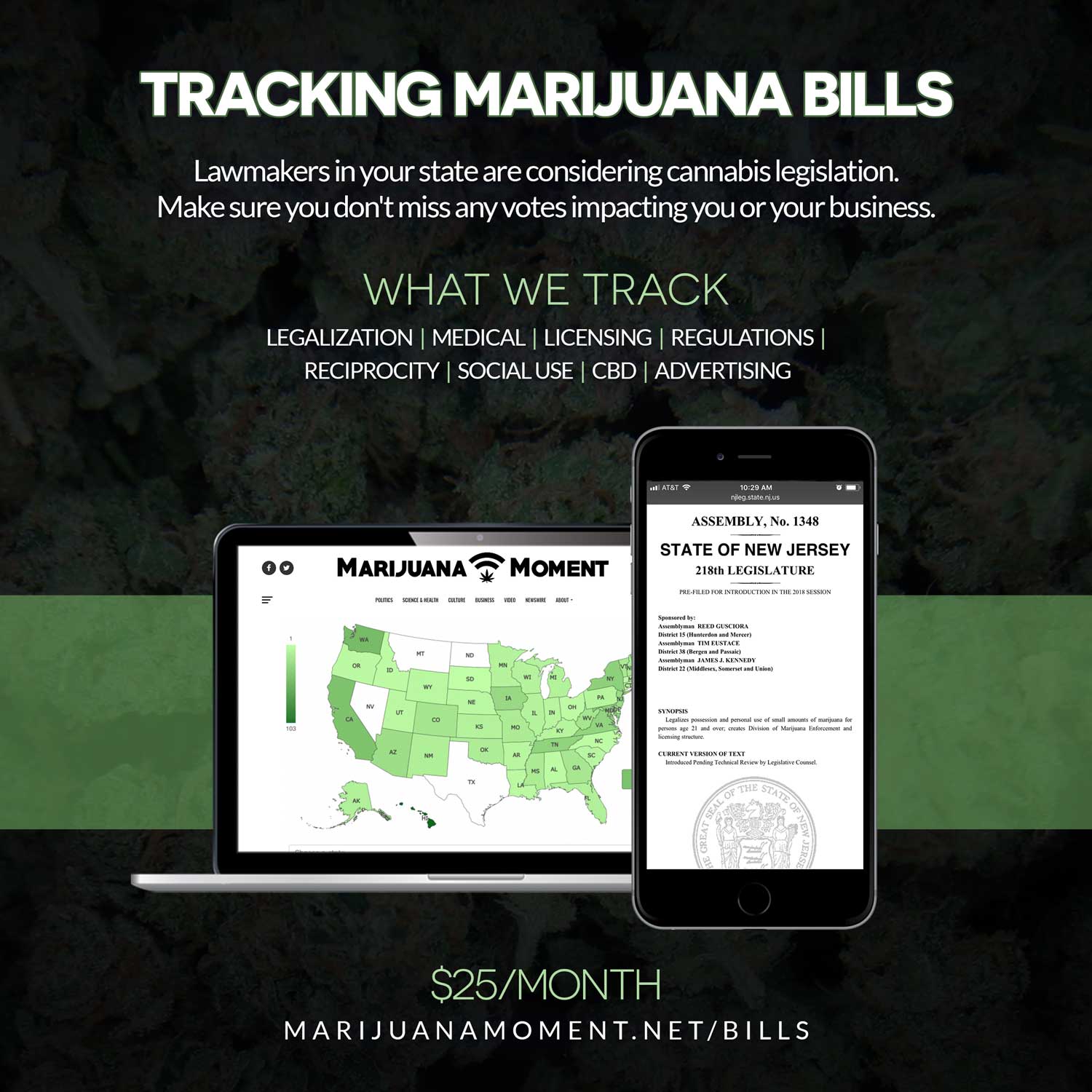
Learn more about our marijuana bill tracker and become a supporter on Patreon to get access.
—
A spokesperson in the governor’s office separately said last month that the Trump administration’s federal marijuana rescheduling move is an “important step” that “adds support” to his push to legalize cannabis in the state.
The governor also used last month’s unofficial cannabis holiday 4/20 as an opportunity to press lawmakers once again to send him a bill to legalize marijuana.
Meanwhile, the CCB established by the bill that is now advancing in the Senate would regulate medical cannabis and hemp, while preparing to eventually handle the adult-use marijuana market as well if that reform is ultimately enacted.
Laughlin, who is also sponsoring bipartisan legislation to legalize adult-use marijuana previewed the regulatory measure last May, writing that Pennsylvania should take initial steps to make sure the state is “ready to act when legalization becomes law” by establishing a CCB now.
In a cosponsorship memo circulated last year, Laughlin said his bill would “transfer regulatory control of the Medical Marijuana Program to the CCB, ensuring continuity, efficiency, and improved oversight of medical cannabis businesses and patient access.” It would further “establish uniform safety standards to protect consumers from untested and potentially harmful products.”
The original bill text itself also doesn’t contain an explicit references to adult-use, or recreational, marijuana, and it would not enact legalization on its own. But the description indicates that the sponsors feel the current regulatory regime under the Pennsylvania Department of Health should be replaced with a more targeted agency that would ostensibly be suited to oversee an adult-use market if lawmakers move to end prohibition.
“By consolidating oversight under a single regulatory board, we can eliminate inconsistencies, enhance transparency, and provide the structure needed to responsibly manage this industry,” the memo says.
Separately last month, the House Health Committee approved a bill to allow terminally ill patients to use medical cannabis in hospitals and other healthcare facilities
The legislative developments come as a recent poll shows that seven out of ten Pennsylvania likely voters support legalizing adult-use marijuana—including majority backing for the reform across party lines.
When asked whether they “support or oppose the regulation and taxation of legal cannabis for use by adults 21 and older in Pennsylvania,” 69 percent of respondents said yes. Support was strongest from Democrats, at 72 percent, but also includes 67 percent of Republicans and 64 percent of independents.
Meanwhile, Shapiro is continuing to pressure on lawmakers to send him a bill to legalize marijuana in the state, saying that doing so would generate new revenue that could be invested in key programs.
“While some in Harrisburg claim we can’t afford to make bigger investments in our kids, public safety, and our economy, know this: If we legalized and regulated adult-use cannabis, we’d bring in $1.3 BILLION in revenue for our Commonwealth over the first five years,” the governor said in another recent social media post.
“Those are dollars that can be invested back into our people and our communities,” he said. “Stop with the excuses. Let’s get this done.”
The state’s Independent Fiscal Office (IFO) reported in February that legalizing cannabis in Pennsylvania would generate nearly half a billion dollars in annual revenue by 2028, an estimate that is a significantly larger cash windfall compared to projections from Shapiro’s own office.
With a proposed 20 percent wholesale cannabis excise tax, 6 percent state sales tax for retail and licensing fees, IFO said the governor’s legalization plan would generate $140 million in tax revenue in the first year of implementation from 2027-2028 and increase to $432 million by 2030-2031.
That’s a much higher revenue estimate than what the governor’s office put forward in the latest executive budget. According to his office’s analysis, legalization would generate about $36.9 million in tax dollars in its first year from a 20 percent wholesale tax on marijuana—rising gradually to $223.8 million by 2030-2031.
In February, a coalition of drug policy and civil liberties organizations urged Shapiro to play a leadership role in convening legislative leaders to get the job done on cannabis legalization this session.