Politics
New Hampshire Democrats Talk Plans To Legalize Marijuana With New Legislative Majority Despite Anti-Reform GOP Governor


New Hampshire Democratic lawmakers are discussing plans to use their newly won majorities in the Senate and House of Representatives to legalize marijuana in the state—even as voters last week also reelected a Republican governor who strongly opposes legalizing cannabis.
Timothy Egan, a Democratic former state representative who won a House seat again last week, told Marijuana Moment that the midterm election results “created a unique opportunity for logical cannabis policy” in New Hampshire “that is developed from the best practices and lessons learned of poor practices from states in the Northeast.”
Egan, who is also chair of the New Hampshire Cannabis Association (NHCANN), pointed to the currently Republican-controlled legislature’s move to override Gov. Kelly Ayotte’s (R) veto of a bill to expand medical marijuana access earlier this year as an example of bipartisan “collaboration” that can propel even further reform next year.
“Now with a different political climate that has legislators keenly understanding residents’ concerns about high property taxes and reduced education funding from the state, creating a new form of revenue for New Hampshire through adult use of cannabis could help with that issue,” he said.
“The political focus and increased education on consumption for expanded cannabis is strong, despite the lack of interest from the governor,” Egan told Marijuana Moment. “It’s a budget year, with a new political mindset. It’s time to be open minded in New Hampshire.”
Meanwhile, a number of other current Democratic lawmakers who will be returning to the legislature next year are also talking about the opportunity for marijuana legalization in the new session.
“Over 70 percent of Granite Staters wanted it, including 55 percent of people who identified as Republicans—so even people in her party want it,” Rep. Jared Sullivan (D) said, referring to recent polling that shows that Ayotte is a minority in her own party in opposing cannabis legalization.
He added, however, that Democrats are “not looking to just jam things down the throats of Republicans or people in the state of New Hampshire.”
“There’s obviously room for negotiation, if there’s something that can make this bipartisan,” he told WMUR-TV.
Former Gov. Chris Sununu (R), after years of adamantly opposing marijuana legalization ultimately proposed legislation to replace prohibition with state-controlled dispensaries, though it did not pass. It remains to be seen if supporters can convince Ayotte to come around to backing a compromise on the issue given her vehement opposition to date.
While Democrats will control both chambers of the legislature in 2027 and 2028 following last week’s midterm elections and appear to have also won a supermajority of two-thirds in the House, they are not projected to have reached that margin in the Senate and would likely need GOP support to override any gubernatorial vetoes. That said, Republican state lawmakers in New Hampshire have been much more friendly to cannabis reform than GOP officials in other states, so Democrats may not end up needing a bicameral supermajority to enact legalization over Ayotte’s protests.
Rep. Will Darby (D), for his part, told WMUR that he believed the governor will be “more willing to compromise with us” following the election results.

“I personally support introducing recreational use of marijuana—with state controls, with state oversight,” he said.
Rep. Alissandra Murray (D) told the local news outlet that it “just seems silly for us to be sending our citizens to literally every state surrounding us and giving these states revenue through their taxes on cannabis, and we aren’t taking advantage of it here.”
During the course of her reelection campaign this year, Ayotte consistently discussed her opposition to marijuana legalization—in contrast to her Democratic challenger, Cinde Warmington, who supports it.
“If you look at the research that has been done, the clinical data, unfortunately, the marijuana, the recreation marijuana, the commercial marijuana, the big marijuana—if you think about your parents or the marijuana when you were young, it’s so much higher in strength, and it’s causing addiction, especially in our young people and our young adults,” the governor said at a debate late last month.
“I’m concerned about the mental health of our young people in this state,” she said. “In fact, the scientific research that has been done on this is showing that is increasing mental illness, including schizophrenia and psychosis.”
“So when we think about our quality of life here in New Hampshire, I do not think it’s the right direction,” the governor argued. “Go to a state where they’ve legalized marijuana. You walk down the street, and that’s all you smell is marijuana. It’s not good for our quality of life. It’s not good for our children or their mental health.”
Ayotte separately said at a recent forum that the issue of cannabis represented a “big difference'” between her and Warmington.
“I don’t think that legalizing cannabis improves our quality of life,” she said. “I know often the argument is made, ‘well, there’s all of our neighbors are that way. Why shouldn’t we take this revenue?,'” she said. “I never say, ‘Oh, our neighbors are doing it, so we should do it.’ I think about my own children. I tell them, ‘Your friends are doing it, you’re doing it.'”
“That’s not really a good standard,” Ayotte said. “We need to make sure we’re looking at our own quality of life and what is the right thing to do for New Hampshire. And when you legalize something, it does send a different message to our young people. So I worry about that and our quality of life. So this is just something we differ on, and I do not think that that revenue is one that comes without a deep cost for New Hampshire.”
The governor also discussed her opposition to legalizing marijuana at an earlier debate with Warmington last month, arguing that cannabis revenue “comes at a huge cost.”
“It comes at the cost of the mental health of our young people. It comes at the cost of our quality of life,” she said. “I don’t think following because our neighbors do something, we should do it. We have the same discussion with our kids, right? If if Johnny jumps off the bridge, are you going to jump off the bridge with it?”
As Egan mentioned, Ayotte in June vetoed legislation to allow businesses in the state’s existing medical cannabis program to cultivate in greenhouses, a reform that advocates say will lead to greater efficiency in the industry and lower prices for patients.
—
Marijuana Moment is tracking hundreds of cannabis, psychedelics and drug policy bills in state legislatures and Congress this year. Patreon supporters pledging at least $25/month get access to our interactive maps, charts and hearing calendar so they don’t miss any developments.
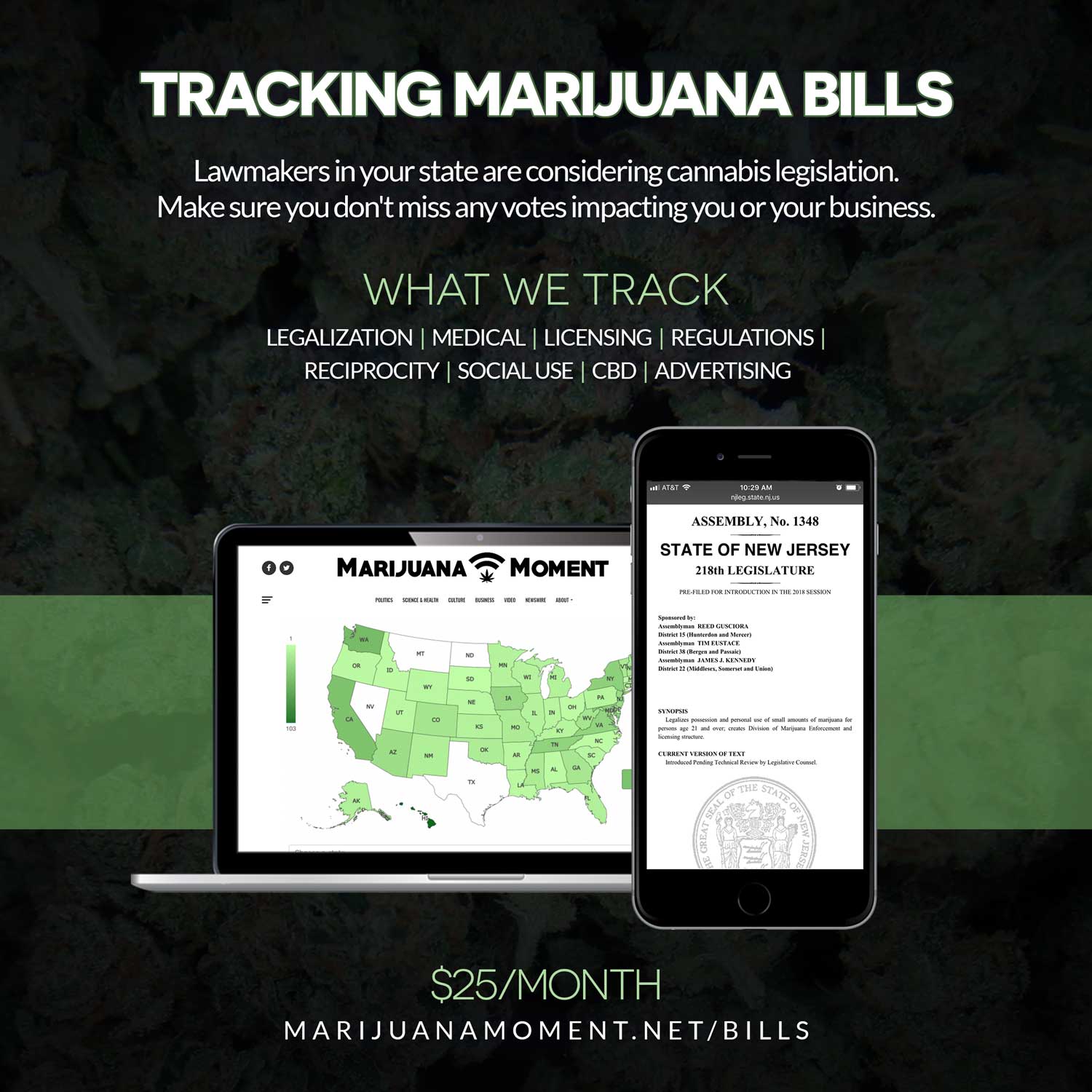
Learn more about our marijuana bill tracker and become a supporter on Patreon to get access.
—
Her veto was overridden by lawmakers, however, the medical marijuana cultivation measure became law despite her objections.
In a veto statement on the medical marijuana greenhouse bill, the governor simply said, “I do not support expanding the cultivation of marijuana in our state.”
The governor said last year that her opposition to marijuana legalization would not change even as the federal government moved forward with rescheduling the plant.