Politics
California Governor Signs Marijuana Bill Adding New Packaging And Labeling Requirements For THC Edibles And Drinks


The governor of California has signed a bill to revise packaging and labeling rules for marijuana-infused edibles and beverages.
Under AB 2532, which Gov. Gavin Newsom (D) approved on Wednesday, labels and inserts for cannabis edibles and drinks would need to include the toll-free telephone number for the national Poison Help line.
The legislation from Assemblymember Jacqui Irwin (D) also mandates that labels for multi-serving THC beverages with more than one serving will need to “clearly and conspicuously” notify consumers that the product contains multiple servings as well as detail the size of servings—measured in fluid ounces to the nearest tenth of a fluid ounce—and provide “information regarding how to accurately measure a single serving for consumption.”
Multi-serving cannabis drinks in containers that are transparent or otherwise visibly display the amount of liquid inside must feature “unobstructed and conspicuous lines delineating individual serving or portion sizes,” the new law says.
Additionally, retailers selling marijuana beverages with more than one serving will need to offer consumers measuring instruments or devices, provided by manufacturers, that contain at least one fluid ounce and measure to the nearest tenth of a fluid ounce under the now-enacted bill.
The new law also prohibits cannabis businesses from advertising or marketing THC drinks with more than one serving as single-serve products or otherwise encouraging consumptions of multiple servings at a time.
The provisions of the legislation are set to take effect on July 1, 2027.
Earlier this week, Newsom separately signed a pair of bills revising various state marijuana laws related to product testing, tracking, consumer access to information and cannabinoid content.
In August, he signed legislation to more clearly define the types of marijuana packaging and labeling that is prohibited due to appealing to children.
Last month, the governor touted the fact that that legal marijuana sales have generated nearly $8.4 billion in tax revenue for the state since voters legalized recreational cannabis in 2016, saying that the money “helps fund programs that benefit Californians, including childcare and early childhood development, youth substance abuse prevention, medical research and environmental recovery.”
Newsom recently took credit for helping to lead the push for the state to legalize marijuana and discussed his own limited experience with using cannabis.
Last October, however, the governor vetoed a bill that would have allowed certain marijuana microbusinesses to ship medical cannabis products directly to patients via common carriers like FedEx and UPS, stating that the proposal “would be burdensome and overly complex to administer.”
Newsom did sign a bill earlier that month aimed at streamlining research on marijuana and psychedelics.
—
Marijuana Moment is tracking hundreds of cannabis, psychedelics and drug policy bills in state legislatures and Congress this year. Patreon supporters pledging at least $25/month get access to our interactive maps, charts and hearing calendar so they don’t miss any developments.
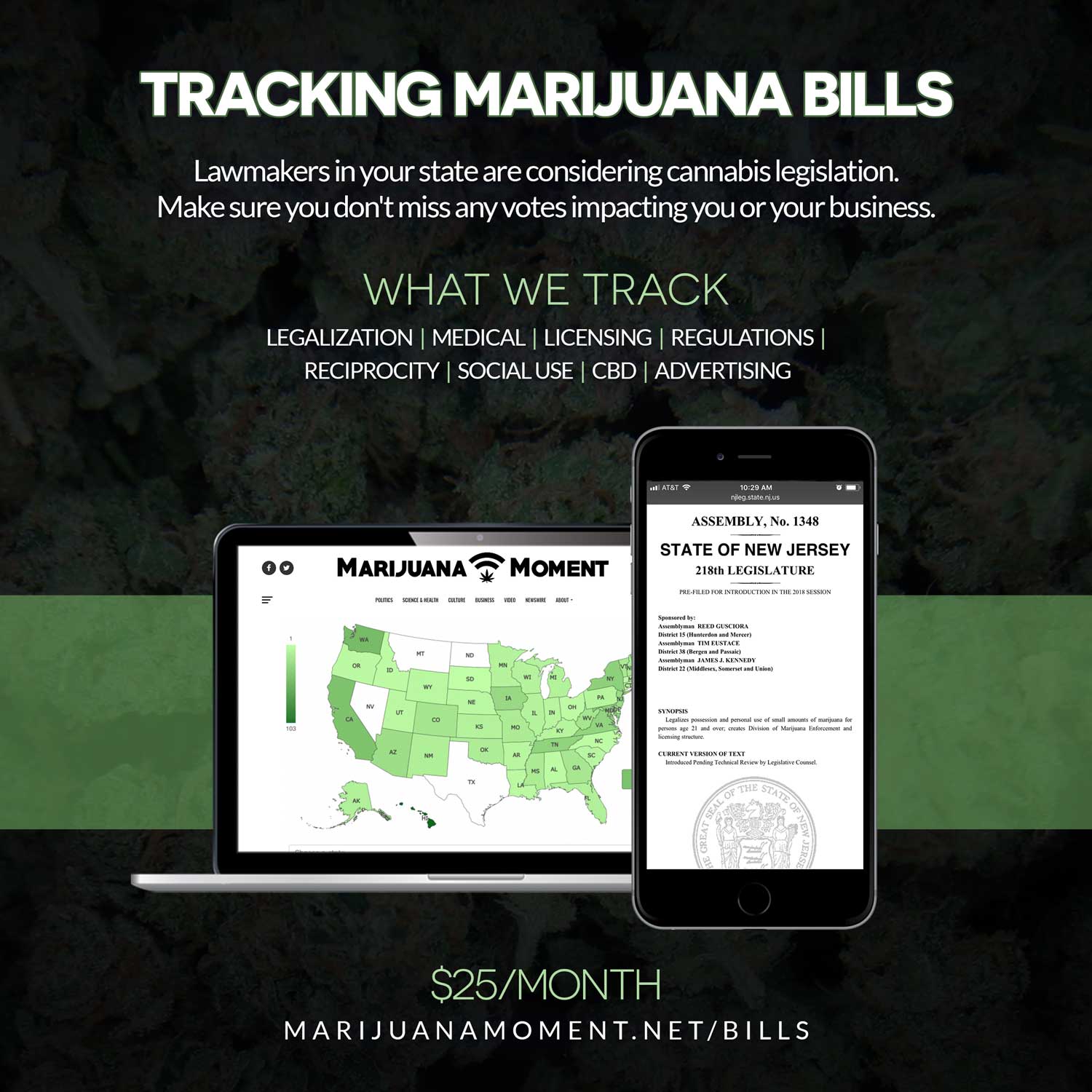
Learn more about our marijuana bill tracker and become a supporter on Patreon to get access.
—
Last September, the governor also signed a measure into law to put a pause on a recently enacted tax hike on marijuana products.
Meanwhile, a lawmaker spoke to Marijuana Moment about her decision to put her own bill to legalize cannabis dispensary drive-thru windows on hold for now.
California’s treasurer recently said the marijuana legalization law that voters approved a decade ago has been a “complete failure” and should be replaced with a new ballot initiative that prioritizes consumers and small businesses.
Republican gubernatorial candidate Steve Hilton, who is endorsed by President Donald Trump, recently told Marijuana Moment that taxes and regulations on cannabis are “too high.”
California’s top cannabis regulator spoke recently about how the Drug Enforcement Administration (DEA) hasn’t been cooperative in answering questions about the implications of the Trump administration’s rescheduling move.
DCC Director Clint Kellum said that there have been “national-level efforts” to contact DEA in conjunction with cannabis regulators from other states, but they “just really haven’t seen any sort of interest on that front, unfortunately.”
Photo courtesy of Brian Shamblen.