Politics
Trump-Endorsed GOP California Gubernatorial Candidate Says Marijuana Taxes And Regulations Are ‘Too High’

The taxes and regulations on marijuana are “too high,” according to California gubernatorial candidate Steve Hilton, a Republican endorsed by President Donald Trump.
At an event in Sacramento on Thursday, Marijuana Moment asked Hilton—who is running against former U.S. Department of Health and Human Services (HHS) Sec. Xavier Becerra, a Democrat, in a general election to become California’s next governor—about his cannabis policy position and challenges facing the state’s industry.
The GOP candidate said that after studying the issue and spending “some time with the industry,” he came to understand that there is a “regulatory burden and a tax burden that is too high.”
“The original intent” of legalization was to “bring the industry, as it were, into the open—and you’ve actually seen the illegal industry growing even more since these policies” were implemented, Hilton told Marijuana Moment. “So we’ve got to make a change.”
He said he’s “actually in a conversation in great detail with the industry to look at the specific parts of the regulatory and tax burden that need to be changed in order to achieve the goals of legalization, which is a thriving industry that provides a product safely that people want to consume.”
As he’s previously discussed, the gubernatorial hopeful said the voter-approved Proposition 64 that legalized marijuana for adult use in 2016 serves as “another example of the corruption that we see here with the system in California,” because, he claims, millions of dollars in tax revenue from cannabis sales that were supposed to be earmarked for substance misuse treatment went to “Democrat political organizations…in small grants that they made deliberately hard to track.”
“When you look at the websites of those organizations, this is taxpayer money. What do they do? Democrat political activity, voter registration, ballot harvesting—all of these things,” he said, without naming specific groups. “It’s an example of how, after 16 years of one-party rule, they’ve built this corrupt machine, and it’s one of the reasons we really need change in California.”
Hilton’s criticism of the implementation of cannabis reform notwithstanding, it’s another sign of the times that both the Republican and Democratic contenders to replace term-limited Gov. Gavin Newsom (D) back the fundamental aims of marijuana reform policies.
Not all California Republicans are on board with the reform, however. The vice chair of the Senate Budget Committee recently floated the idea of putting a new initiative on the state ballot to “reverse” Proposition 64, arguing that voters were misled and voicing concerns about the health impacts of marijuana use.
“We have seen significant negative consequences of this legalization, both here as well as in other states,” the senator, who was speaking at a hearing at which lawmakers approved a bill to legalize marijuana dispensary drive-thru windows in California, said.
Becerra, who previously served in Congress and as California’s attorney general, meanwhile, facilitated a scientific review process during his time as HHS secretary under the Biden administration that ultimately resulted in a recommendation to move cannabis from Schedule I to Schedule III of the Controlled Substances Act (CSA).
But it was was the Justice Department under Trump in April that saw the process at least partially through, moving medical cannabis authorized by states to Schedule III. Marijuana could be fully rescheduled depending on the outcome of administrative hearings that begin this month.
A Schedule III reclassification of marijuana doesn’t fully federally legalize it in the way states like California have, but it represents another meaningful step towards normalizing the cannabis industry. Marijuana businesses can claim tax deductions if they work with Schedule III drugs; they’re barred from doing so for Schedule I and II drugs under an Internal Revenue Service (IRS) code known as 280E.
—
Marijuana Moment is tracking hundreds of cannabis, psychedelics and drug policy bills in state legislatures and Congress this year. Patreon supporters pledging at least $25/month get access to our interactive maps, charts and hearing calendar so they don’t miss any developments.
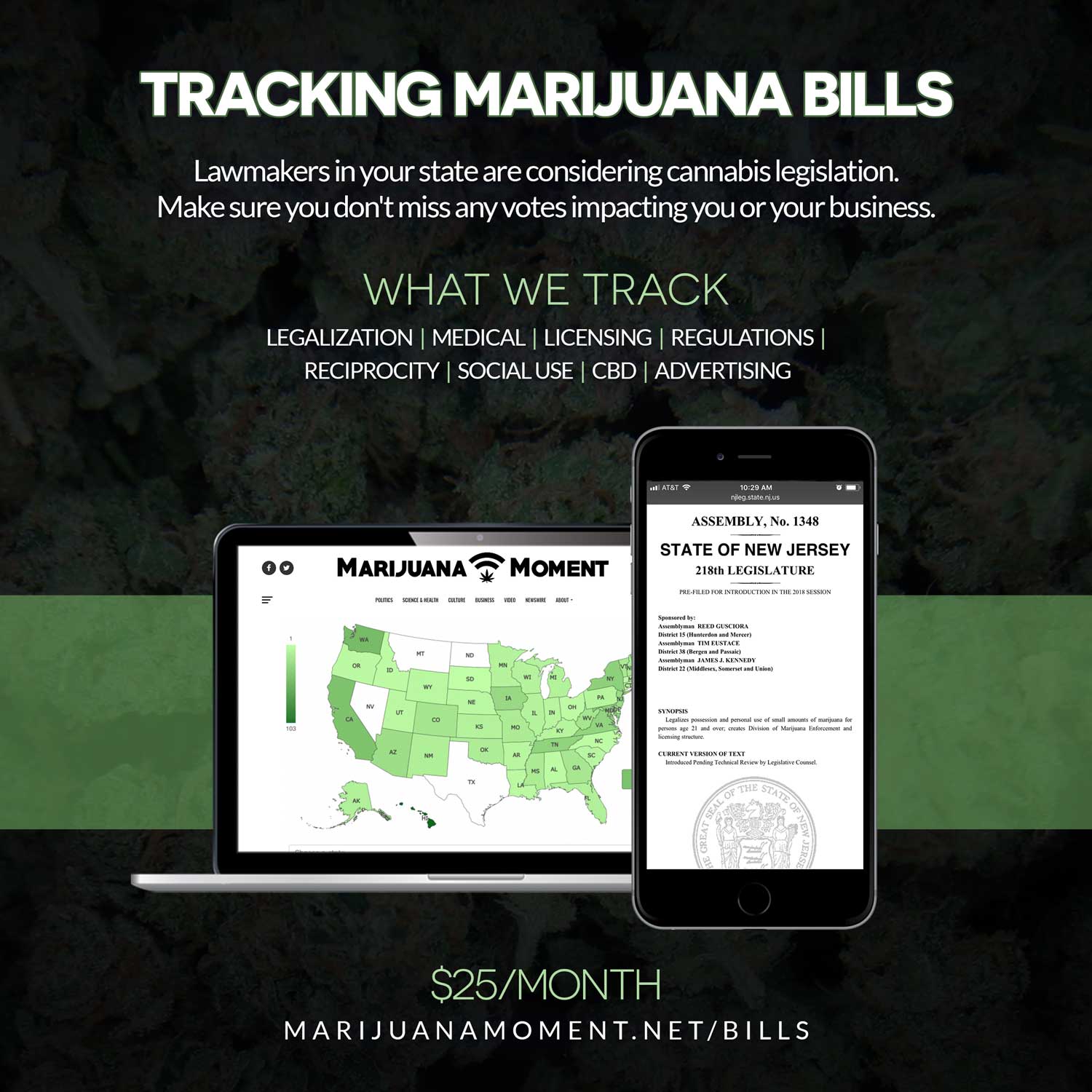
Learn more about our marijuana bill tracker and become a supporter on Patreon to get access.
—
Meanwhile, California regulators recently adopted emergency rules changes for the state’s marijuana licensing process that are intended to make it easier for businesses to qualify for benefits in line with the Trump administration’s recent move to federally reschedule medical cannabis.
They also launched a new AI tool to help businesses identify marijuana product packaging may appeal to kids in violation of state rules.
Separately, Newsom recently took credit for helping to lead the push for the state to legalize marijuana and discussed his own limited experience with using cannabis.
In October, however, the governor vetoed a bill that would have allowed certain marijuana microbusinesses to ship medical cannabis products directly to patients via common carriers like FedEx and UPS, stating that the proposal “would be burdensome and overly complex to administer.”
Newsom did sign a bill earlier that month aimed at streamlining research on marijuana and psychedelics.
In September, the governor also signed a measure into law to put a pause on a recently enacted tax hike on marijuana products.
Separately, the state attorney general says Indian tribes cannot independently engage in marijuana commerce with licensed cannabis businesses without first obtaining their own commercial license from state officials.
California officials recently awarded nearly $30 million in grants for marijuana-focused academic research projects.
Photo courtesy of Chris Wallis // Side Pocket Images.