Politics
Wisconsin Should Legalize Marijuana To Fund Pre-K And Healthcare Expansion, Democratic Governor Candidate Says

The Democratic Party’s nominee to be the next governor of Wisconsin says the state should legalize marijuana to raise revenue that can be used to fund free pre-kindergarten education and an expansion of healthcare access.
David Crowley, who currently serves as the Milwaukee County executive, said last week that in addition to ending tax breaks for billionaires to address fiscal issues, the state should also “look at new revenues and how we grow our economy.”
“We want to make sure, one, that we legalize marijuana,” he told a reporter from CBS 58 News. “That will help bring in more dollars throughout the state.”
He added that he also wants to form a commission to examine fiscal issues more broadly to “permanently fix our taxing and spending problem” in the state.
Crowley separately told Fox6 News that if elected his administration would need to “continue to have to work with the legislature” on solutions to fund universal pre-K and expanded access to the state’s BadgerCare program.
“It’s about looking at the totality of our revenue and spending,” he said. “It’s about bringing in new revenues like the legalization of marijuana, but also making sure that the big corporations who have seen permanent tax cuts in the state of Wisconsin for the past decade and a half, that they start to pay their fair share.”
The Democratic gubernatorial candidate also addressed cannabis in another interview with Wisconsin Watch, saying that “it needs to be legalized.”
“We don’t have the same opportunities as folks in Minnesota and in Michigan and in Illinois,” he said. “I believe that we should support it, one, because this is a personal health position for those who want to utilize it as an alternative to a prescription drug.”
“But I also look at it as an opportunity, right?” Crowley said. “Being able to grow our economy here locally, but also finding a new revenue stream to invest in things like public safety, public education and child care.”
Crowley’s Republican opponent in the governor’s race, U.S. Rep. Tom Tiffany (R-W), told the outlet that he prefers to “take a go-slow approach” on marijuana “because we’ve seen some states that went straight to it, like I think about Colorado, and they had some real problems as a result of that.”
“Think about Oregon, where they adopted full legalization, but then they also legalized other hard drugs. They had to pull back, and so I think those are a lesson to other states that we should take this go-slow approach,” Tiffany argued. “Also, I’ve voted federally for more money to go into research, and I think that research can inform states about what’s the best approach to take in regards to legalization.”
Tiffany voted against bills to federally legalize marijuana on the House floor in 2020 and 2022, as well as an amendment in 2020 to shield state recreational cannabis laws from federal interference. He also opposed a bill to increase marijuana businesses’ access to banking services in 2021.
That said, the GOP congressman’s gubernatorial campaign website says. “I support legalizing medical marijuana in Wisconsin through a responsible program that gives veterans, those suffering from chronic pain, and other patients access to the treatment they need.”
“At the same time, we must have strict age requirements, responsible oversight, and strong protections to keep marijuana out of our schools and away from children,” it says.
Meanwhile, a Democratic congressman who represents Wisconsin recently told Marijuana Moment that he thinks the state is poised to legalize cannabis as soon as next year—especially if his party wins control of the legislature in the November elections, but perhaps even if Republicans maintain a majority under new leadership for the 2027 session.
Rep. Mark Pocan (D-WI) said there’s a “really good chance” of legalizing cannabis in Wisconsin in the short term if Democrats can “flip the legislature,” where marijuana reform proposals have stalled under Republican control in recent sessions.
Pocan said, however, that he thinks cannabis legislation has a shot even if the GOP stays in control under an expected new leader in the state Assembly who is seen as more friendly to reform than the current one.
Gov. Tony Evers (D) and Democratic lawmakers have pushed to legalize marijuana for recreational and medical purposes for years, but those proposals have been blocked by the legislature’s Republican majority.
A limited medical cannabis bill did clear one committee this session, but did not advance further.
Crowley said at a forum hosted by a cannabis reform group earlier this year reform supporters “cannot wait until after the governor’s election” to push the issue, arguing that they need to “organize in making this one of the top priorities in this upcoming election.”
“If you can’t change minds, you have to change faces,” he said. “I want you all to know that we’re going to work directly with you and make sure that you have a seat at the table, because if you don’t have a seat at the table, that means you’re on it.”
Evers, for his part, recently sent a letter calling on the state’s congressional delegation to “prevent mass disruption of the hemp industry” by stopping the planned federal recriminalization of hemp THC products that’s set to take effect later this year.
The governor has repeatedly pushed for broader reform—including marijuana legalization in multiple budget requests, for example—but efforts to enact it have consistently stalled out in the Republican-controlled Assembly and Senate even as adult-use markets have come online in neighboring states such as Illinois and Michigan.
Evers said last year that if his party can take control of the legislature, the state can “finally” legalize marijuana so that residents don’t have to go to neighboring Illinois to visit its adult-use market.
—
Marijuana Moment is tracking hundreds of cannabis, psychedelics and drug policy bills in state legislatures and Congress this year. Patreon supporters pledging at least $25/month get access to our interactive maps, charts and hearing calendar so they don’t miss any developments.
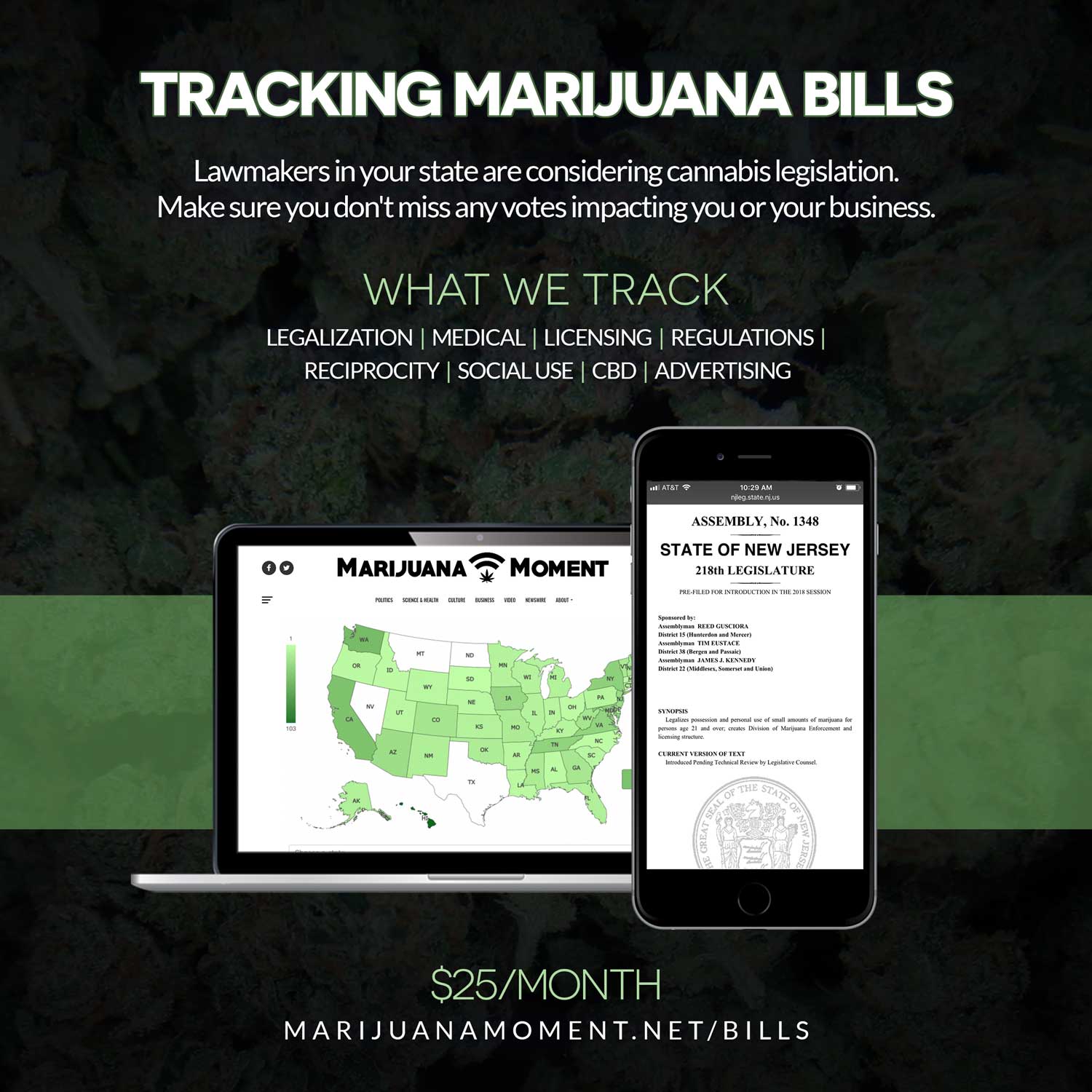
Learn more about our marijuana bill tracker and become a supporter on Patreon to get access.
—
Democratic lawmakers filed legislation in the 2026 session to broadly legalize and regulate marijuana, and bipartisan legislation to simply decriminalize cannabis possession was also filed—but neither proposal advanced.
A poll released last year by Marquette Law School found that two in three Wisconsin voters support legalizing marijuana.
A legislative analysis requested by lawmakers estimated that Wisconsin residents spent more than $121 million on cannabis in Illinois alone in 2022, contributing $36 million in tax revenue to the neighboring state.
Meanwhile, the state Department of Revenue released a fiscal estimate of the economic impact of a legalization bill in 2023, projecting that the reform would generate nearly $170 million annually in tax revenue.