Politics
Wisconsin Is Ready To Legalize Marijuana Next Year Under Democratic Or GOP Control, Congressman Says

A Democratic congressman who represents Wisconsin says the state is poised to legalize marijuana as soon as next year—especially if his party wins control of the legislature in the November elections, but perhaps even if Republicans maintain a majority under new leadership for the 2027 session.
Rep. Mark Pocan (D-WI) told Marijuana Moment that there’s a “really good chance” of legalizing cannabis in Wisconsin in the short term if Democrats can “flip the legislature,” where marijuana reform proposals have stalled under Republican control in recent sessions.
The congressman was responding to a question about Wisconsin having among the highest amount of marijuana arrests in the U.S. last year, according to recently released FBI data.
Pocan said, however, that he thinks cannabis legislation has a shot even if the GOP stays in control. That’s because current Assembly Speaker Robin Vos (R), who the congressman said is “very anti-marijuana,” is retiring at the end of this year and is likely be replaced by someone who is more open to reform.
While leadership elections have not yet been held, Majority Leader Tyler August (R) has been mentioned as a possible successor to Vos.
“The incoming Republican—if they have the majority, although I think we can flip it—is far more libertarian, even more than a Republican,” Pocan said. “So I would think if he really maintains those values, that would change. But it really was kind of held back by one individual largely in Wisconsin.”
August suggested last year that it is time to modernize Wisconsin’s approach to cannabis.
“I don’t think anyone is naive enough to think that marijuana and THC products aren’t present in the state of Wisconsin when they are readily available over state lines, so I think we need to come to an answer on this,” he said at the time. “I’m hopeful that we can.”
Pocan, for his part, told Marijuana Moment that there is a cannabis dispensary just over the border from his district in neighboring Illinois and that “all the cars are Wisconsin cars in that lot.”
“Most of the folks I’ve talked to in the Wisconsin legislature want to change it because we’re surrounded by states that have it legal,” he said. “We can continue to pretend it’s the 1950s, or we can accept where society’s at. Just arresting people for that seems like a terrible waste of resources that law enforcement could do useful this with.”
The congressman said the “reality” is that cannabis reform is coming one way or another.
“This is a very old view that people are clinging on to, but I don’t think there’s that many people that are clinging on to it,” he said of prohibitionist attitudes.
Pocan, who noted that he sponsored medical marijuana bills in the Wisconsin legislature decades ago, said that federal reform stands to benefit if Democrats can win back a congressional majority in the November elections.
In particular, he said Congress could “take away some of these stupid riders” that have blocked local officials from legalizing recreational marijuana sales in Washington, D.C.
In Wisconsin, meanwhile, Gov. Tony Evers (D) and Democratic lawmakers have pushed to legalize marijuana for recreational and medical purposes for years, but those proposals have been blocked by the legislature’s Republican majority.
A limited medical cannabis bill did clear one committee this session, but did not advance further.
Evers is not running again this year. Democratic gubernatorial nominee David Crowley and other candidates competing in his party’s primary at the time appeared at a forum hosted by a cannabis reform group earlier this year.
Crowley, who is currently the Milwaukee County Executive, said reform supporters “cannot wait until after the governor’s election” to push the issue, arguing that they need to “organize in making this one of the top priorities in this upcoming election.”
“If you can’t change minds, you have to change faces,” he said. “I want you all to know that we’re going to work directly with you and make sure that you have a seat at the table, because if you don’t have a seat at the table, that means you’re on it.”
His Republican opponent, Tom Tiffany, currently a member of Congress, has voted against bills to federally legalize marijuana and increase the cannabis industry’s access to banking services—though he has also voiced support for letting states set their own policies on the issue and has discussed how Schedule I status impedes research.
Evers, for his part, recently sent a letter calling on the state’s congressional delegation to “prevent mass disruption of the hemp industry” by stopping the planned federal recriminalization of hemp THC products that’s set to take effect later this year.
The governor has repeatedly pushed for broader reform—including marijuana legalization in multiple budget requests, for example—but efforts to enact it have consistently stalled out in the Republican-controlled Assembly and Senate even as adult-use markets have come online in neighboring states such as Illinois and Michigan.
Evers said last year that if his party can take control of the legislature, the state can “finally” legalize marijuana so that residents don’t have to go to neighboring Illinois to visit its adult-use market.
—
Marijuana Moment is tracking hundreds of cannabis, psychedelics and drug policy bills in state legislatures and Congress this year. Patreon supporters pledging at least $25/month get access to our interactive maps, charts and hearing calendar so they don’t miss any developments.
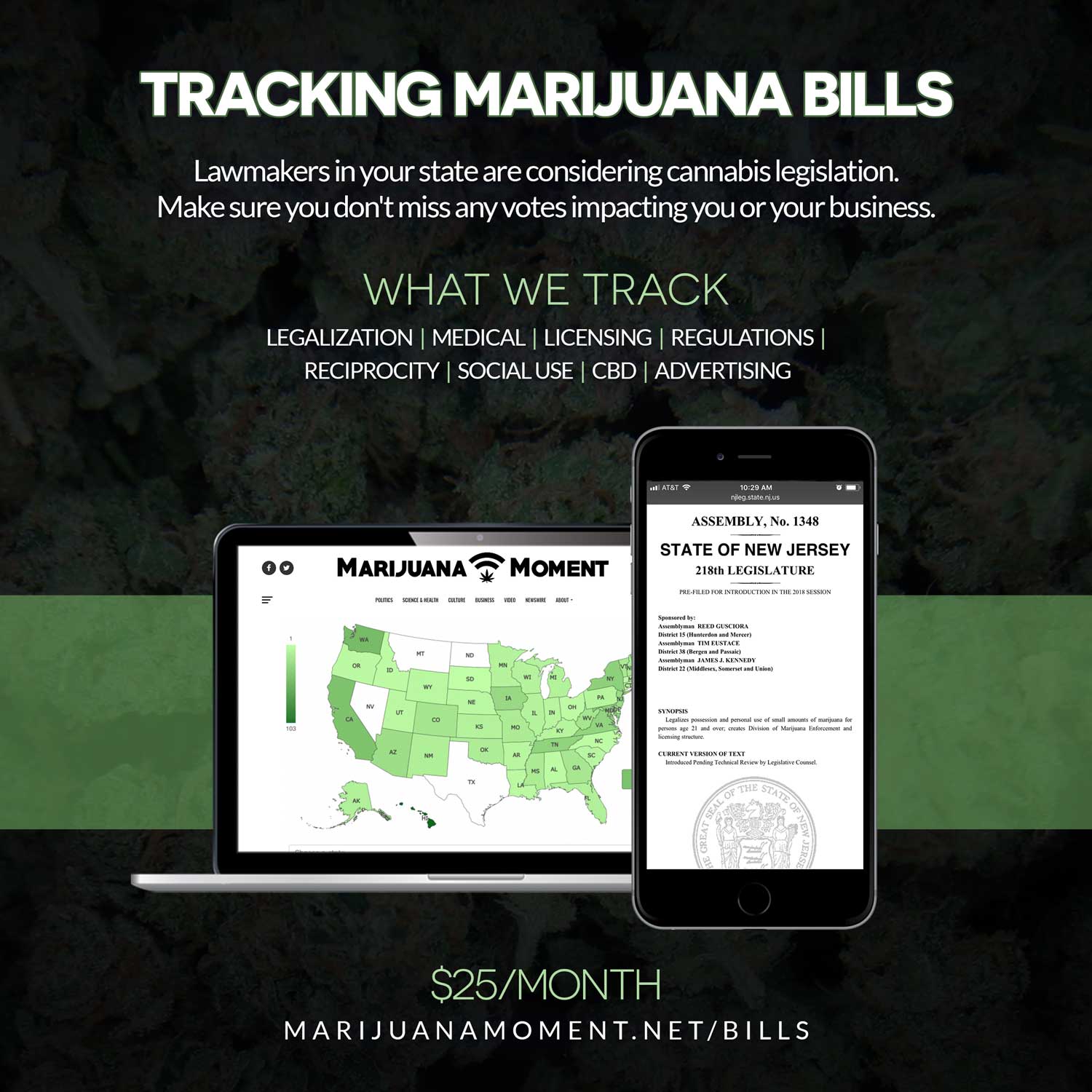
Learn more about our marijuana bill tracker and become a supporter on Patreon to get access.
—
Democratic lawmakers filed legislation in the 2026 session to broadly legalize and regulate marijuana, and bipartisan legislation to simply decriminalize cannabis possession was also filed—but neither proposal advanced.
A poll released last year by Marquette Law School found that two in three Wisconsin voters support legalizing marijuana.
A legislative analysis requested by lawmakers estimated that Wisconsin residents spent more than $121 million on cannabis in Illinois alone in 2022, contributing $36 million in tax revenue to the neighboring state.
Meanwhile, the state Department of Revenue released a fiscal estimate of the economic impact of a legalization bill in 2023, projecting that the reform would generate nearly $170 million annually in tax revenue.
The LCB contributed reporting from Washington, D.C.