Politics
New Pennsylvania Bill Would Award Medical Marijuana Licenses To Small, Diverse and Disadvantaged Businesses


As Pennsylvania Democrats ramp up pressure to Republicans to allow a vote on marijuana legalization in the state Senate, a group of House members have filed a new bill that would prioritize issuing licenses to small, diverse and disadvantaged businesses through the state’s existing medical cannabis program.
The legislation, from Rep. Nathan Davidson (D) and seven cosponsors, would expand the medical marijuana program by adding an additional dispensary permit in each geographic region of the state to a disadvantaged, diverse or small business.
It would also require regulators to publish an annual list of surrendered or revoked medical cannabis business licenses and then accept applications from disadvantaged, diverse or small businesses to re-award those licenses.
A “disadvantaged business” would be defined under the legislation as being owned or controlled by a majority of people, not limited to members of minority groups, who are subject to racial or ethnic prejudice or cultural bias.
A “diverse business” means a disadvantaged business, minority-owned or women-owned business or service-disabled veteran-owned or veteran-owned small business that has been certified by a third party certifying organization.
A “small business” under the bill means an independently owned and operated for-profit business that employs 100 or fewer employees and is not a subsidiary or affiliate of a corporation.
Davidson wrote in a cosponsorship memo for the bill earlier this year that the diversity goal included in the medical cannabis program “has not been met due to multistate corporations dominating the Commonwealth’s medical cannabis industry.”
“Small, diverse, and/or disadvantaged businesses have largely been prevented from competing for dispensary permits,” he said. “To help meet these needs, I am introducing legislation that would require the Department of Health to annually reallocate all surrendered, revoked, or vacated permits to small, diverse, and/or disadvantaged businesses. This legislation will give these businesses the initial opportunity to compete for these permits.”
“Please join me in co-sponsoring this important legislation to expand patient access to care and ensure all communities across the Commonwealth are given fair access to medical cannabis products,” Davidson wrote to colleagues.
Meanwhile, Senate Democrats recently filed a discharge resolution that seeks to bring a bipartisan cannabis legalization bill out of committee, where it is stuck, and onto the floor for a vote.
The legislative maneuvering around the bill comes as new poll shows that Pennsylvania voters overwhelmingly support marijuana legalization—and that the largest share put the blame on Republican lawmakers for the fact that the state has not yet enacted the reform.
Gov. Josh Shapiro (D) has repeatedly called on lawmakers to send him a marijuana legalization bill and for the last several years has included the reform in his budget requests to the legislature.
Republican gubernatorial nominee Stacy Garrity, who is running against Shapiro, recently pledged to veto a marijuana legalization bill if lawmakers ever sent one to her desk—though she added that she doesn’t think the reform stands a chance of making it that far in the state.
“I don’t support legalizing recreational marijuana,” she said. “Recreational marijuana will not end up in the budget. They’re never going to pass it…not as long as Senate Republicans are in control of the Senate.”
Her running mate for lieutenant governor, Jason Richey, claimed that legalizing marijuana would be “catastrophic” for the state, arguing it would increase the size of the illegal market, undermine job creation and harm public health.
In April, the Democratic-controlled Pennsylvania House of Representatives passed budget legislation proposed by Shapiro that relies on revenue that would be generated from recreational marijuana sales, which has yet to be legalized in the state.
The governor earlier this year, as he has in past years, included cannabis legalization and the resulting expected revenue in his budget request.
The House last year passed a bill to legalize marijuana and put sales in state-owned dispensaries, but the Republican Senate majority has criticized that plan while also not advancing a cannabis legalization model of its own.
The state’s Independent Fiscal Office (IFO) reported in February that legalizing cannabis in Pennsylvania would generate nearly half a billion dollars in annual revenue by 2028, an estimate that is a significantly larger cash windfall compared to projections from Shapiro’s own office.
A spokesperson in the governor’s office said the Trump administration’s federal marijuana rescheduling move is an “important step” that “adds support” to his push to legalize cannabis. A GOP senator also said that federal reform will make it easier to legalize marijuana in the state.
—
Marijuana Moment is tracking hundreds of cannabis, psychedelics and drug policy bills in state legislatures and Congress this year. Patreon supporters pledging at least $25/month get access to our interactive maps, charts and hearing calendar so they don’t miss any developments.
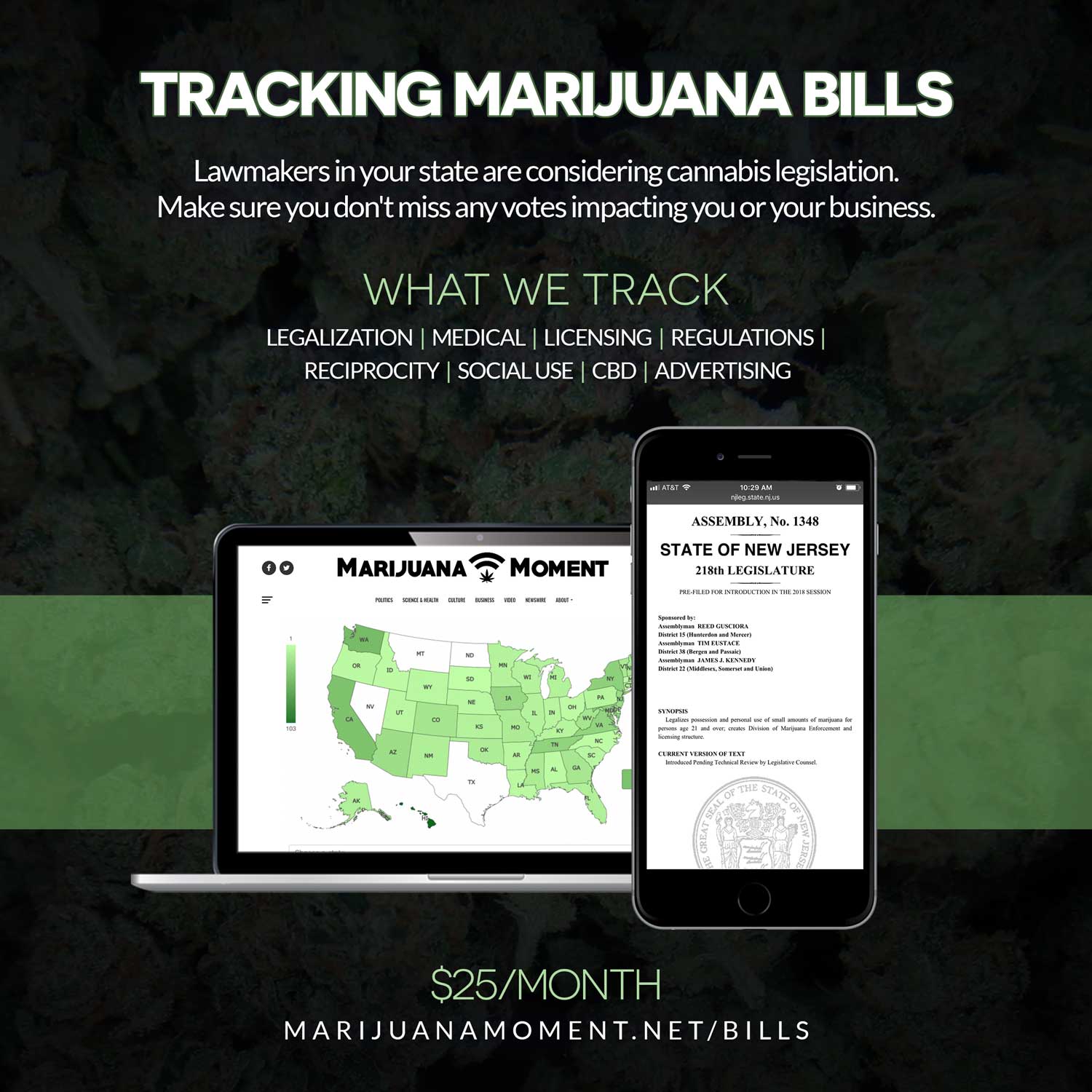
Learn more about our marijuana bill tracker and become a supporter on Patreon to get access.
—
Meanwhile, a Republican senator is blaming the governor for the defeat of his bill to create a new Cannabis Control Board (CCB) to oversee the state’s medical marijuana program and intoxicating hemp products and that could also one day oversee recreational cannabis if it is legalized.
Most GOP senators in the Republican-controlled chamber voted for the legislation, and all but two Democrats opposed it—with even some lawmakers who signed onto the measure as cosponsors ultimately voting against it.
The governor “obviously weighed in on the Democratic side of the aisle and asked for a ‘no’ vote over there, successfully,” Sen. Dan Laughlin (R) said after the vote. “I knew it was a risk putting it up for a vote, because there were some discussions going back and forth… I had a little bit of a heads-up, but we chose to roll forward.”
The governor’s office confirmed in a statement that he opposes the bill as drafted.
“The Shapiro Administration remains supportive of comprehensive cannabis regulation, which would enable a competitive, revenue-generating adult-use market, protect patient access to the current Medical Marijuana Program and rein in hemp-based intoxicant products that are currently unregulated,” Rosie Lapowsky, a spokesperson for the governor, said. “Senate Bill 49 does not substantively advance those goals.”
The now-defeated measure would transfer regulatory authority for the state’s existing medical cannabis program from the Department of Health to a new seven-member CCB. The body would oversee cannabis permits, enforcement, seed-to-sale tracking, advertising, labeling, testing and other aspects of the legal industry.
Moments after the bill’s defeat on the Senate floor, the chamber adopted a motion to reconsider—but it’s not yet clear when or if the legislation will get another vote.
Laughlin’s legislation would also significantly restrict most hemp THC products, aligning the state with a new federal policy that is set to take effect later this year recriminalizing preparations with total THC content of more than 0.3 percent on a dry-weight basis or more than 0.4 milligrams of THC per container.
The action on the cannabis regulatory bill, SB 49, came shortly after the House of Representatives passed a bill to allow terminally ill patients to use medical cannabis in hospitals and other healthcare facilities.