Politics
California’s Top Marijuana Regulator Says Local Bans ‘Benefit’ Illicit Market, With 97% Of Busts In Counties Without Legal Growers

About 97 percent of marijuana seized by California officials in unincorporated areas of the state came from counties that continue to ban licensed growers, new data from the Department of Cannabis Control (DCC) reveals.
That shows how local governments that have refused to get on board with California’s legalization law that voters approved 10 years ago “benefit” the illicit market, the state’s top cannabis regulator told State Affairs, which obtained and first reported on the data.
DCC has repeatedly argued that the current system of patchwork regulations—where localities are able to opt-in or opt-out of allowing certain types of licensed marijuana businesses from operating in their area—is a key factor keeping the state’s illegal cannabis trade alive.
It creates barriers to access for adult consumers, while allowing unlicensed operators to function in a policy vacuum. To combat the problem, the state established the Unified Cannabis Enforcement Taskforce (UCETF) in 2022 to coordinate multi-agency enforcement action against illicit growers, manufacturers and sellers.
Through that work, DCC has been able to put the local control issue into perspective. According to data on enforcement activity spanning October 2022 to August 2025, the department found that 96.6 percent of illicit marijuana seized by UCETF in unincorporated areas of the state was discovered in eight counties—almost all of which maintain local bans on licensed marijuana cultivators.
DCC Director Clint Kellum said that “cannabis is used in every community, regardless of local rules,” and while localities can ban licensed shops, “they cannot eliminate consumer demand.”
“When local governments deny consumers access to licensed retailers, the illicit market and organized crime benefit, while public health and safety is harmed,” he told State Affairs.
Kellum added that the department “will continue applying pressure to illegal operators, particularly when the activity involves organized crime, unlawful transportation and distribution, illegal manufacturing, diversion, threats to the licensed market, environmental harm, labor exploitation or conduct that crosses jurisdictional lines.”
DCC released the county-level data days after Gov. Gavin Newsom (D) touted the state’s work seizing 63,000 pounds of illicit cannabis valued at more than $104 million, while destroying more than 89,000 cannabis plants, from April to June.
All told, the multi-agency task force has seized over 841,000 pounds (or 420 tons, as the governor’s office went out of its way to note in a press release) since its establishment four years ago.
“Disrupting the illegal cannabis market is about more than seizing unlicensed products—it’s about taking on criminal networks, removing illegal firearms out of the hands of dangerous individuals, and stopping activity that threatens public safety,” the governor said. “Through strong multiagency collaboration, California is making clear: if you threaten our communities, we will act.”
Meanwhile, Newsom is term-limited, but California’s two major party general election gubernatorial candidates both support legalization. Republican Steve Hilton, who is endorsed by President Donald Trump, recently told Marijuana Moment that taxes and regulations on cannabis are “too high.”
Not all California Republicans are on board with the reform, however. The vice chair of the state Senate Budget Committee has floated the idea of putting a new initiative on the state ballot to “reverse” Proposition 64, for example, arguing that voters were misled and voicing concerns about the health impacts of marijuana use.
“We have seen significant negative consequences of this legalization, both here as well as in other states,” the senator, who was speaking at a hearing at which lawmakers approved a bill to legalize marijuana dispensary drive-thru windows in California, said.
Democratic gubernatorial contender Xavier Becerra, who previously served in Congress and as California’s attorney general, meanwhile, facilitated a scientific review process during his time as health and human services secretary under the Biden administration that ultimately resulted in a recommendation to move cannabis from Schedule I to Schedule III of the Controlled Substances Act (CSA).
—
Marijuana Moment is tracking hundreds of cannabis, psychedelics and drug policy bills in state legislatures and Congress this year. Patreon supporters pledging at least $25/month get access to our interactive maps, charts and hearing calendar so they don’t miss any developments.
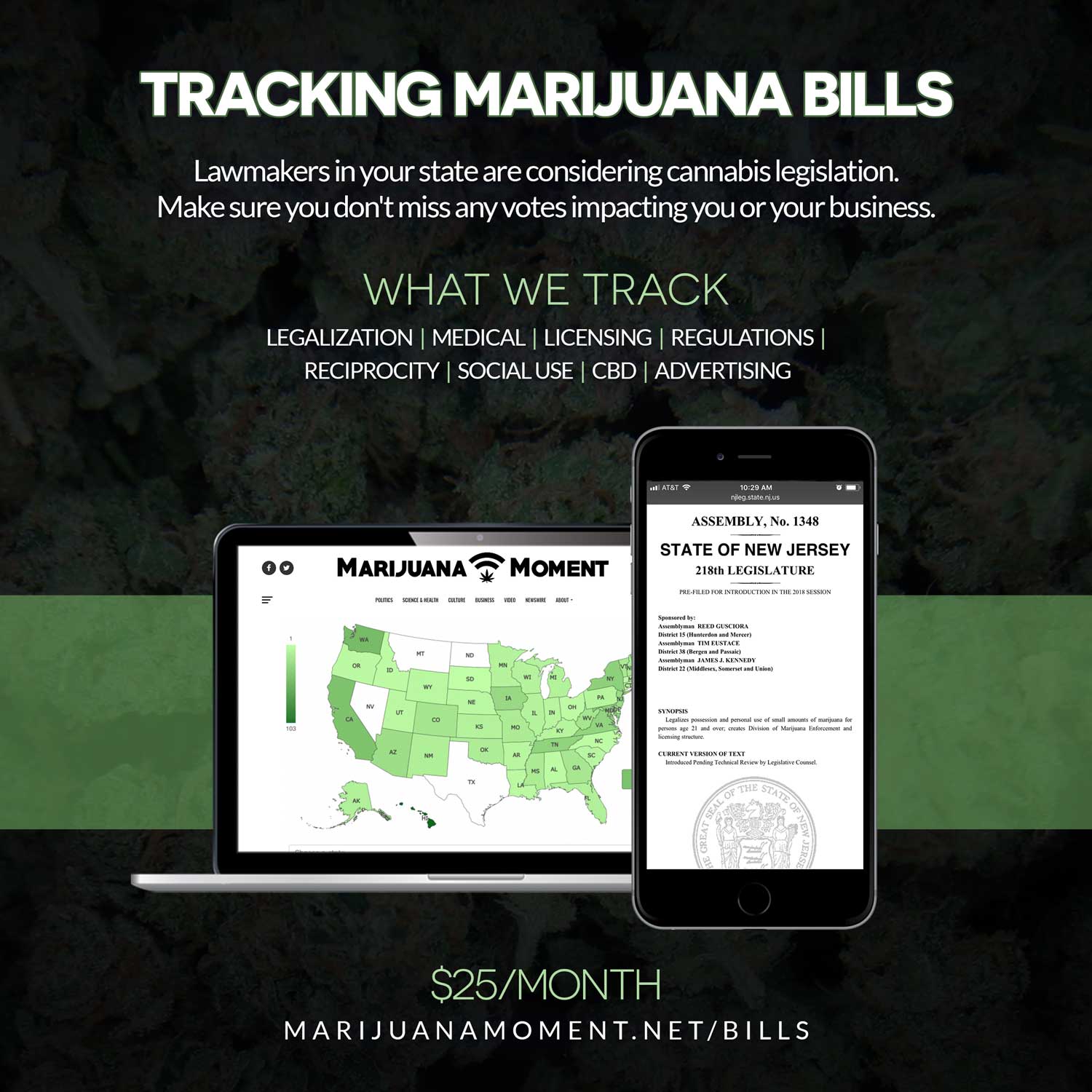
Learn more about our marijuana bill tracker and become a supporter on Patreon to get access.
—
Meanwhile, California regulators recently adopted emergency rules changes for the state’s marijuana licensing process that are intended to make it easier for businesses to qualify for benefits in line with the Trump administration’s recent decision to move ahead with federally rescheduling medical cannabis.
They also launched a new AI tool to help businesses identify marijuana product packaging may appeal to kids in violation of state rules.
Separately, Newsom recently took credit for helping to lead the push for the state to legalize marijuana and discussed his own limited experience with using cannabis.
In October, however, the governor vetoed a bill that would have allowed certain marijuana microbusinesses to ship medical cannabis products directly to patients via common carriers like FedEx and UPS, stating that the proposal “would be burdensome and overly complex to administer.”
Newsom did sign a bill earlier that month aimed at streamlining research on marijuana and psychedelics.
In September, the governor also signed a measure into law to put a pause on a recently enacted tax hike on marijuana products.
Separately, the state attorney general says Indian tribes cannot independently engage in marijuana commerce with licensed cannabis businesses without first obtaining their own commercial license from state officials.
California officials recently awarded nearly $30 million in grants for marijuana-focused academic research projects.
Photo courtesy of Chris Wallis // Side Pocket Images.