Politics
California Lawmakers Approve Bill Restricting Marijuana Packaging That’s ‘Attractive To Children’


California lawmakers have passed a bill to more clearly define the types of marijuana packaging and labeling that is prohibited due to appealing to children, sending the legislation to the governor’s desk.
The measure, sponsored by Assemblymember Jacqui Irwin (D), passed by the Assembly in a vote of 69-1 on Thursday after having cleared the Senate 38-0 a day earlier. The proposal now heads to Gov. Gavin Newsom (D), who can sign or veto the bill or allow it to become law without his signature.
As passed by lawmakers, AB 2249 would define “attractive to children” to mean designed or likely to appeal to people under the age of 21.
Indications for that youth appeal would include the use of cartoons, depictions of individuals who appear to be under 21, use of mythological creatures like unicorns or dragons or references to celebrities or characters who are primarily associated with children’s entertainment.
It would also include images of consumable goods that are primarily marketed to children—such as candies, cereals, sweets and desserts—as well as the use of lettering styles resembling “overinflated bubbles or balloons” that are typical in products marketed to kids.
“Cannabis and cannabis product packaging and labeling shall not imitate, mimic, or closely resemble the packaging, labeling, trade dress, or overall appearance of a non-cannabis product that is primarily marketed to children,” the legislation says.
While the bill says that “edible cannabis product or vape cartridge labeling shall not include cartoon or overly stylized depictions of fruit,” one provision clarifies that “realistic depictions of fruit used to identify or accurately depict the product ingredients or production region are not prohibited.”
The packaging and labeling restrictions would take effect on January 1, 2028 if the measure is enacted into law.
—
Marijuana Moment is tracking hundreds of cannabis, psychedelics and drug policy bills in state legislatures and Congress this year. Patreon supporters pledging at least $25/month get access to our interactive maps, charts and hearing calendar so they don’t miss any developments.
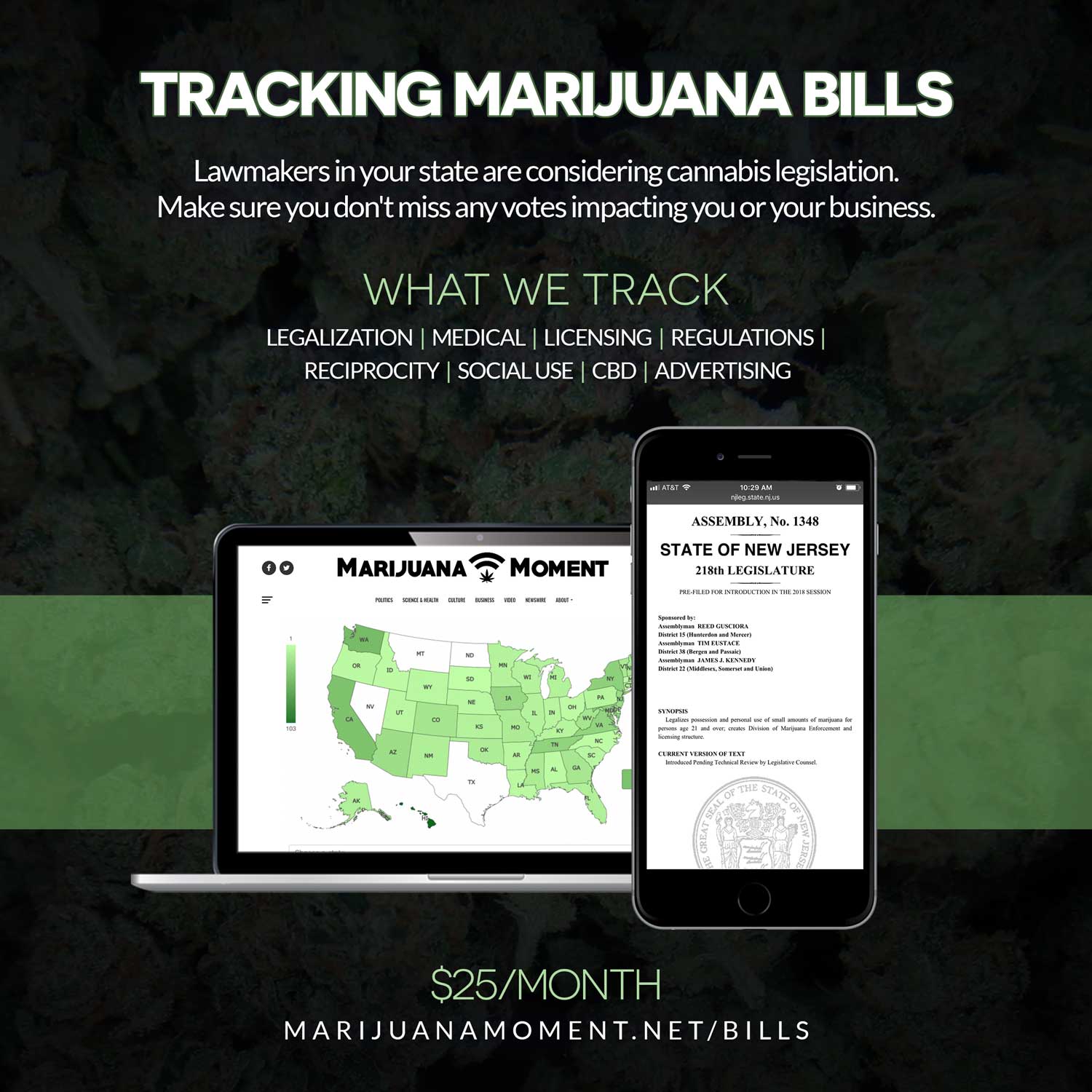
Learn more about our marijuana bill tracker and become a supporter on Patreon to get access.
—
Under the legislation, the Department of Cannabis Control (DCC) would be directed to adopt regulations to “address additional packaging and labeling design elements or product characteristics that pose heightened risk to children.”
DCC would also be required to develop “compliance assessment resources” to help cannabis businesses self-evaluate whether their packaging and labeling at attractive to children.
In June, the department rolled out a new AI tool to help businesses identify marijuana product packaging may appeal to kids in violation of existing state rules, which already ban cartoons on cannabis labels.
Irwin, the bill’s sponsor, previously requested the California State Auditor to conduct an assessment of DCC’s enforcement of existing laws against marketing cannabis products to children.
That audit “confirmed what many have long recognized: California’s cannabis industry continues to package and market products in ways which are overtly attractive to children,” the lawmaker said.
“Since the passage of Proposition 64, child cannabis poisonings have increased dramatically. These exposures are often driven by cannabis product packaging that uses features which are explicitly attractive to children, leading children to consume the products unintentionally,” Irwin said. “Young children who accidentally consumer cannabis require poison control treatment consistently, and in many cases they can also expose their fellow elementary and middle school peers to cannabis.”
The California Cannabis Industry Association (CCIA), for its part, opposes the bill.
“AB 2249 would impose significant costs on the licensed businesses that already keep cannabis away from children, undermine the state’s efforts to bring consumers into the regulated market, and does not address safe at-home storage practices,” the trade association said.
The measure was amended by the Senate after initially clearing the Assembly, including by delaying its effective date, narrowing the definition of “attractive to children” and removing some requirements for regulators.
Meanwhile, lawmakers this session have also advanced legislation to allow marijuana retailers to offer drive-thru windows to serve customers.
Last month, California’s treasurer said the marijuana legalization law that voters approved a decade ago has been a “complete failure” and should be replaced with a new ballot initiative that prioritizes consumers and small businesses.
The vice chair of the state Senate Budget Committee has floated the idea of putting a new initiative on the state ballot to “reverse” Proposition 64, for example, arguing that voters were misled and voicing concerns about the health impacts of marijuana use.
Republican gubernatorial candidate Steve Hilton, who is endorsed by President Donald Trump, recently told Marijuana Moment that taxes and regulations on cannabis are “too high.”
DCC recently released data showing how 97 percent of state cannabis enforcement actions in unincorporated cities have happened in counties that have locally banned licensed growers from operating.
California regulators also recently adopted emergency rules changes for the state’s marijuana licensing process that are intended to make it easier for businesses to qualify for benefits in line with the Trump administration’s recent move to federally reschedule medical cannabis.
Gov. Gavin Newsom (D) recently took credit for helping to lead the push for the state to legalize marijuana and discussed his own limited experience with using cannabis.
In October, however, Newsom vetoed a bill that would have allowed certain marijuana microbusinesses to ship medical cannabis products directly to patients via common carriers like FedEx and UPS, stating that the proposal “would be burdensome and overly complex to administer.”
Newsom did sign a bill earlier that month aimed at streamlining research on marijuana and psychedelics.
In September, the governor also signed a measure into law to put a pause on a recently enacted tax hike on marijuana products.
Separately, the state attorney general says Indian tribes cannot independently engage in marijuana commerce with licensed cannabis businesses without first obtaining their own commercial license from state officials.
California officials recently awarded nearly $30 million in grants for marijuana-focused academic research projects.