Politics
Supreme Court Upholds Marijuana Users’ Gun Rights, Rejecting Trump DOJ Arguments In Major Second Amendment Case

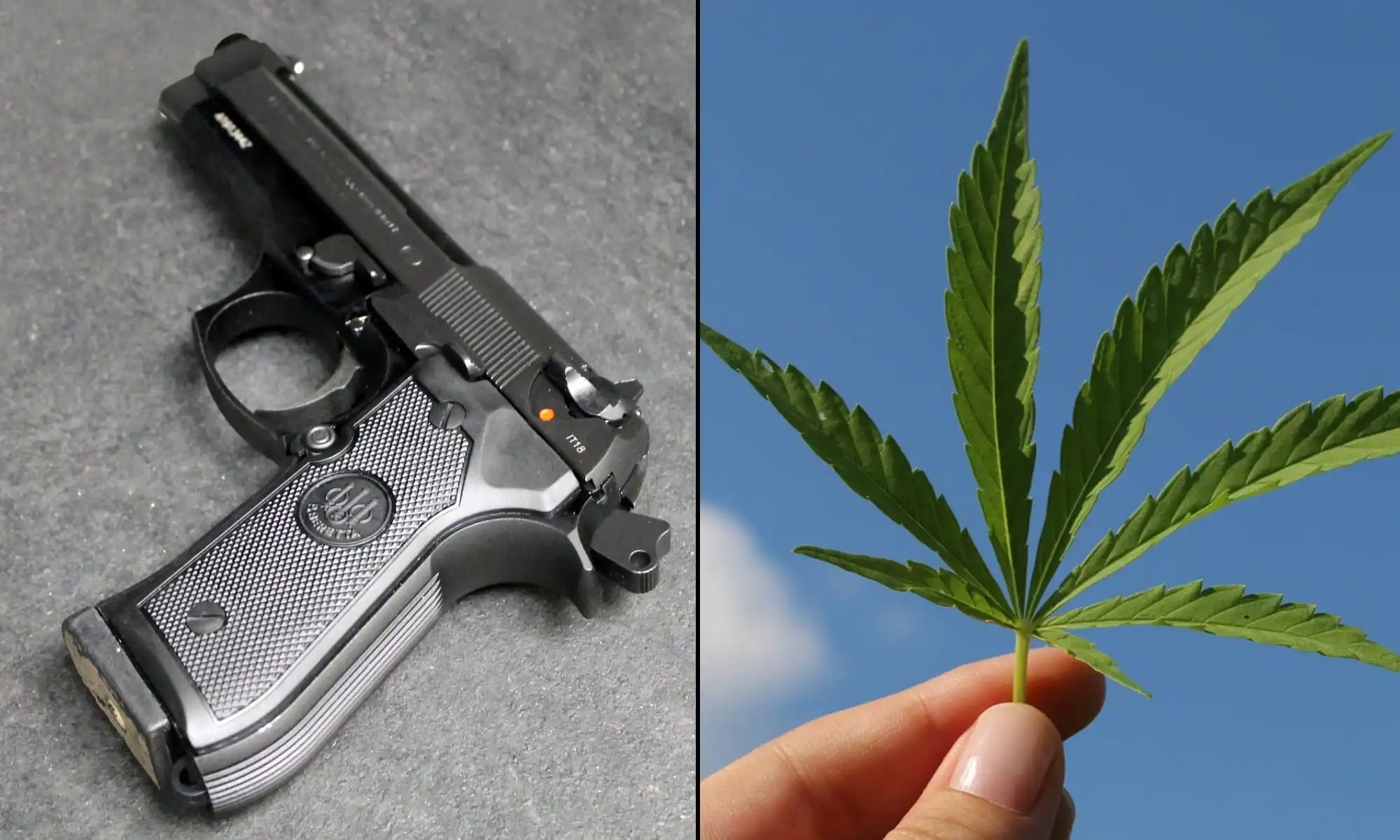
The U.S. Supreme Court has unanimously sided with a man who was prosecuted for possessing a gun while being a regular consumer of marijuana, ruling that the government’s actions violate the Second Amendment.
The opinion authored by Justice Neil Gorsuch is narrow in scope and does not entirely strike down the federal law known as 922(g)(3) that prohibits people who illegally consume controlled substances from possessing or purchasing firearms.
But it does say that as applied to the man in the current case, Ali Danial Hemani, it is unconstitutional to automatically bar people from lawful gun ownership just because they happen to use marijuana occasionally.
It also says that the broad ban and the government’s effort to defend it are “at odds with” the Trump administration’s move to federally reschedule cannabis.
The government “asks us to conclude that anyone who regularly uses marijuana is categorically violent and dangerous without any further showing,” the opinion says. “All based on little more than its current say-so, one at odds with its own regulatory actions. And affording the government that kind of ‘broad power to designate any group as dangerous and thereby disqualify its members from having a gun’ would risk allowing it to ‘quickly swallow’ the Second Amendment.”
The court’s opinion in U.S. vs. Hemani does not address “efforts to ban addicts, or those presently intoxicated, from possessing a firearm,” it says. “We do not address other prophylactic laws Congress might adopt after determining that users of a particular drug pose a special risk of misusing firearms. We do not address 18 U. S. C. §922(g)(1)’s provision disarming individuals convicted of felonies (often including drug-related ones).”
“We do not even address whether the government could bring a prosecution under §922(g)(3) accompanied by individualized proof that the defendant’s use of marijuana (or any other drug) renders him a danger to himself or others. Or proof that a certain drug always renders its users dangerous because of its potency or for some other reason. None of those issues is before us and we do not pass on them either way.”
“All that is before us is one, if surely ambitious, theory. The government maintains that it may automatically strip Mr. Hemani of his Second Amendment right to possess a firearm because he uses marijuana a few times a week,” Gorsuch wrote. “More than that, because he possessed a gun despite this prohibition, the government insists it may imprison him for up to 15 years and disarm him for life.”
“According to the government, none of this turns on how much marijuana Mr. Hemani uses or what effect it has on him. It makes no difference either if he keeps a firearm only in his home for selfdefense, never misuses a gun while intoxicated, and never poses a danger to himself or others as a result of his marijuana use. The only thing the government must show, it says, is that an individual like Mr. Hemani regularly uses any amount of any controlled substance.”
The court’s opinion details recent large-scale federal policy changes concerning marijuana, and how they undermine the broad statute seeking to strip cannabis consumers of their Second Amendment rights.
“As this case came to us, marijuana was listed on Schedule I—a schedule reserved for drugs with ‘a high potential for abuse’ with ‘no currently accepted medical use.’ But after we heard oral argument, the government moved some marijuana products to Schedule III, a schedule that applies to drugs with a lower potential for dependence and abuse and for which a ‘currently accepted medical use’ exists. Years before that, too, the Department of Justice issued a memorandum directing federal prosecutors nationwide to curtail their enforcement efforts against marijuana users even while all marijuana products remained on Schedule I.
Seismic changes followed that memorandum. While marijuana use largely remained unlawful under federal law, the number of federal offenders sentenced for possession of marijuana dwindled. And most States responded by legalizing marijuana use to one degree or another as a matter of state law. As a result, some surveys suggest there now may be more adults in this country who regularly use marijuana than consume alcohol. Whatever one thinks of these developments, the federal government has not just tolerated them; it helped fuel them. All of which leaves it awkwardly positioned to suggest that the millions of Americans who now regularly use marijuana are categorically and unusually dangerous.”
“In these circumstances, marijuana use today is like alcohol use at the founding,” the opinion says. “It is widespread and increasingly considered socially acceptable in many quarters. And from a practical standpoint, law enforcement widely tolerates the use of marijuana.”
Six other justices signed onto Gorsuch’s majority opinion, and three separate concurring opinions were also issued.
The court heard arguments in the case in March, with the Trump administration urging the justices to uphold the ban on gun possession by marijuana users.
The federal government has consistently maintained its position that the law appropriately disarms marijuana users who, they claim, are uniquely dangerous. To meet a strict Supreme Court standard for firearm laws, the Department of Justice has also drawn sometimes eyebrow-raising comparisons between cannabis consumers and the mentally ill and habitual drunkards to establish a historical analogue that aligns with the country’s founding era.
“Those laws, the government contends, demonstrate a tradition of firearm regulation consistent with its effort to disarm any regular user of any controlled substance without any further showing. But the government’s analogy fails under every measure it asks us to consider,” the court’s opinion issued on Thursday says. “The historical laws on which it relies targeted different kinds of people, did so for different reasons, and operated in different ways. And faced with all these shortcomings in the government’s submission, we cannot say it has carried its conceded burden of showing its prosecution of Mr. Hemani complies with the Second Amendment.”
A concurring opinion authored by Justice Samuel Alito that was joined by Justice Elena Kagan highlights the “mismatch” between the historical analogues and how marijuana use is increasingly mainstream today.
“The mismatch between the Government’s historical analogues and the theory on which the Government defends the constitutionality of §922(g)(3) as applied to respondent is clear. All that we know about respondent’s marijuana use is that he used the drug about every other day. We do not know how much he used, the strength of the marijuana he used, how many times he used it on the days in question, the time of day when he used it, where he used it, or the degree to which this use affected his ability to exercise judgment and perform daily tasks responsibly. As a result, the Government has failed to show that a marijuana user like respondent is incapacitated in a way analogous to the habitual drunkards that the Government’s analogues regulated.
Marijuana consumption is increasingly common in this country. Many States have legalized its use and sale, and although possession of the drug remains a federal crime, very few persons are convicted of that offense each year. The Government has largely tolerated the production and sale of marijuana when done in accord with state law, and it has allowed a multi-billion-dollar marijuana business to develop. For its part, Congress has restricted the use of appropriated funds to prevent States from implementing laws that allow the use, distribution, possession, or cultivation of medical marijuana, or to prosecute certain parties.”
Trump administration Solicitor General D. John Sauer, for his part, told the Supreme Court in a brief that people who use illegal drugs “pose a greater danger” than those who drink alcohol.
In a separate filing for the case, the Justice Department also emphasized that “the question presented is the subject of a multi-sided and growing circuit conflict.” In asking the court to take up the dispute, the solicitor general also noted that the defendant is a joint American and Pakistani citizen with alleged ties to Iranian entities hostile to the U.S., putting him on the FBI’s radar.
In December, attorneys general for 19 states and Washington, D.C. filed their own brief siding with the federal government in the Hemani case, insisting that justices should maintain the current § 922(g)(3) statute. The governor of Colorado, whose attorney general was among that group, subsequently said he didn’t think his state should have taken that position.
Also in December, Smart Approaches to Marijuana (SAM) and 21 other prohibitionist groups filed a brief urging justices to uphold the constitutionality of the federal gun ban for people who use cannabis—which they claim is associated with violence and psychosis.
SAM decried the ruling on Thursday, with the group’s CEO, Kevin Sabet, saying the court sent the message that “today’s highly potent marijuana and guns go together just fine.”
“They do not,” he said. “The research could not be more glaring: combining supercharged marijuana with firearms endangers families, law enforcement, and communities… We are working now with our allies in Congress to strengthen protections against more marijuana-induced violence, consistent with today’s narrow ruling.”
On the other side of the debate, civil rights groups—including the American Civil Liberties Union (ACLU), whose attorneys are among those representing Hemani—and gun organizations such as the National Rifle Association (NRA) have argued that the current policy represents a misguided categorical infringement of Second Amendment rights for a population that uses a substance that’s been legalized in a majority of states and is now being partially federally reclassified.
“Today’s unanimous 9-0 decision makes it clear that the government cannot make it crime for people to own a gun, which the Supreme Court has held is a fundamental constitutional right, simply because they use marijuana,” Cecillia Wang, legal director at the ACLU, said in a press release about Thursday’s ruling.
“With nearly half of Americans reporting marijuana use at some point in their lives, this ruling protects the rights of millions and curbs the government’s ability to impose arbitrary and discriminatory penalties,” she said. “The court has sent a strong message that the government cannot criminalize the conduct of large numbers of people by making categorical and unfounded assumptions about whether they are dangerous.”
Meanwhile, the Biden administration was evidently concerned about potential legal liability in federal cases for people convicted of violating gun laws simply by being a cannabis consumer who possessed a firearm, documents obtained by Marijuana Moment show.
The previously unpublished 2024 guidance from former President Joe Biden’s Justice Department generally cautioned U.S. attorneys to use discretion in prosecuting federal cannabis cases, particularly for offenses that qualified people for pardons during his term. But one section seems especially relevant as the Supreme Court takes on a case challenging the constitutionality of the current federal gun statute.
In interviews with Marijuana Moment, several Republican senators shared their views on the federal ban on gun possession by people who use marijuana—with one saying that if alcohol drinkers can lawfully buy and use firearms, the same standard should apply to cannabis consumers.
The ruling comes amid several key federal developments on cannabis and firearms.
The Bureau of Alcohol, Tobacco, Firearms and Explosives in May posted a proposed revised version of Form 4473, which must be filled out by anyone purchasing a gun from a federally licensed firearms dealer, to acknowledge the federally legal status of medical marijuana under the Trump administration’s recent move to reschedule the drug.
The change is likely due to the fact that in April, Acting Attorney General Todd Blanche issued an order that immediately moved marijuana products regulated by a state medical cannabis license to Schedule III of the Controlled Substances Act (CSA), and similarly rescheduled marijuana products that are approved by the Food and Drug Administration (FDA). A hearing to consider broader cannabis rescheduling is scheduled for this month.
Sauer, the solicitor general, sent the justices a letter in April arguing that the Trump administration’s move to federally reschedule marijuana should not impact their decision in the Hemani case.
Separately in April, Blanche had suggested that the Trump administration may soon stop aggressively defending 922(g)(3), the federal law that criminalizes gun possession by people who consume marijuana and other illegal drugs.
ATF also moved earlier this year to loosen rules that bar people who consume marijuana and other illegal drugs from being able to lawfully purchase and possess guns by making it so fewer people would be affected.
The interim final rule from ATF, which is currently open for public comment through June 30, seeks to update the definition of “unlawful user of or addicted to any controlled substance” under an existing policy that has been interpreted to deny Second Amendment rights to people who have used illegal substances a single time within the past year.