Politics
Federal Marijuana Rescheduling Shouldn’t Impact Case On Gun Rights For Users, Trump DOJ Says In Supreme Court Filing

The federal rescheduling of marijuana announced by the Justice Department on Thursday doesn’t change how the Supreme Court should decide a pending case on cannabis consumers’ gun rights, the Trump administration said in a new filing.
The court heard arguments last month in the case, U.S. vs. Hemani, that was brought by a man who is challenging his conviction for unlawful possession of a gun as a person who regularly used marijuana—with several justices appearing skeptical of the federal government’s legal defense of a law banning people who use illegal drugs from having firearms.
In a letter to justices on Thursday, Trump administration Solicitor General D. John Sauer said that the new DOJ order transferring marijuana products regulated by a state medical cannabis license, as well as any marijuana products that are approved by the Food and Drug Administration (FDA), from Schedule I to Schedule III of the Controlled Substances Act, “does not affect the proper resolution of this case.”
Ali Danial Hemani’s “criminal liability depends on the law that was in effect at the time of the offense rather than the law in effect now,” the solicitor general wrote. “At the time of respondent’s offense, marijuana was classified as a Schedule I controlled substance. Even under the final order, moreover, respondent’s marijuana would remain a Schedule I controlled substance because it was neither incorporated into an FDA-approved drug product nor covered by a state medical marijuana license.”
“To the extent the Court wishes to avoid deciding the constitutionality of 18 U.S.C. 922(g)(3) as applied to medical marijuana,” Sauer said, referring to the federal statute that bars people who use illegal drugs from purchasing or possessing guns, “it could limit its decision in this case to Schedule I marijuana and could leave for a future case the statute’s constitutionality as applied to Schedule III marijuana.”
The federal government has consistently maintained its position that the law appropriately disarms marijuana users who, they claim, are uniquely dangerous. To meet a strict Supreme Court standard for firearm laws, DOJ has also drawn sometimes eyebrow-raising comparisons between cannabis consumers and the mentally ill and habitual drunkards to establish a historical analogue that aligns with the country’s founding era.
On the other side of the debate, civil rights groups—including the ACLU, whose attorneys are among those representing Hemani—and gun organizations such as the National Rifle Association (NRA) have argued that the current policy represents a misguided categorical infringement of Second Amendment rights for a population that uses a substance that’s been legalized in a majority of states and is possibly going to be reclassified under federal law as well.
It’s unclear when justices will issue their ruling in the case. The lines of questioning and commentary from justices during the oral arguments demonstrated a degree of skepticism regarding the government’s defense of current statute, and gun groups following the hearing seemed to generally interpret the case as moving in the respondent’s favor—thought it’s not clear how sweeping of a ruling the court will issue, if it does in fact rule for Hemani.
It also remains to be seen how, if at all, the advancement of federal marijuana rescheduling affects the outcome.
Numerous amici briefs were filed with the court ahead of the much-anticipated hearing, with several pointing out that the validity of the current federal policy is made all the more confounding by the then-pending rescheduling move that President Donald Trump in December directed DOJ to expeditiously finalize.
In the background, the Bureau of Alcohol, Tobacco, Firearms, and Explosives (ATF) has moved to loosen rules that bar people who consume marijuana and other illegal drugs from being able to lawfully purchase and possess guns by making it so fewer people would be affected.
The interim final rule from ATF seeks to update the definition of “unlawful user of or addicted to any controlled substance” under an existing policy that has been interpreted to deny Second Amendment rights to people who have used illegal substances a single time within the past year.
Meanwhile, in December, attorneys general for 19 states and Washington, D.C. filed their own brief siding with the federal government in the Hemani case, insisting that justices should maintain the current § 922(g)(3) statute. The governor of Colorado, whose attorney general was among that group, subsequently said he didn’t think his state should have taken that position.
Also in December, Smart Approaches to Marijuana (SAM) and 21 other prohibitionist groups filed a brief urging justices to uphold the constitutionality of the federal gun ban for people who use cannabis—which they claim is associated with violence and psychosis.
The solicitor general, for his part, told the Supreme Court that people who use illegal drugs “pose a greater danger” than those who drink alcohol.
Meanwhile, the Biden administration was evidently concerned about potential legal liability in federal cases for people convicted of violating gun laws simply by being a cannabis consumer who possessed a firearm, documents recently obtained by Marijuana Moment show.
The previously unpublished 2024 guidance from former President Joe Biden’s Justice Department generally cautioned U.S. attorneys to use discretion in prosecuting federal cannabis cases, particularly for offenses that qualified people for pardons during his term. But one section seems especially relevant as the Supreme Court takes on a case challenging the constitutionality of the current federal gun statute.
With respect to Hemani, in a separate August filing for the case, the Justice Department also emphasized that “the question presented is the subject of a multi-sided and growing circuit conflict.” In seeking the court’s grant of cert, the solicitor general also noted that the defendant is a joint American and Pakistani citizen with alleged ties to Iranian entities hostile to the U.S., putting him the FBI’s radar.
If justices declare 922(g)(3) constitutional, such a ruling could could mean government wins in the remaining cases. The high court recently denied a petition for cert in U.S. v. Cooper, while leaving pending decisions on U.S. v. Daniels and U.S. v. Sam.
In interviews with Marijuana Moment, several Republican senators shared their views on the federal ban on gun possession by people who use marijuana—with one saying that if alcohol drinkers can lawfully buy and use firearms, the same standard should apply to cannabis consumers.
—
Marijuana Moment is tracking hundreds of cannabis, psychedelics and drug policy bills in state legislatures and Congress this year. Patreon supporters pledging at least $25/month get access to our interactive maps, charts and hearing calendar so they don’t miss any developments.
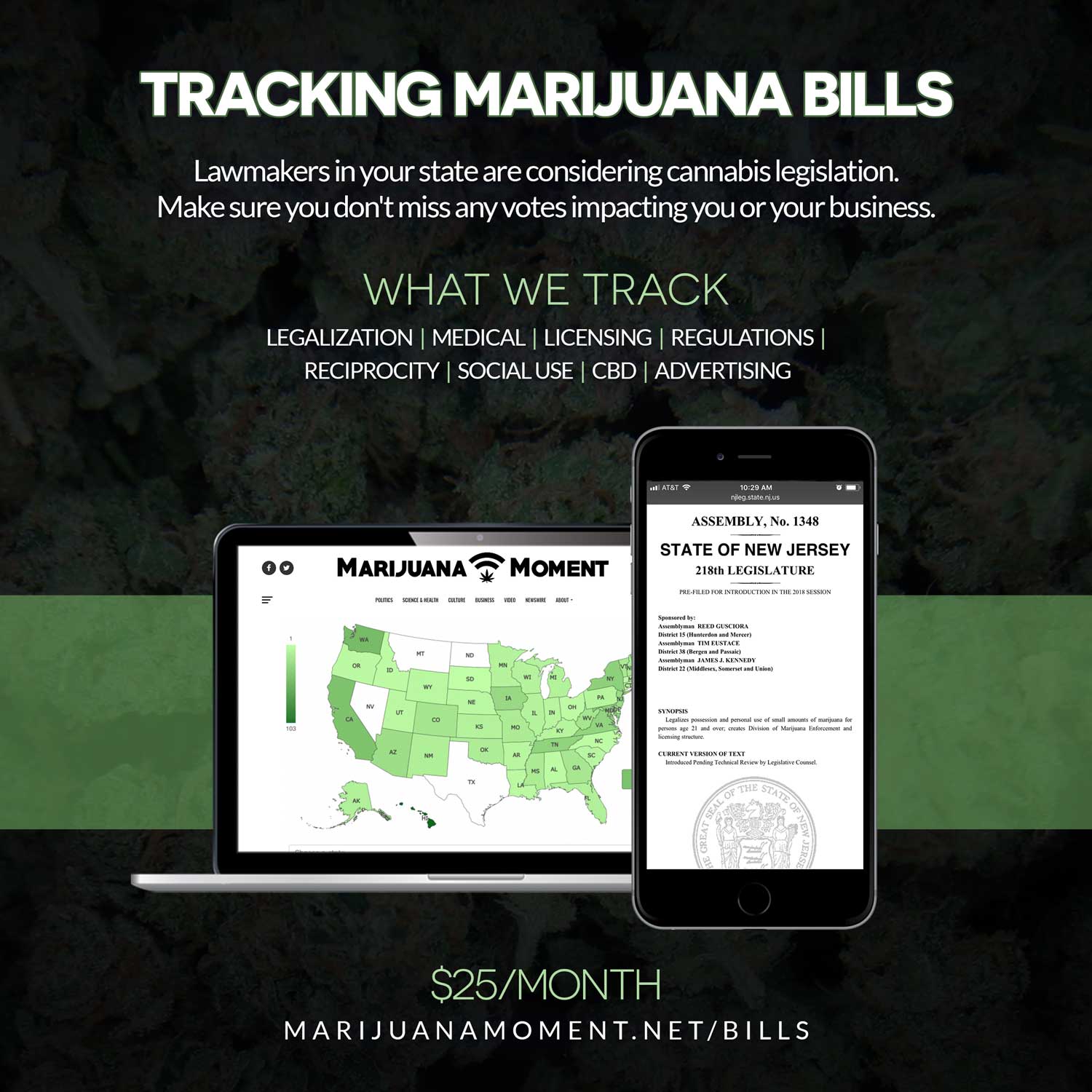
Learn more about our marijuana bill tracker and become a supporter on Patreon to get access.
—
A recent report from the Congressional Research Service (CRS) explained the current legal landscape, saying that a growing number of federal courts are now “finding constitutional problems in the application of at least some parts” of the firearms prohibition.
DOJ has claimed in multiple federal cases over the past several years that the statute banning cannabis consumers from owning or possessing guns is constitutional because it’s consistent with the nation’s history of disarming “dangerous” individuals.
In 2023, for example, the Justice Department told the U.S. Court of Appeals for the Third Circuit that historical precedent “comfortably” supports the restriction. Cannabis consumers with guns pose a unique danger to society, the Biden administration claimed, in part because they’re “unlikely” to store their weapon properly.