Politics
Senate Democrats File Bill To Fully Legalize Marijuana Under Federal Law As Trump Moves To Merely Reclassify It

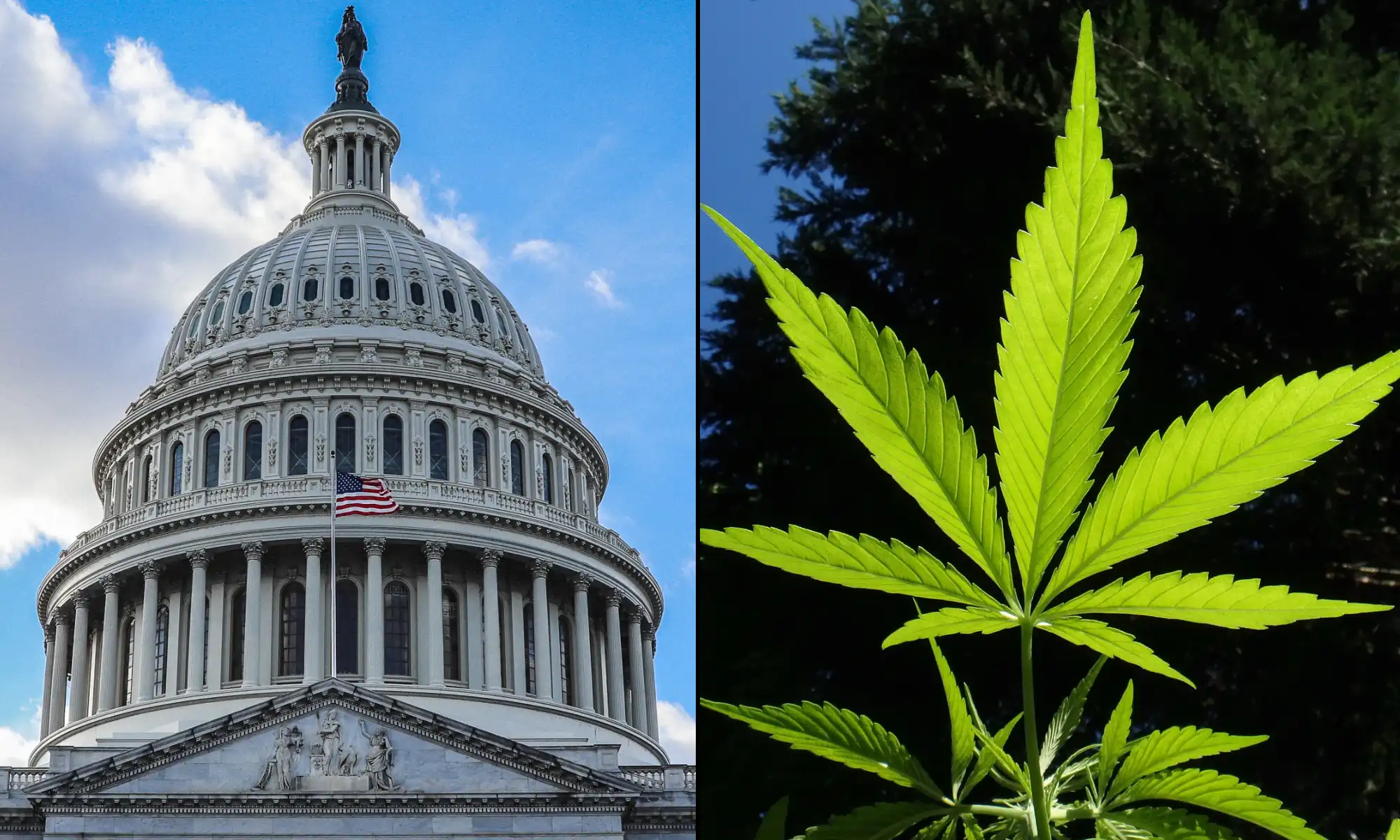
Senate Democrats have filed a bill to federally legalize marijuana, a far-reaching proposal that comes as the Trump administration is moving ahead with a more incremental reform to reschedule cannabis.
The Cannabis Administration and Opportunity Act (CAOA), which is being led by Sen. Cory Booker (D-NJ), Minority Leader Chuck Schumer (D-NY) and Sen. Ron Wyden, along with other Democratic senators, would completely remove cannabis from the Controlled Substances Act (CSA), a process known as “descheduling.”
It would also create a pathway for people to get their prior criminal sentences for cannabis reduced and expunged while restoring access to housing, jobs and civil rights that they may have lost.
The legislation would additionally apply a federal tax on marijuana and use some of the revenue to create a Department of Justice Cannabis Justice Office that would manage a fund to support job training, reentry and legal aid for people from communities harmed by prohibition.
“For decades, generations have suffered unjustly under the failed War on Drugs and broken cannabis laws—hurting primarily people of color. It is long overdue that we stand up for them,” Booker said in a press release. “I am proud to reintroduce this commonsense legislation, which will dismantle the unjust and outdated federal marijuana prohibition, establish a federal regulatory framework to protect public health and safety, expunge past convictions for low-level cannabis offenses, and deliver restorative justice to the communities most harmed by decades of failed drug policy.”
The bill filed on Thursday is largely similar to versions that have been filed in the previous two Congresses, though it contains new provisions on hemp. Specifically, it would prevent the federal recriminalization of hemp THC products that is scheduled to take effect in November.
The measure’s introduction comes one day after the conclusion of a Drug Enforcement Administration (DEA) hearing on the Trump administration’s proposal to reschedule marijuana from Schedule I of the CSA to Schedule III.
Schumer said that “the over-criminalization of cannabis has destroyed far too many lives, disproportionately harming communities of color.”
“Our Cannabis Administration and Opportunity Act is necessary and would correct historical wrongs while investing in safety, research, workers’ rights, and banking accessibility for industry,” he said. “The movement is budding, and I won’t stop until restorative justice is achieved. The American people overwhelmingly support the federal legalization of cannabis—it’s long past time the government caught up”
Wyden added that “the only reefer madness I’m seeing is the continued federal prohibition of cannabis.”
“Our legislation is the most comprehensive proposal on the books to end federal cannabis prohibition while keeping public health and safety front and center,” he said. “The federal government needs to get with the times, and our bill is the way to do it.”
Separately, a bipartisan group of senators last month filed a bill to ease marijuana businesses’ access to banking services.
CAOA, the federal legalization measure, is being introduced with a total of 17 original cosponsors.
In addition to the trio of senators leading the bill, the other members signed on are Sens. Michael Bennet (D-CO), John Fetterman (D-PA), Kirsten Gillibrand (D-NY), John Hickenlooper (D-CO), Ben Ray Luján (D-NM), Alex Padilla (D-CA), Gary Peters (D-MI), Tina Smith (D-MN), Raphael Warnock (D-GA), Ed Markey (D-MA), Jeff Merkley (D-OR), Patty Murray (D-WA), Elizabeth Warren (D-MA) and Peter Welch (D-VT).
Here are the key versions of the CAOA as reintroduced:
- Require the attorney general to finalize a rule removing marijuana from the CSA within 180 days of enactment.
- Impose a 5 percent federal excise tax on small- to mid-sized cannabis producers, which would gradually increase to 12.5 percent after five years. For large businesses, the tax would start at 10 percent and increase to a maximum of 25 percent.
- Only those 21 and older would be allowed to purchase recreational marijuana products, as is already the policy in states that have legalized for adult use.
- Expunge the records of people with low-level, federal cannabis convictions within one year of enactment, while allowing those currently incarcerated over marijuana to petition the courts for relief.
- Create a federal regulatory framework for the marijuana industry, with the Food and Drug Administration (FDA), the Bureau of Alcohol, Tobacco, Firearms and Explosives (ATF) and the Alcohol and Tobacco Tax and Trade Bureau (TTB) all playing key roles.
- Within FDA, there would be a Center for Cannabis Products responsible for regulating “the production, labeling, distribution, sales and other manufacturing and retail elements of the cannabis industry,” according to a summary.
- The Financial Crimes Enforcement Network (FinCEN) would need to update or issue new guidance clarifying to banks and credit unions that the policy change means that they can lawfully service legitimate cannabis businesses.
- States could choose to continue prohibiting marijuana production and sales, but they could not prevent transportation of cannabis products between legal states through their jurisdictions.
- Federal laws would still prohibit trafficking in states that ban marijuana and in legal states that impose laws for trafficking.
- Establish a grant program to fund non-profit organizations that provide job training, reentry services and legal aid. The program would be managed by a new Cannabis Justice Office under the Justice Department.
- DOJ grants would also go toward law enforcement hiring and community outreach to combat the illicit market.
- Separate Equitable Licensing Grant and Equitable Licensing Grant Programs would provide funding for states and localities to promote participation in the industry by minority and low-income people.
- Further, there would be a 10-year pilot program through the federal Small Business Administration “for intermediary lending” to provide “direct loans to eligible intermediaries that in turn make small business loans to startups, businesses owned by individuals adversely impacted by the War on Drugs, and socially and economically disadvantaged small businesses.”
- People could not be denied federal benefits due to the use or possession of marijuana or for a conviction for a cannabis offense. That includes preventing the revocation of security clearances for federal employees.
- Federal employment drug testing for marijuana would also be prohibited, with certain exceptions for sensitive positions such as law enforcement and those involving national security.
- Physicians with the U.S. Department of Veterans Affairs (VA) would be authorized to issue recommendations for medical cannabis to veterans.
- There would be measures taken to prevent diversion, including the establishment of a track-and-trace regime. Further, retail cannabis sales would be limited to 10 ounces in a single retail transaction.
- Federal law would be amended to explicitly state that SBA programs and services available to marijuana businesses and companies that work with them.
- The Government Accountability Office (GAO) would be required to facilitate a number of studies into marijuana policy—for example evaluations of the societal impact of legalization in states with recreational marijuana laws on the books, including information on impaired driving, violent crime and more.
- The Bureau of Labor Statistics (BLS) would need to compile demographic data on business owners and employees in the cannabis industry.
- Employers with federal cannabis permits required under the legislation that violate certain federal labor laws could see their permits rescinded—a bold policy proposal that would make the marijuana industry uniquely labor friendly.
- The U.S. Department of Health and Human Services (HHS) would be required to work with the National Institutes of Health (NIH) on ways to promote research into cannabis impacts. There would be a specific requirement to study the diversity of marijuana products available for research purposes.
- The bill calls for an increase in the quantity of cannabis that’s available for study purposes.
- There would be targeted public education campaigns meant to deter youth consumption. States would also receive funding for initiatives to prevent youth use and impaired driving, which would include money for education and enforcement.
- The Department of Transportation would be responsible for developing a standard for THC-impaired driving within three years of the bill’s enactment that states would be required to adopt, unless the secretary finds the department is unable to set such a scientific standard.
- The National Highway Traffic Safety Administration (NHTSA) would be tasked with collecting data on impaired driving, producing educational materials on the issue for states to distribute and carry out education campaigns.
- Vaping delivery system products that contain added natural or artificial flavors would be banned under the proposal.
Cannabis reform supporters cheered the introduction of the bill.
“The reintroduction of the CAOA in the Senate represents a critical opportunity for Congress to adopt marijuana reform that prioritizes the health, safety and wellbeing of everyday Americans,” Maritza Perez Medina, director of federal affairs for the Drug Policy Alliance, said in a press release. “Recent federal orders to advance marijuana reform show how far public opinion and our movement have come. A majority of people across the political spectrum recognize that marijuana criminalization has been a failure and support legal regulation that works.”
“The question is not if, but how, we continue on the path toward legalization and repair,” she said. “Do we adopt a piecemeal approach that largely benefits corporate interests and stops short of ending criminalization? Or do we embrace a comprehensive approach that ends federal criminalization, removes all barriers to research into health risks and benefits, and ensures that workers, small businesses, and patients have the protections and opportunities they deserve?”
Bryon Adinoff, president of Doctors for Drug Policy Reform, said that moving cannabis to Schedule III, as the Trump administration is considering, “would represent an important acknowledgment of medical reality, but it still falls far short of the comprehensive reform that is needed.”
“Cannabis would remain within the Controlled Substances Act, preserving many of the barriers that have distorted research, limited product standardization and placed physicians and patients in legal uncertainty for decades,” he said. “The federal government has already effectively conceded that cannabis has accepted medical use in the United States, a position that is incompatible with continued criminalization at the federal level.”
“What is ultimately needed is legislation that provides a regulatory framework and full federal descheduling, such as the Cannabis Administration and Opportunity Act, so cannabis policy can finally be approached as a matter of public health rather than criminal law,” Adinoff said.
Dasheeda Dawson, board chair for the Cannabis Regulators of Color Coalition, said that “cannabis regulators across the country understand that rescheduling alone does not resolve the core failures of prohibition.”
“Instead, it risks creating a two-tiered industry, where federally protected businesses move ahead while justice-impacted communities still bear the burden of enforcement and exclusion. We cannot regulate our way to equity while preserving the same criminal legal framework that caused the harm,” she said. “The CAOA offers a more comprehensive path because it treats cannabis policy as inseparable from restorative justice, community reinvestment, fair market access and protection against monopolization. Real reform means dismantling the architecture of the drug war—not rebranding it.”
The Republican majority in the House of Representatives, meanwhile, has advanced legislation this Congress to block the Trump administration from carrying out marijuana rescheduling.
The House Appropriations Committee also approved a bill containing a provision to block federal workers’ compensation programs from covering medical cannabis—”regardless of any change in the scheduling of marijuana.”
The panel also approved a separate spending bill and attached report that directs federal officials to continue requiring government employees and safety-sensitive workers such as truck drivers and airline pilots to be drug tested for marijuana, “regardless of any future changes to the legal status or scheduling.”
Read the full text of the new Senate marijuana legalization bill below: