Politics
Congressional Committee Votes To Block Marijuana Rescheduling, Even As Trump Administration Moves Forward With The Reform

A key congressional committee has voted to block the federal rescheduling of marijuana—even after the Trump administration announced last month that it is moving ahead with enacting the reform.
The House Appropriations Committee on Wednesday approved a funding bill containing a provision that, if enacted, would prevent federal officials from taking further steps to carry out cannabis rescheduling.
“SEC. 591. None of the funds appropriated under this Act or otherwise made available by this Act may be used to reschedule marijuana (as such term is defined in section 102 of the Controlled Substances Act (21 U.S.C. 802)) or to remove marijuana from the schedules established under section 202 of the Controlled Substances Act (21 U.S.C. 812).”
The panel has advanced similar language in the past years as the federal government has weighed marijuana rescheduling, but those provisions were never passed into law.
The Department of Justice announced last month that marijuana products regulated by a state medical cannabis license immediately moved to Schedule III, as did any marijuana products that are approved by the Food and Drug Administration (FDA). An administrative hearing scheduled to begin next month will consider broader cannabis rescheduling.
Because the rescheduling of medical cannabis under Acting Attorney General Todd Blanche’s order took effect immediately, it’s not clear if or how the congressional rider would impact businesses and patients who are covered by that reform. If the language is passed by the full House and Senate and makes it into an appropriations package that President Donald Trump signs into law, however, it could prevent the hearing and related action on broader marijuana rescheduling from taking place.
The committee approved the Fiscal Year 2027 Commerce, Justice, Science, and Related Agencies Bill containing the anti-rescheduling provision in a 32-28 vote. It will next head to the House Rules Committee, which will prepare the legislation for floor consideration.
Meanwhile, the funding bill that is advancing also contains an updated version of a longstanding rider that since 2014 has protected state medical cannabis programs from federal interference.
“SEC. 531. (a) None of the funds made available under this Act to the Department of Justice may be used, with respect to any of the States of Alabama, Alaska, Arizona, Arkansas, California, Colorado, Connecticut, Delaware, Florida, Georgia, Hawaii, Illinois, Indiana, Iowa, Kentucky, Louisiana, Maine, Maryland, Massachusetts, Michigan, Minnesota, Mississippi, Missouri, Montana, Nebraska, Nevada, New Hampshire, New Jersey, New Mexico, New York, North Carolina, North Dakota, Ohio, Oklahoma, Oregon, Pennsylvania, Rhode Island, South Carolina, South Dakota, Tennessee, Texas, Utah, Vermont, Virginia, Washington, West Virginia, Wisconsin, and Wyoming, or with respect to the District of Columbia, the Commonwealth of the Northern Mariana Islands, the United States Virgin Islands, Guam, or Puerto Rico, to prevent any of them from implementing their own laws that authorize the use, distribution, possession, or cultivation of medical marijuana.
(b) Funds made available under this Act to the Department of Justice may be used to enforce violations of 21 U.S.C. 860.”
This year’s provision for the first time includes Nebraska, after advocates pointed out the state was omitted from previously enacted appropriations legislation even though voters there approved medical cannabis legalization in 2024.
The latter subsection of the medical cannabis rider has never been enacted before, and it seeks to stipulate that the Justice Department can still enforce a section of U.S. code that calls for increased penalties for distributing cannabis within 1,000 feet of an elementary school, vocational school, college, playground or public housing unit.
Separately, the bill also includes another longstanding rider that protects state hemp research programs from federal interference.
“SEC. 530. None of the funds made available by this Act may be used in contravention of section 7606 (‘‘Legitimacy of Industrial Hemp Research’’) of the Agricultural Act of 2014 (Public Law 113–79) by the Department of Justice or the Drug Enforcement Administration.”
Meanwhile, the committee report attached to the spending bill also contains a number of cannabis-related provisions.
It calls on the Drug Enforcement Administration (DEA) and Food and Drug Administration (FDA) to address the “proliferation of Federally unregulated ingestible, inhalable, and topical products that contain intoxicating cannabinoids” and that “threaten consumer safety.”
“Intoxicating Cannabinoids.—The Committee is concerned by the proliferation of Federally unregulated ingestible, inhalable, and topical products that contain intoxicating cannabinoids. The Committee directs the DEA, in coordination with the FDA Office of Inspections and Investigations, to take appropriate enforcement actions against those whose products threaten consumer safety and fail to meet the statutory definition of section 10113 of Public Law 115–334 and section 781 of Public Law 119–37. The Committee further directs the DEA to report on these efforts and any resources necessary to enforce the controlled substance laws and regulations of the United States not later than 90 days after the enactment of this Act.”
While the provision doesn’t use the word “hemp,” it cites statutes covering the crop and appears responsive to widespread sales of products derived from it after they became legal under the 2018 Farm Bill. Congress has since passed, however, and President Donald Trump has signed, new legislation that will broadly recriminalize hemp THC products starting in November.
The new appropriations report attached to the bill also calls on the Department of Justice to take action against “money laundering schemes” tied to Chinese-connected illegal marijuana grow operations within the U.S.
“Chinese Communist Party (CCP) Money Laundering.—The Committee directs the Department to utilize funds directed to anti-money laundering programs to investigate potential money laundering schemes involving CCP-connected marijuana businesses and entities providing financial services to these businesses.”
Finally, the report notes that funding is being set aside for the Bureau of Prisons (BOP) to monitor wastewater to detect use of synthetic cannabinoids and other drugs by incarcerated people.
“Wastewater Surveillance Pilot.—The Committee provides $8,500,000 to BOP to carry out a pilot program using a wastewater surveillance system to monitor the prevalence of infectious diseases—including Hepatitis C, HIV, tuberculosis, and respiratory pathogens—as well as the use of covered drugs, including fentanyl, nitazenes, and other synthetic opioids, methamphetamine, synthetic cannabinoids, and other controlled substances, among the incarcerated population at not fewer than six Federal correctional institutions. Sites will be selected to ensure representation across security classification levels, geographic regions of the United States, and institutional population sizes. Not later than 180 days after the completion of the pilot program, BOP shall submit a report detailing findings regarding the prevalence of infectious diseases and covered drug use at participating institutions, along with recommendations for legislative or administrative action.”
—
Marijuana Moment is tracking hundreds of cannabis, psychedelics and drug policy bills in state legislatures and Congress this year. Patreon supporters pledging at least $25/month get access to our interactive maps, charts and hearing calendar so they don’t miss any developments.
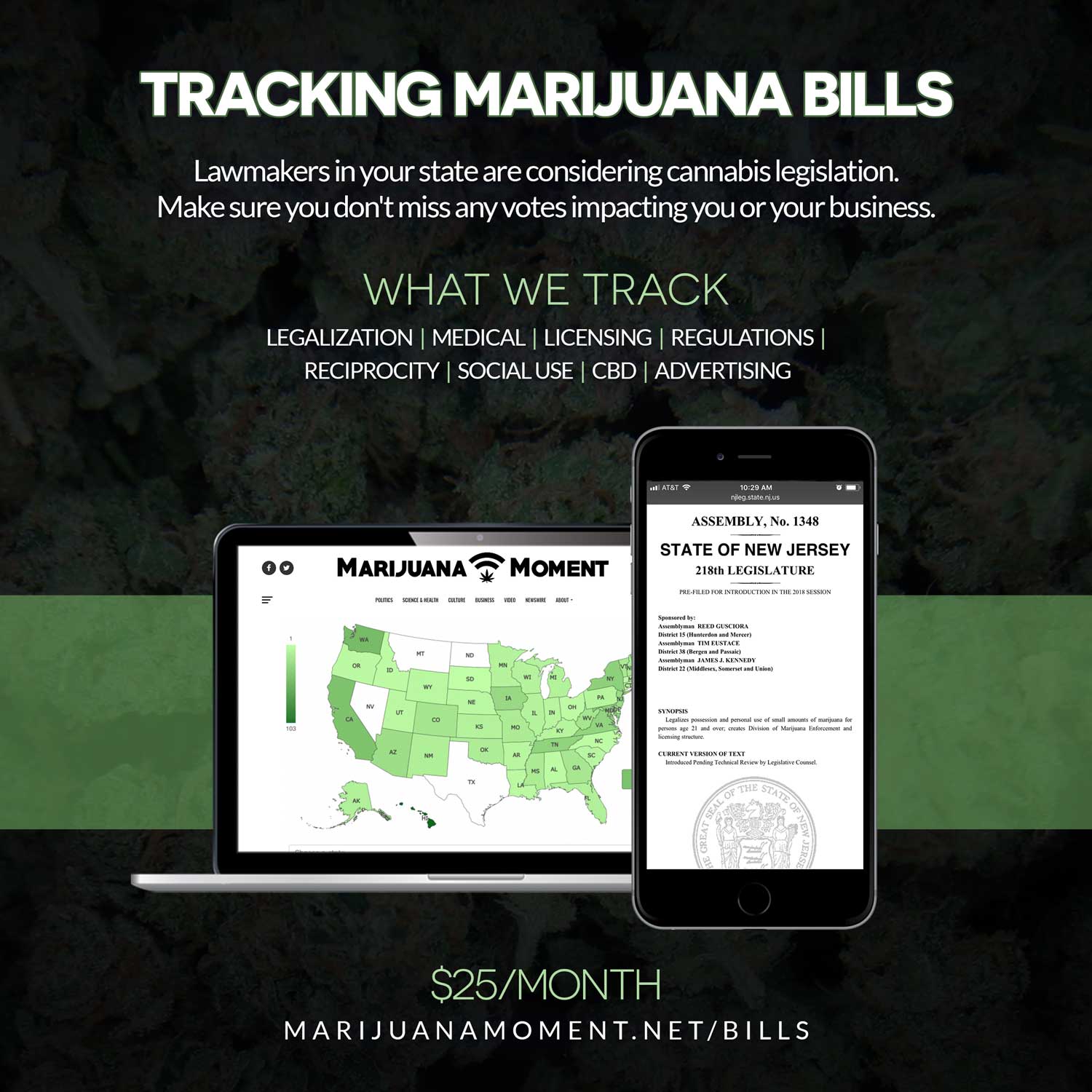
Learn more about our marijuana bill tracker and become a supporter on Patreon to get access.
—
Meanwhile in Congress, the House is expected to consider an amendment this week to let military veterans receive recommendations for medical marijuana through their doctors at the Department of Veterans Affairs (VA)
Separately, the House Appropriations Committee approved a spending bill and an attached report that expresses concerns about health risks from cannabis-derived products, while also encouraging research into the therapeutic benefits of psychedelics.
The full House also recently passed a Farm Bill with provisions aimed at aiding industrial hemp producers—but without any language to delay or alter the federal recriminalization of hemp THC products that’s scheduled to take effect later this year.
A new report from the Congressional Research Service details the scope and limitations of the federal marijuana rescheduling move.