Politics
Iowa Democratic Gubernatorial Candidate Praises Trump For Rescheduling Marijuana

The Democratic Party’s nominee for Iowa governor is heaping praise on the Republican president of the United States for taking steps to update federal marijuana policies.
Rob Sand, the Democratic gubernatorial candidate in Iowa, was asked at an event on Wednesday about areas of bipartisanship where he can work with President Donald Trump’s administration.
“I’m someone who has always been willing to call the good ‘good,'” he said. “I was really glad to see the Trump administration move towards making marijuana more accessible for medical purposes. I’m a believer that it should be treated the way we treat alcohol. And so when they did it, I said, ‘Good for them.'”
Under an order issued by Attorney General Todd Blanche in April, marijuana products regulated by a state medical cannabis license immediately moved from Schedule I of the Controlled Substances Act (CSA) to Schedule III, as did any marijuana products that are approved by the Food and Drug Administration (FDA). An administrative hearing is considering broader marijuana rescheduling.
Sand, who has often discussed his support for broader cannabis legalization on the campaign trail, said on Wednesday that “nobody has a monopoly on good ideas.”
“Nobody has a monopoly on bad ideas either,” he said. “And if we’re willing to just work with people and focus our work on whether or not what they’re doing is good, then we can get all kinds of all kinds of things done.”
“I don’t care what the name of the president is. I don’t care care what their party is,” Sand said. “What I care about is what is it they want to do—is it good for Iowa? Great, let’s do it, and I’ll give them all the credit that’s due.”
Sand said last month that legalizing marijuana is a “no-brainer” move to help ward off a “fiscal time bomb” in Iowa that could otherwise lead to cuts in funding for education and public safety in the state.
“I think we should treat it the way we treat alcohol. That seems like a no-brainer to me, right?” the Democratic gubernatorial nominee, who is currently the state auditor, said at a town hall event.
“Alcohol is a dangerous drug. You shouldn’t abuse it. Also, we’re not going to throw you in prison for having a beer,” Sand said. “Why is it any different for marijuana? It is a dangerous drug. You shouldn’t abuse it. We shouldn’t be throwing people in prison just for using it.”
Sand also spoke about his support for legalizing marijuana at an earlier event in August, saying that he thinks cannabis should be legalized and treated like alcohol, even if he thinks it’s “dangerous.”
“Marijuana is a dangerous drug,” he said at the time. “You shouldn’t abuse it, but we also shouldn’t throw people in prison just for using it. We should treat it the way we treat alcohol. Alcohol is a dangerous drug. You shouldn’t abuse it, but we don’t throw you in prison just for having a beer when you get home.”
The Democratic gubernatorial candidate said that Iowa is “spending perfectly good tax dollars to lock people up” for marijuana while people who want to use it are driving across the border to purchase it in other states.
“They’re spending their money in Illinois, or they’re spending it in Missouri. And then they’re driving back without their money,” Sand said. “The money stays there, and the tax dollars stay there.”
Republican gubernatorial nominee Zach Lahn reportedly opposes legalizing cannabis but doesn’t appear to have spoken extensively about the issue.
Josh Turek, the Democratic nominee in a U.S. Senate race, said last month that cannabis’s longtime restrictive Schedule I status is “ridiculous.” Marijuana “should be legalized and regulated, and let’s tax it,” he said.
Meanwhile, Iowa regulators are circulating proposed rules changes to remove the residency requirement for patients in the state’s medical cannabis program while also ensuring that military veterans qualify for reduced registration fees.
The residency-focused part of the regulatory change from the state Department of Health and Human Services is meant to comply with provisions of a bill that Reynolds signed into law in June.
In addition to allowing out-of-state residents to register in the medical cannabis program if they have a certification from an Iowa healthcare provider legislation, that legislation also doubles the number of medical cannabis dispensaries that are allowed to operate in the state.
Regulators said in the new rule filing that removing the residency requirement is expected to “primarily impact qualified Nebraska residents since Nebraska is the only bordering state that does not currently have an operational medical or adult-use cannabis program.”
“Although Nebraska has taken steps to establish a medical cannabidiol program, implementation has experienced significant delays and setbacks,” the regulatory explanation says.
Beyond the residency change that is part of the bill the governor signed this year, the new rule change also restores regulatory language that was “inadvertently removed during the 2023 Red Tape Review process” that allowed proof of military veteran status to be used to qualify for a reduced patient application fee of $25 instead of the standard $100.
Under prior law, Iowa’s limited medical marijuana program allowed only five dispensaries. That has doubled to 10 under HF 990, which the governor signed.
—
Marijuana Moment is tracking hundreds of cannabis, psychedelics and drug policy bills in state legislatures and Congress this year. Patreon supporters pledging at least $25/month get access to our interactive maps, charts and hearing calendar so they don’t miss any developments.
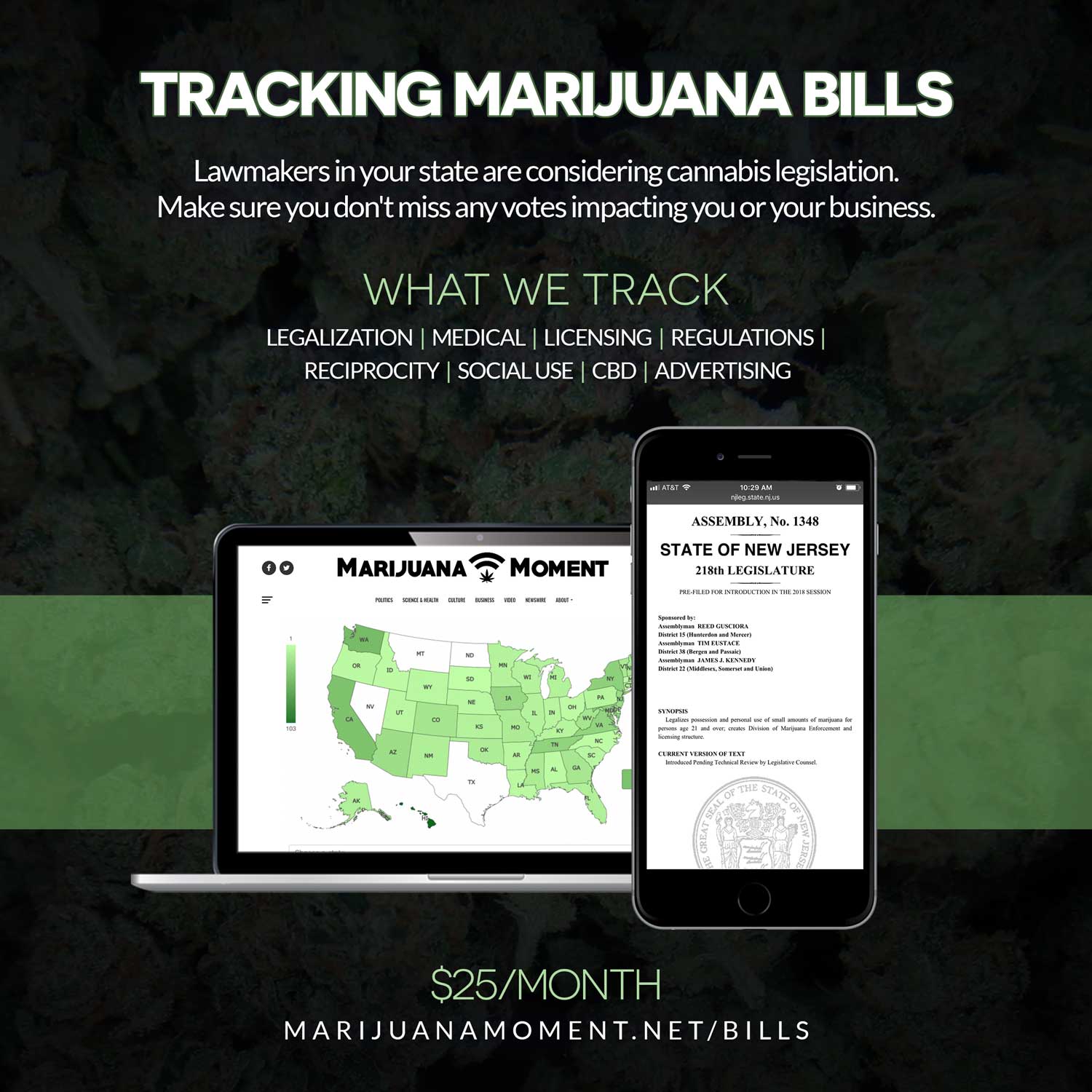
Learn more about our marijuana bill tracker and become a supporter on Patreon to get access.
—
The Iowa Medical Cannabidiol Board, which oversees the state’s medical marijuana program, recommended in a 2023 report that the state allow more licenses “in an effort to provide Iowans with greater geographical access to medical cannabis products.”
Under the program, patients with certain conditions can obtain cannabis products containing no more than at 4.5 grams of THC every 90 days. Flower and smoking are not allowed. Healthcare practitioners can allow greater amounts of THC for patients who are terminally ill or who have experience with the program and for whom the provider believes 4.5 grams is not enough.
Separately this session, Iowa lawmakers considered a bill to create a state-regulated therapeutic psilocybin program for patients with post-traumatic stress disorder (PTSD).
Last year, the governor vetoed earlier legislation that would have allowed doctors in the state to immediately prescribe a synthetic form of psilocybin in the event of federal approval of the psychedelic substance by the U.S. Food and Drug Administration (FDA), arguing that it “surrenders state authority to make an informed determination about classification to federal officials.”
Photo courtesy of Max Pixel.