Politics
There Are ‘No Deaths From Overdose Of Marijuana,’ DEA Confirms In Updated Report

Marijuana can have a number of effects on people who use it but there are no known instances of someone fatally overdosing from consuming cannabis, federal officials say.
“No deaths from overdose of marijuana have been reported,” the Drug Enforcement Administration (DEA) said in a new update to its “Drugs of Abuse” publication for 2026.
That said, the agency is cautioning that cannabis’s effects on perception and coordination can cause “serious impairments in learning, associative processes, and psychomotor behavior (driving abilities)” and that long-term use can lead to “physical dependence and withdrawal following discontinuation, as well as psychological addiction or dependence.”
The report also notes that “there have been an increasing number of emergency room visits involving marijuana edibles.”
On the other hand, however, DEA notes that marijuana use can lead to “merriment, happiness, and even exhilaration at high doses.”
While the updated 119-page report’s marijuana section is largely the same as the one in the previous edition published in 2024, it has been revised to note the Trump administration’s move to federally reschedule cannabis as well as to more favorably characterize the growing number of states that are changing their own laws.
“Over the last three decades, the majority of U.S. states have legalized the sale and use of marijuana for medical purposes as a matter of state law and have established systems to regulate that activity,” the new edition says.
The previous version of the document had said:
“Although some states within the United States have allowed the use of marijuana for medicinal purpose, it is the U.S. Food and Drug Administration that has the federal authority to approve drugs for medicinal use in the U.S. To date, FDA has not approved a marketing application for any marijuana product for any clinical indication. Consistent therewith, FDA and DEA have concluded that marijuana has no federally approved medical use for treatment in the U.S. and thus it remains as a Schedule I controlled substance under federal law.”
The newly updated report notes that in April of this year, “the U.S. Department of Justice placed drug products containing marijuana that have been approved by the Food and Drug Administration (FDA) in schedule III of the Controlled Substances Act” (CSA).
“This regulation applies to marijuana as defined in the CSA, marijuana extracts, delta-9- tetrahydrocannabinol and other compounds derived from the marijuana plant (other than the mature stalks and seeds) that fall outside the definition of hemp, to the extent that any of these are included in an FDA-approved drug product or are subject to a state-issued license to manufacture, distribute, and/or dispense marijuana or products containing marijuana for medical purposes,” it says.
The new document also includes an updated table of controlled substances that shows state-licensed medical cannabis now falls under Schedule III of the CSA.
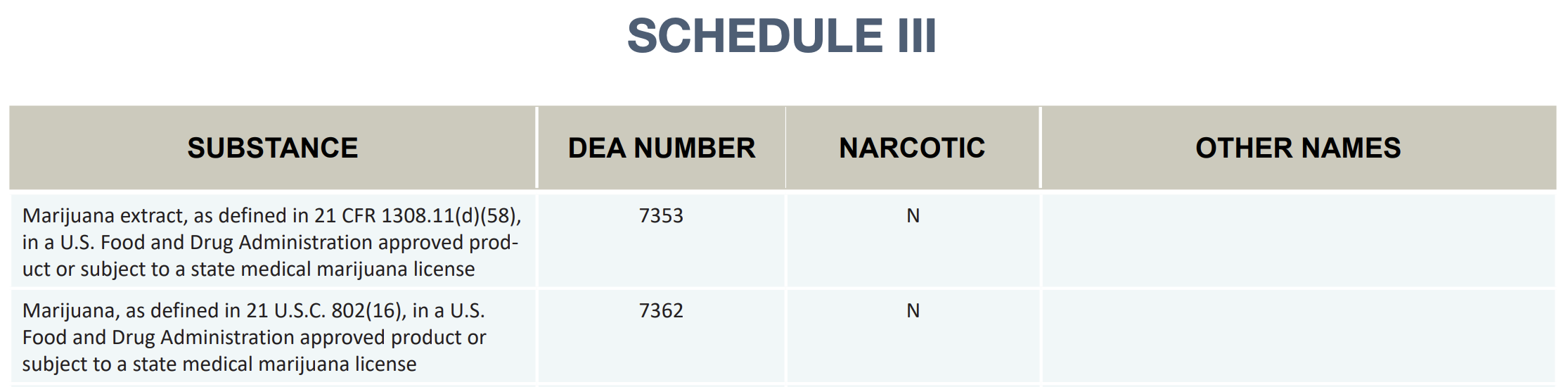
Under an action announced by Attorney General Todd Blanche in April, marijuana products regulated by a state medical cannabis license immediately moved from Schedule I of the CSA to Schedule III, as did any marijuana products that are approved by the FDA.
A hearing is considering broader cannabis rescheduling, including for recreational products.