Politics
New Congressional Bill Would Require Drinks With Cannabis, Alcohol Or Kratom To Have Color-Coded Labels

A new bill from a Republican congressman would require federal officials to establish a system for color coding cannabis-infused beverages and other intoxicating drinks.
Under the Safe Sips Act, filed by Rep. Nick LaLota (R-NY), there would be “one single color” used on packaging for beverages containing THC, other intoxicating cannabinoids, alcohol, kratom-related compounds or any other intoxicating substances, “regardless of the type of intoxicating substance in such drink.”
The color would have to appear at the dispensing point of drinks, defined as the top or closure where liquid is poured from, such as a bottle cap, lid, cork or nozzle.
There would also be a non-color identifier on packaging—such as text, a symbol, a pattern or a tactile feature—to help with “ensuring accessibility to a consumer of such drink who is blind or colorblind.”
Once the identifying color is chosen by federal officials, it or substantially similar colors could not be used on other beverages that don’t fall under the scope of the bill.
“Nowadays, you can get a lot of different drinks in these fancy cylinder kind of cans—and some of them are intoxicating, and some of them are not,” LaLota said in a video posted to social media. “Some of them can get you high and drunk, and some of them don’t. And I think that the public, and especially kids, should know the difference when they’re grabbing one of these cans.”
In another video, the congressman displayed six different beverage cans on his desk, asking, “How long would it take you to figure out what’s what amongst these six?”
“It took me a while to turn the cans around, having to read the fine print, and it’s tough,” he said. “And it shouldn’t be that tough, and especially shouldn’t be that tough for kids. We should be able to protect our kids from ingesting these intoxicating drinks and be aware of them, even as adults.”
The legislation charges the health and human services secretary and treasury secretary with carrying out its provisions, with their duties designated to the Food and Drug Administration (FDA) and the Alcohol and Tobacco Tax and Trade Bureau (TTB), respectively. Rules would need to be in place within two years of passage, and the requirements would apply to any covered drinks manufactured, distributed or sold after four years of the law being enacted.
Under the measure, intoxicating cannabinoid would defined as “a cannabinoid, including an isomer, a derivative, an analogue, a homolog, or a synthetic cannabinoid, that has an intoxicating or impairing effect substantially similar to or greater than THC, as determined by the Secretary, when ingested by a human.”
THC would be defined as “a tetrahydrocannabinol or any isomer thereof, as determined by the Secretary, including a delta-8, delta-9, or delta-10 tetrahydrocannabinol, regardless of whether such tetrahydrocannabinol or isomer is naturally occurring, chemically converted, synthesized, or derived from hemp, marihuana, or any such other source.”
—
Marijuana Moment is tracking hundreds of cannabis, psychedelics and drug policy bills in state legislatures and Congress this year. Patreon supporters pledging at least $25/month get access to our interactive maps, charts and hearing calendar so they don’t miss any developments.
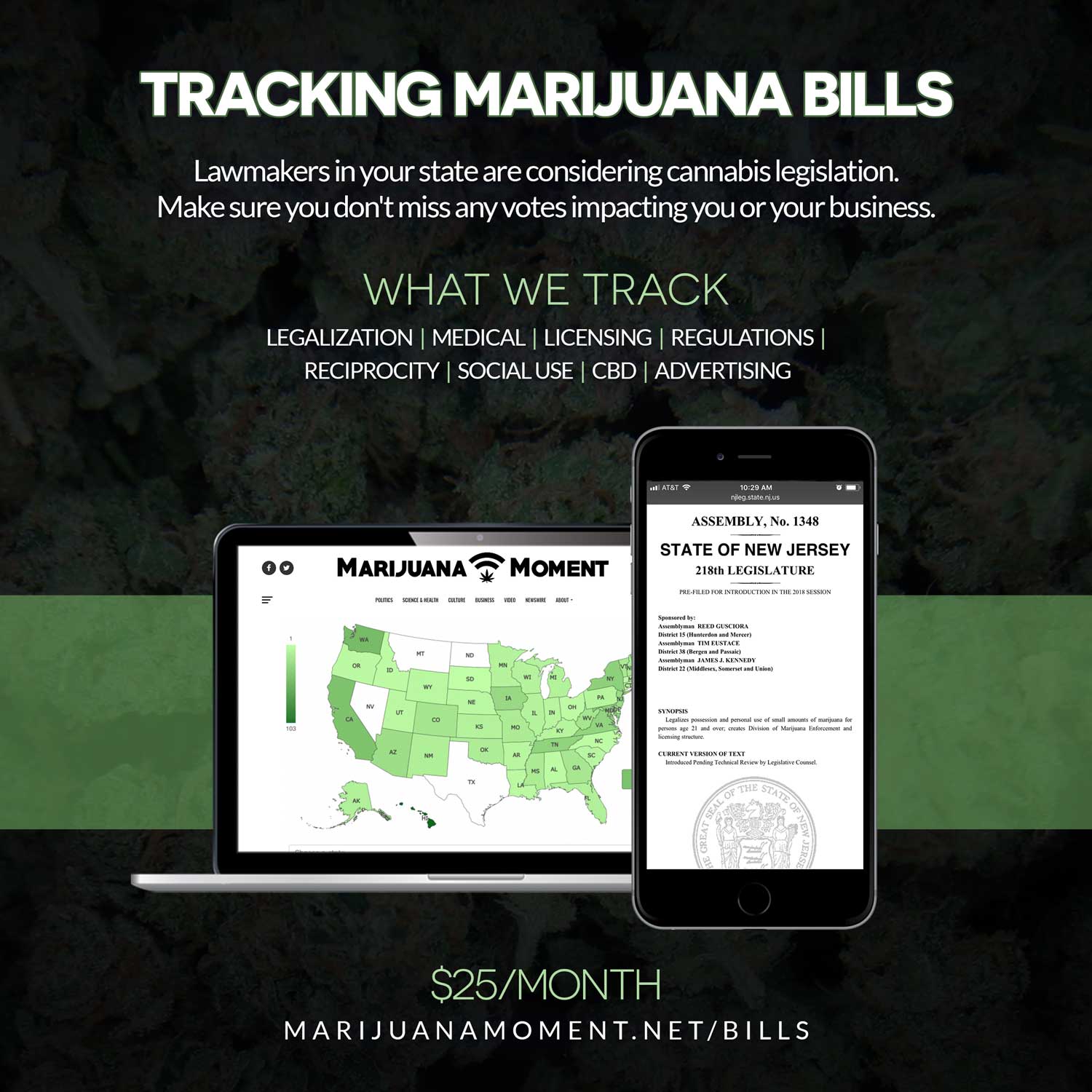
Learn more about our marijuana bill tracker and become a supporter on Patreon to get access.
—
The proposal specifies that its provisions do not effect authorities under the Controlled Substances Act (CSA), “including the scheduling of a controlled substance or any requirement or prohibition with respect to such scheduling.”
The bill, H. R. 9913, has been referred to the Energy and Commerce Committee and Ways and Means Committee.
Its introduction comes as several other pieces of legislation are being considered to prevent the scheduled federal recriminalization of hemp THC drinks and other products later this year.
That includes a new key spending bill unveiled by Senate Appropriations Committee leaders on Sunday that has provisions to delay the new prohibition on many, but not all, hemp THC products.
Hemp derivatives with less than 0.3 percent delta-9 THC on a dry-weight basis were federally legalized under the 2018 Farm Bill that President Donald Trump signed during his first term in office. But late last year, the president signed new legislation containing provisions that will redefine hemp to make it so only products with 0.4 milligrams of total THC per container will remain legal after November 12.
Bipartisan lawmakers in the House and the Senate have introduced or are informally circulating various proposal to delay, alter or prevent the forthcoming ban, and the White House has also called for reforms on the issue.