Science & Health
Teen Marijuana Use Continues To Decline As More States Legalize It For Adults, Federal Study Shows

Opponents of marijuana legalization often argue that allowing adults to consume cannabis without punishment will cause more underage teens to use it—but that isn’t what is happening, according to the latest results of a new federal drug survey.
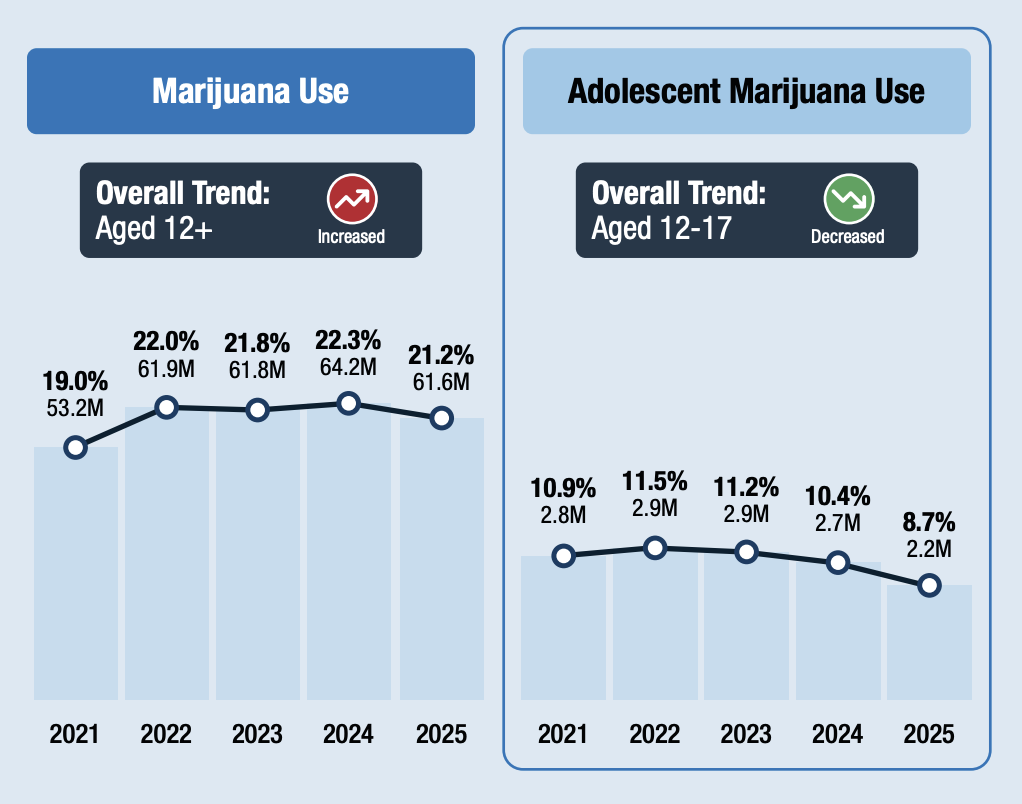
The 2025 National Survey on Drug Use and Health (NSDUH), released on Monday, shows that 8.7 percent of people between the ages of 12 and 17 use marijuana within the past year.
That’s down from 14.2 percent in 2011, the year before the first U.S. states legalized recreational cannabis.
Although politicians and organizations that oppose ending marijuana prohibition have warned that the reform would lead to skyrocketing teen use, that hasn’t occurred.
In fact, teen marijuana use has declined—dropping considerably over the last several years even as use by adults has risen.
Via SAMHSA.
The new NSDUH report, published by the Substance Abuse and Mental Health Services Administration (SAMHSA), shows that marijuana was the most commonly consumed illicit drug, with more than a fifth of population over the age of 12 (21.2 percent) having used it within the past year.
That amounts to 61.6 million cannabis consumers, according to the federal government report, representing an increase from 2021, when 19 percent reported using cannabis in the past year.
Marijuana use in 2025 was highest among young adults between the ages of 18 and 25 (33.7 percent), followed by people 26 and older (20.6 percent).
The SAMSHA study shows similar results when measuring past-month use:
“Among people aged 12 or older, the percentage who used marijuana in the past month increased from 13.2 percent (or 37.0 million people) in 2021 to 15.1 percent (or 43.8 million people) in 2025. Among adults aged 26 or older, the percentage who used marijuana in the past month also increased from 2021 to 2025. However, the percentages among adolescents aged 12 to 17 and young adults aged 18 to 25 who used marijuana in the past month decreased from 2021 to 2025. For example, the percentage of adolescents who used marijuana in the past month decreased from 6.1 percent (or 1.6 million people) in 2021 to 5.0 percent (or 1.3 million people) in 2025.”
To reform advocates, the results of the survey reinforce the idea that creating a regulatory framework for cannabis where licensed retailers must check IDs and implement other security mechanisms to prevent unlawful diversion is a far more effective policy than prohibition, with illicit suppliers whose products may be untested and where age-gating isn’t a strictly enforced regulation.
SAMHSA Principal Deputy Assistant Secretary Christopher D. Carroll said in a press release that “building on encouraging trends first reported in the 2024 NSDUH, in 2025, adolescents aged 12 to 17 and young adults aged 18 to 25 continued to show downward or stable trends in most behavioral health indicators over the past five years.”
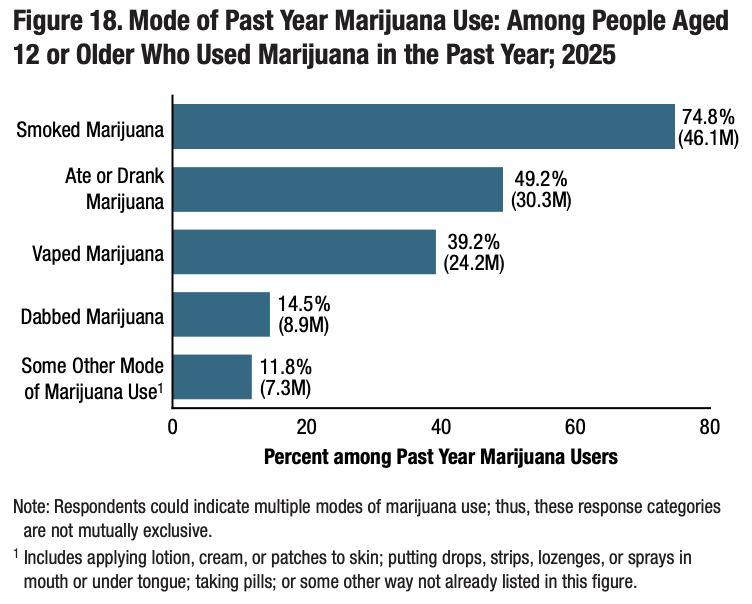
The federal survey also looks at the methods by which people are consuming cannabis, finding that smoking was the most common, (74.8 percent or 46.1 million people), followed by eating or drinking (49.2 percent or 30.3 million people), vaping (39.2 percent or 24.2 million people) and dabbing waxes, shatter, or concentrates (14.5 percent or 8.9 million people).
Via SAMHSA.
Prior research also suggests that marijuana use by young people has generally fallen in states that legalize it for adults.
A report from the advocacy group Marijuana Policy Project (MPP), for example, found that youth marijuana use declined in 19 out of 21 states that legalized adult-use marijuana—with teen cannabis consumption down an average of 35 percent in the earliest states to legalize.
The report cited data from a series of national and state-level youth surveys, including the annual Monitoring the Future (MTF) Survey, which is supported by the National Institute on Drug Abuse (NIDA).
The latest version of MTF, released late last year, found that cannabis use among eighth, 10th and 12 graders “remained stable” even as mort states enacted legalization.
Another survey from the U.S. Centers for Disease Control and Prevention (CDC) also showed a decline in the proportion of high-school students reporting past-month marijuana use over the past decade, as dozens of states moved to legalize cannabis.
A separate federally funded study out of Canada found that that youth marijuana use rates declined after the country legalized cannabis.
A Canadian government report similarly found that daily or near-daily use rates by both adults and youth have held steady over the last six years after the country enacted legalization.
Another U.S. study reported a “significant decrease” in youth marijuana use from 2011 to 2021—a period in which more than a dozen states legalized marijuana for adults—detailing lower rates of both lifetime and past-month use by high-school students nationwide.
Separately, a research letter published by the Journal of the American Medical Association (JAMA) in 2024 said there’s no evidence that states’ adoption of laws to legalize and regulate marijuana for adults have led to an increase in youth use of cannabis.
Another JAMA-published study similarly found that neither legalization nor the opening of retail stores led to increases in youth cannabis use.
In 2023, meanwhile, a U.S. health official said that teen marijuana use has not increased “even as state legalization has proliferated across the country.”