Politics
More Than 200,000 People Were Arrested For Marijuana Possession In The U.S. Last Year, FBI Data Shows

More than 200,000 people were arrested for possessing marijuana in the U.S. last year, according to the FBI’s latest annual crime report, and another 17,000 were booked for allegedly selling or growing cannabis.
Those figures likely understate the true number of people busted for marijuana, however, given inconsistencies in the federal data and questions about the agency’s changing methodology from recent years, as well as the fact that about 13 percent of state and local law enforcement agencies did not contribute data for 2025.
The full 2025 data set is based on more than 13 million criminal offenses reported to the Uniform Crime Reporting (UCR) Program, which is used to document and analyze national crime trends. The report covers 96,2 percent of the U.S. population, FBI said.
This latest data shows that cannabis-related offenses increased year over year, jumping to 200,960 marijuana possession busts in 2025 from 187,792 in the year prior, and to 17,192 sales or manufacturing arrests from 16,244 in 2024.
All told, marijuana busts accounted for a quarter of all drug arrests in 2025—more than for any other specifically listed substance—with 92 percent of cannabis incidents stemming from possession alone.
Despite the uptick in marijuana arrests from 2024 to 2025, advocates note that busts have been trending overall downward in recent years, which they attribute largely to the success of the expanding state-level legalization movement.
“While the number of marijuana-related arrests has trended downward for the better part of the past decade, in large part due to 24 states legalizing and regulating cannabis for adults, it is clear that marijuana-related prosecutions still remain a primary driver of drug war enforcement in the United States,” Paul Armentano, deputy director for NORML, said. “Hundreds of thousands of Americans continue to be arrested annually for low-level cannabis-related violations even though a majority of voters no longer believe that the responsible use of marijuana by adults should be a crime.”
“The criminalization of cannabis and the prosecution of those who possess it and consume it is a terribly destructive policy that disrupts lives and has lasting consequences,” he said. “Low-level marijuana offenders, many of them younger, poor and people of color, should not be saddled with an arrest, a criminal record and with the lifelong penalties and stigma associated with it for engaging in behavior that is legally regulated in nearly half the states in this country.”
Because not all agencies provide complete data for the reporting periods, FBI has explained that the bureau calculates estimated crime numbers, essentially extrapolating “by following a standard estimation procedure using the data provided.” In terms of total reported arrests for a category labelled “drug/narcotic,” for example, FBI said there were 858,852 arrests.
At the same time, frustrations over FBI’s inconsistent data reporting on cannabis and other drug arrest trends have persisted. Various sections of the report provide different numbers for seemingly similar categories of offenses.
One FBI table says that there were 1,492,005 “Drug/Narcotic Offenses” in 2025. Another uses the figure for 1,656,774 under the same heading. A third puts the total at 1,958,377.
Another section says there were 845,031 arrests for drug abuse violations in 2025, accounting for about 11 percent of the approximately 7.5 million estimated arrests nationwide. Other FBI tables say, inconsistently, that there were 754,497 or 768,170 drug abuse violations in 2025.
The FBI data also attempts to show trends over time, indicating that there were 1,157,129 drug offenses charged in 2016 and 645,512 drug offenses charged in 2025—a reduction of about 44 percent, though it’s not clear how much of the change is due to the agency’s shifting methodology for reporting arrests and how much is due to actual changes in enforcement practices and state drug laws over the past decade.
In terms of controlled substances seized in 2024, the agency said were 408,688 marijuana seizures and 5,378 hashish seizures out of 1,122,990 total drug seizures, representing about 37 percent of enforcement actions.
FBI’s arrest data is widely relied on by lawmakers, researchers and media to understand and contextualize law enforcement trends. Any inconsistencies influence not just the public’s understanding of crime and law enforcement, but also potentially how policy is crafted and implemented.
Apparent errors in FBI marijuana were pointed out to the bureau in May 2022, when a longtime drug reformer and former congressional staffer, Eric Sterling, claimed to have discovered that a Maryland police department was reporting cannabis possession citations issued under the state’s decriminalization law at the time as arrests as part of a data-sharing partnership with FBI.
Since other state and local law enforcement agencies appear to not be reporting cannabis citations as arrests, Sterling reasoned, the inconsistent practice could significantly alter FBI’s annual reports—making it harder to draw reasonable policy conclusions from the data.
In 2023—about 14 months after Sterling sent the inquiry—the office finally replied. Rather than address the apparent problem, however, the Department of Justice’s (DOJ) Office of the Inspector General’s investigations division said it had “determined that the matters that you raised are more appropriate for review by another office within the DOJ” and referred the inquiry to FBI’s own inspection division.
FBI’s cannabis enforcement reporting is also compromised by the fact that local and state police are not required to share data to inform the agency’s annual report, meaning it offers an incomplete overview of national law enforcement activities. The agency itself says that certain data may not be comparable to previous years because of different levels of participation over time.
—
Marijuana Moment is tracking hundreds of cannabis, psychedelics and drug policy bills in state legislatures and Congress this year. Patreon supporters pledging at least $25/month get access to our interactive maps, charts and hearing calendar so they don’t miss any developments.
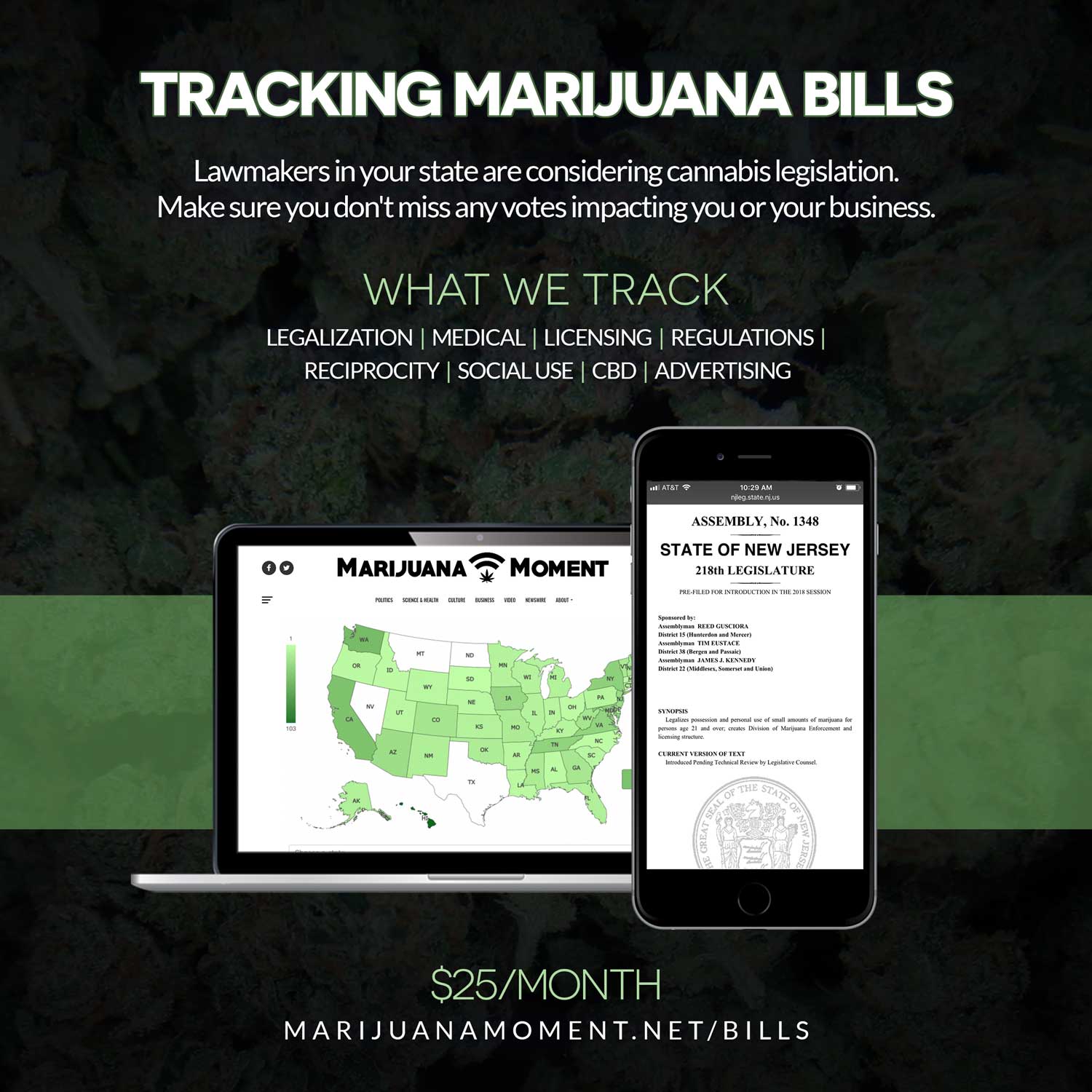
Learn more about our marijuana bill tracker and become a supporter on Patreon to get access.
—
The new FBI arrest data comes at the Trump administration is moving forward with the process of federally rescheduling marijuana.
Attorney General Todd Blanche in April issued an order that immediately reclassified state-licensed medical cannabis, as well as marijuana products approved by the Food and Drug Administration (FDA) from Schedule I of the Controlled Substances Act (CSA) to Schedule III.
Under a separate order the acting attorney general signed, a hearing is considering more comprehensively moving marijuana to Schedule III.
The Drug Enforcement Administration (DEA), which is charged with defending the proposed rescheduling move, said in its final brief filed last week that “marijuana no longer fits the statutory requirements for Schedule I because it has a currently accepted medical use within the United States and it has an accepted safety for its use under medical supervision.”
The agency noted that under the law it must give “significant deference” to an “extensive ten-month study on the scientific and medical properties” of cannabis conducted by the Department of Health and Human Services (HHS), which recommended rescheduling.
“Currently there are over 30,000 practitioners treating more than six million patients in 43 U.S. jurisdictions,” DEA said. “Such practices demonstrate that there is no longer a lack of accepted safety for use of marijuana under medical supervision, and as such, marijuana does not fulfill the requirements of being a Schedule I substance.”
It also said that there is “substantial evidence sufficient to show that marijuana’s abuse and dependency profiles better align with Schedule III substances than Schedule II” or Schedule I. “The vast majority of individuals who use marijuana do so in a manner that does not result in dangers to themselves or to their communities.”
In conclusion, DEA asked the judge overseeing the hearing to “expeditiously recommend” that marijuana be transferred from Schedule I to Schedule III.