Politics
House Votes To Let Military Veterans Get Medical Marijuana Recommendations From VA Doctors

The U.S. House of Representatives has voted to let military veterans receive recommendations for medical marijuana through their doctors at the Department of Veterans Affairs (VA)—while also approving a separate amendment focused on the therapeutic benefits of psychedelics.
The cannabis proposal from Reps. Brian Mast (R-FL), Dave Joyce (R-OH) and Dina Titus (D-NV) passed by a voice vote on Thursday.
If enacted into law, the amendment would prevent VA from enforcing a longstanding directive that has blocked its providers from assisting veterans with registering for state medical cannabis programs.
Under current policy, VA doctors can discuss marijuana use with their patients, but they cannot fill out forms to help them actually get legal access to cannabis. As a result, veterans need to seek outside, often expensive, services from separate providers instead of being able to get assistance from their own doctors at VA.
That would change under the new amendment from the co-chairs of the Congressional Cannabis Caucus, which is now attached to the Fiscal Year 2027 Military Construction, Veterans Affairs, and Related Agencies Appropriations Act.
Mast, himself a military veteran who lost two legs during combat in Afghanistan, said on the floor ahead of the vote that medical cannabis programs “exist in a lot of states.”
“And if former members of the military have doctors that they are seeing inside of the Department of Veterans Affairs, and if there’s a treatment option that they want to be considered, they want to know if it’s right for them, if it’s not right for them, if it doesn’t fit in good with other prescriptions that they have, you name it,” he said. “If they want to discuss it, they have to be able to discuss it with their doctor. That is the most important person for them to discuss it with, is their doctor.”
“Whether the doctor says, ‘hey, it’s good or bad,’ that’s that’s up to the doctor to decide, but they have to be able to have that conversation,” Mast said.
“I tell people often, I was in Afghanistan, lost two legs and a finger there. When I woke up in the hospital, I woke up on antidepressants, anti inflammatories, heavy sleep sedatives, a host of narcotic pain killers…and I weaned myself off of those things very quickly. That is not the case for all of my brothers and sisters. A lot of these narcotics that people are on and get placed on, especially after injuries are serious and very difficult to get off of, and leave long term, long term, lasting effects on them. There’s got to be an ability, again, for people inside the system to have that conversation with their doctor about whether that’s right.”
Titus said that “cannabis is proven to help with a wide variety of medical issues that veterans face, including pain management, PTSD and opioid addiction.”
“Instead of self-medicating and going outside the VA system, the veterans should be able to speak with a doctor honestly about what their options are,” she said. “Our veterans deserve the best health care they can get, and should not be left behind because the federal government lags behind the states. They need to hear their options and make their choices.”
Joyce said that the amendment “is about ensuring veterans are not denied access to treatment options that may improve their quality of life. ”
“Do you want them getting advice from doctors or budtenders?” he asked. “Simple question.”
“Many of our service members return home bearing invisible wounds that last long after the battlefield,” Joyce said. “Chronic pain, PTSD, traumatic brain injuries, depression and other service-connected conditions that ca, profoundly affect the quality of their lives. Some veterans’ traditional treatments have not worked. Others are searching for alternatives that may help manage pain, improve daily functioning or reduce reliance on highly addictive opioids.”
The veterans medical marijuana amendment reads:
“SEC. __. None of the funds appropriated or otherwise made available to the Department of Veterans Affairs in this Act may be used to enforce Veterans Health Directive 1315 as it relates to—
(1) the policy stating that ‘VHA providers are prohibited from completing forms or registering Veterans for participation in a State-approved marijuana program’;
(2) the directive for the ‘Deputy Under Secretary for Health for Operations and Management’ to ensure that ‘medical facility Directors are aware that it is VHA policy for providers to assess Veteran use of marijuana but providers are prohibited from recommending, making referrals to or completing paperwork for Veteran participation in State marijuana programs’; and
(3) the directive for the ‘VA Medical Facility Director’ to ensure that ‘VA facility staff are aware of the following’ ‘[t]he prohibition on recommending, making referrals to or completing forms and registering Veterans for participation in State-approved marijuana programs.'”
While similar proposals on veterans’ medical marijuana access have been passed by both the House of Representatives and Senate in past years, they have never been enacted into law.
Last year, when the House- and Senate-passed language was left out of the final bill sent to President Donald Trump, Mast told Marijuana Moment that the exclusion was “ridiculous.”
“It was a great and easy opportunity to do so, and a sensical thing to move forward—and detrimental to veterans to not do so,” he said.
—
Marijuana Moment is tracking hundreds of cannabis, psychedelics and drug policy bills in state legislatures and Congress this year. Patreon supporters pledging at least $25/month get access to our interactive maps, charts and hearing calendar so they don’t miss any developments.
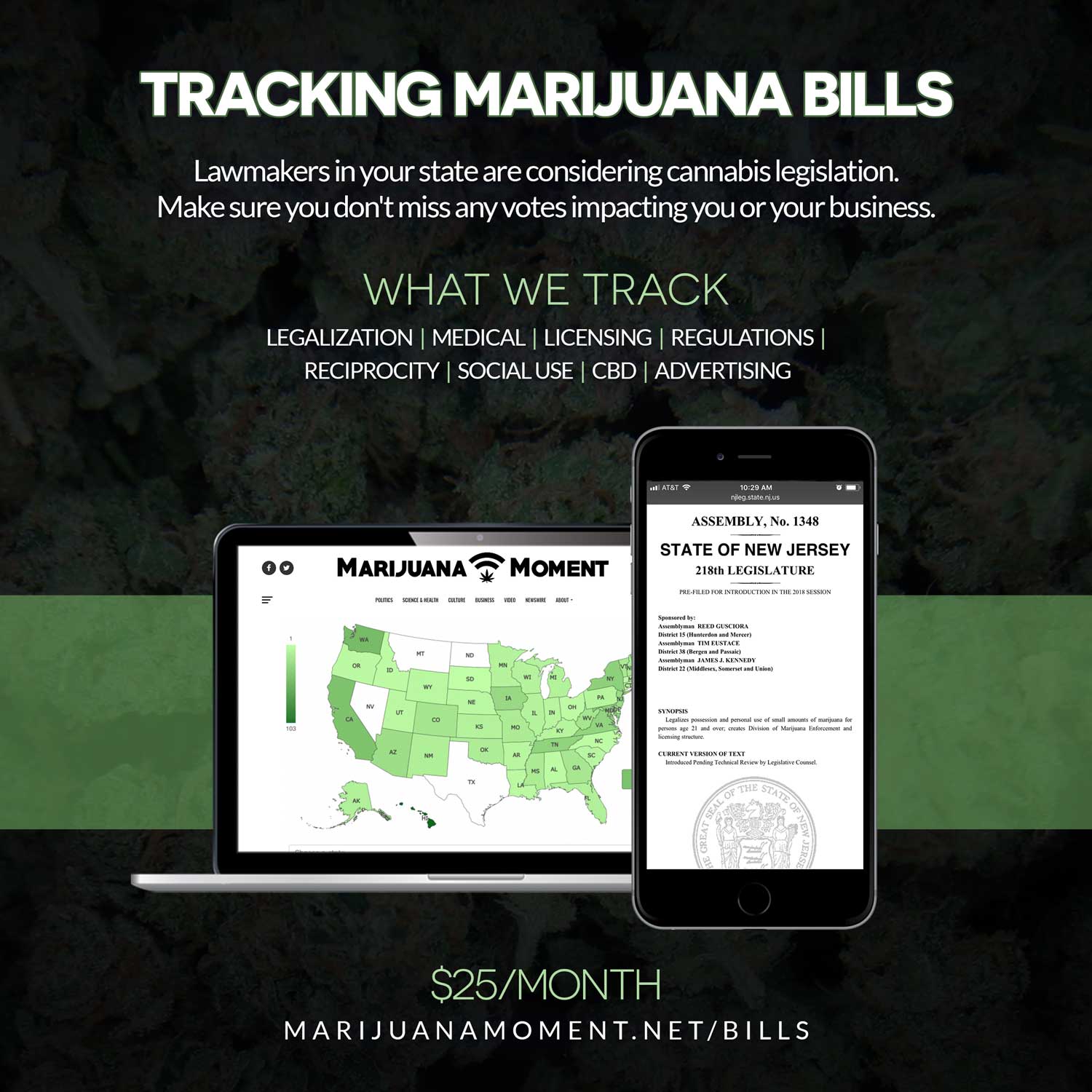
Learn more about our marijuana bill tracker and become a supporter on Patreon to get access.
—
The current amendment comes just weeks after medical marijuana was rescheduled under federal law by the Trump administration, a major policy and political development that advocates hope could boost the chances of the veterans-focused reform being enacted this year.
A separate amendment to the military and veterans spending bill that was also approved on the floor in a voice vote on Thursday seeks to raise awareness about the benefits of psychedelic and other therapies for military veterans.
Sponsored by Reps. Lou Correa (D-CA) and Jack Bergman (R-MI), who co-chair the Congressional Psychedelics Advancing Therapies Caucus, the amendment’s description says it “increases and decreases funding for the Medical and Prosthetic Research account at the Department of Veterans Affairs to emphasize the importance of the Department’s research on areas benefiting veterans such as oncology, traumatic brain injury care, psychedelic therapies, and assistive devices.”
Correa noted ahead of the vote that President Donald Trump last month “signed an executive order to expedite psychedelic therapy research for depression and substance abuse disorder, specifically for veterans.”
“This amendment is basically about taking care of those that have answered the call of duty to defend our country—those individuals have come back from combat with invisible wounds they still have not healed,” he said.
“On a daily basis, 20 to 40 veterans take their lives commit suicide because of PTSD,” Correa said. “Many veterans have taken this treatment, and essentially been cured of PTSD… This is about treating our veterans’ invisible wounds.”
Meanwhile in Congress, the House Appropriations Committee approved a bill this week containing provisions that would block Department of Justice officials from taking further steps to reschedule cannabis while continuing to protect state medical marijuana laws from federal interference.
A report attached to that legislation also directs federal officials to take enforcement action against unregulated cannabinoid products that “threaten consumer safety.”
Separately, that panel recently approved another spending bill and an attached report that expresses concerns about health risks from cannabis-derived products, while also encouraging research into the therapeutic benefits of psychedelics.
The full House also recently passed a Farm Bill with provisions aimed at aiding industrial hemp producers—but without any language to delay or alter the federal recriminalization of hemp THC products that’s scheduled to take effect later this year.
A new report from the Congressional Research Service details the scope and limitations of the federal marijuana rescheduling move.