Politics
House Passes Bill To Delay Hemp THC Product Ban, Sending It To Trump’s Desk

The U.S. House of Representatives has passed a bill that contains provisions to delay the federal recriminalization of hemp THC products that is currently scheduled to take effect in November. The legislation, which has already been approved by the Senate, is intended to give lawmakers more time to craft regulations as an alternative to prohibition.
It now heads to President Donald Trump’s desk.
The provision is part of legislation, which cleared the House in a 370-48 vote on Tuesday, to keep the federal government funded through December 11—past the end of the current fiscal year on September 30. If enacted into law, the effective date of the hemp product ban would also be moved to December 11.
The Senate last month rejected an amendment from Sen. Ted Budd (R-NC) and several cosponsors that would have removed the hemp ban delay provision from the funding bill, tabling it in a vote of 61-32, and the passing the overall legislation 90-6.
Hemp derivatives with less than 0.3 percent delta-9 THC on a dry-weight basis were federally legalized under the 2018 Farm Bill that President Donald Trump signed during his first term in office. But late last year, the president signed new legislation containing provisions that will redefine hemp to make it so only products with 0.4 milligrams of total THC per container will remain legal after November 12.
The funding bill’s provision to delay the ban, which is supported by the White House, contains a carve-out to allow the immediate recriminalization on November 12 of synthetic cannabinoids “that are not capable of being naturally produced by a Cannabis sativa L. plant.”
Rep. Jim Baird (R-IN), who has sponsored standalone legislation to delay the scheduled hemp ban, said he is “proud to also see a priority of mine included” in the funding bill.
“This short extension of the current hemp definition will provide Congress and farmers the time needed to develop a long-term solution.,” he said in a press release. “Producers deserve as much certainty as possible in deciding what to plant. Farmers should have the freedom to plant the crops that best serve their operations and profits.”
Centers for Medicare and Medicaid Services Director Mehmet Oz sent a letter to senators expressing “grave concern” that the amendment to remove the delay would undermine the administration’s initiative to cover hemp-derived products through Medicare.
Separately, the White House pushed back on the idea that the president’s support for keeping hemp products legal is intended to benefit the son-in-law of Trump’s chief of staff, who owns businesses in the industry—with a spokesperson saying that the administration’s advocacy is in “the best interest of the American people” and is aimed at helping veterans and other people who use hemp products for medical purposes.
During a “tense” meeting with Senate Republicans about the issue, White House Director of Legislative Affairs James Braid reportedly committed that there would be no further extensions of the hemp ban’s effective date if the current proposal was enacted into law, though it was reported soon after that the staffer would be leaving the administration in September.
Jonathan Miller, general counsel for the U.S. Hemp Roundtable, said on Tuesday that the industry is “grateful to the president and large bipartisan majorities in Congress for the lifeline of a 30-day extension.”
“Now the important work comes: passing in December robust regulation that cracks down on illicit sales to minors, honors our commitments to farmers and ensures that safe hemp and CBD products are manufactured for adults, particularly seniors and veterans who rely on them for their health and wellness,” he said.
Jim Higdon, co-founder and chief communications officer for Cornbread Hemp, said that “one month is not much time.”
“Still, it gives us the chance to work on this issue after Election Day to build a long-needed regulatory framework that preserves interstate commerce for low-dose hemp THC beverages and full-spectrum CBD products, including the 3-milligram-per-serving THC standard for CBD products already established under the CMS Medicare pilot,” he said. “This hemp extension ends the debate over whether low-dose hemp products should be regulated or subject to re-criminalization. The work now is to write the regulations for full spectrum CBD, topical and pet products, and low-dose THC beverages sold to American consumers in interstate commerce.”
But Chris Lindsey, vice president of policy and state advocacy, for the American Trade Association for Cannabis and Hemp, said his group is “disappointed” in the delay, even if it was expected.
“Our sights are set on December,” he said. “The loophole empowers bad actors, threatens public health, and undermines state regulations. We urge Congress to end the scourge of ‘gas station weed.'”
Dueling coalitions of police, military veterans and industry groups sent letters pushing Congress in different directions on whether the planned federal recriminalization of hemp THC products should move forward as scheduled or be delayed.
Additionally, a bipartisan coalition of 35 state and territory attorneys general sent a letter calling on Congress not to reverse the hemp THC product ban, saying that lawmakers’ move to enact the forthcoming prohibition “protected consumers, provided much-needed regulatory clarity, and preserved legitimate industrial, agricultural, and nonintoxicating hemp markets.”
The Beverage Alcohol Merchants Coalition (BAMCO), which represents major alcohol retailers, is supporting the move to delay the hemp product ban—saying it provides industry supporters with more time to convince Congress to “establish a responsible federal framework for low-dose hemp-derived THC beverages.”
BAMCO’s members include Total Wine & More, BevMo! by Gopuff, ABC Fine Wine & Spirits, Spec’s Wine and Spirits & Finer Foods, as well as a group of hemp product wholesalers. The group supports incorporating hemp THC drinks into the existing three-tier system for alcoholic beverages, along with new requirements for testing, labeling, marketing and taxation in tandem with flexibility for state regulations.
Other alcohol industry groups such as Wine & Spirits Wholesalers of America have also backed regulating hemp products instead of prohibiting them.
A number of lawmakers from both chambers and both parties have filed or are circulating a growing number of bills to prevent the scheduled federal recriminalization of hemp THC drinks and other products later this year. Until now, none of those proposals have gained traction with congressional leaders.
For example, Reps. Beth Van Duyne (R-TX) and Greg Landsman (D-OH) filed a bill to keep hemp THC drinks legal while taxing and regulating them like alcohol.
Rep. James Comer (R-KY), who chairs the House Oversight and Government Reform Committee, is circulating legislation that would delay a planned federal ban on hemp THC products and institute some regulations—including packaging requirements, testing rules and age limits.
Separately, Rep. Andy Barr (R-KY), filed a lengthier proposal to prevent the federal recriminalization of hemp THC products and put in place a number of regulations for manufacturing, labeling, sales and taxation of hemp-derived products, including an age limit of 21.
Trump and White House officials have in recent weeks repeatedly pressed Congress to delay, alter or reverse the ban.
In a letter to House Speaker Mike Johnson (R-LA) in June, for example, White House Office of Management and Budget (OMB) Director Russell Vought said the Trump administration wants lawmakers to “ensure the fair treatment of hemp products”—specifically citing Barr’s earlier amendment to keep many hemp products legal while adding regulations and taxes.
The administration “welcomes the opportunity to work with the Congress to, at a minimum, update the statutory definition of final hemp-derived cannabinoid products to allow Americans to benefit from access to appropriate full-spectrum CBD products,” OMB separately said in June, “while preserving the Congress’s intent to restrict the sale of products that pose serious health risks.”
Also in April, the president himself urged congressional lawmakers to again redefine hemp to avoid recriminalization of full-spectrum CBD products.
“I am calling on Congress to update the Law to ensure that Americans can continue to access the full-spectrum CBD products they have come to rely on, and that help them, while preserving Congress’s intent to restrict the sale of products that pose Health risks,” Trump said in a Truth Social post.
“We must get this done RIGHT and FAST, especially for those who saw that CBD helps them,” he said. “Plus, I am told it will also help our GREAT FARMERS, who we love, and will always be there for.”
Industry advocates say that the law as enacted last year not only threatens to prohibit intoxicating and synthetic cannabinoid products but also stands to remove popular full-spectrum CBD products that many Americans use therapeutically from the market.
“ONE in FIVE adults used it in the past year, and many say it improved their chronic pain enormously,” the president said in his social media post, adding that hemp-derived CBD “has made a HUGE difference for so many people.”
He also referenced a new initiative the administration launched in April to cover up to $500 worth of hemp-derived products each year for eligible Medicare patients. The program being implemented by the Centers for Medicare & Medicaid Services (CMS) focuses largely on CBD but also allows products to have up to 3 milligrams of total THC per serving. A federal judge granted the government’s motion to dismiss marijuana legalization opponents’ lawsuit challenging the initiative, but that is being appealed.
“In December, I signed a very important Executive Order calling for Research and Innovation for Hemp-derived CBD,” Trump said. “Our wonderful Dr. Mehmet Oz moved fast to follow the directive in the Executive Order, and launched a model for some Seniors earlier this month. But more must be done!”
“Please get it done, and SOON,” the president said in reference to a congressional fix for the broad recriminalization set to take effect in November. “Thank you for your attention to this matter!”
The Wine & Spirits Wholesalers of America (WSWA), an alcohol industry trade association issued praise for Barr’s bipartisan hemp regulation bill, but said the measure’s tax provisions require “continued discussion.”
Hemp policy observers expect to see a Senate companion bill to Barr’s proposal filed soon, likely from Sens. Tim Sheehy (R-MT) and Amy Klobuchar (D-MN).
Sheehy recently cited hemp legislation as an area where Republicans and Democrats can work together in an otherwise “hyperpartisan time.”
—
Marijuana Moment is tracking hundreds of cannabis, psychedelics and drug policy bills in state legislatures and Congress this year. Patreon supporters pledging at least $25/month get access to our interactive maps, charts and hearing calendar so they don’t miss any developments.
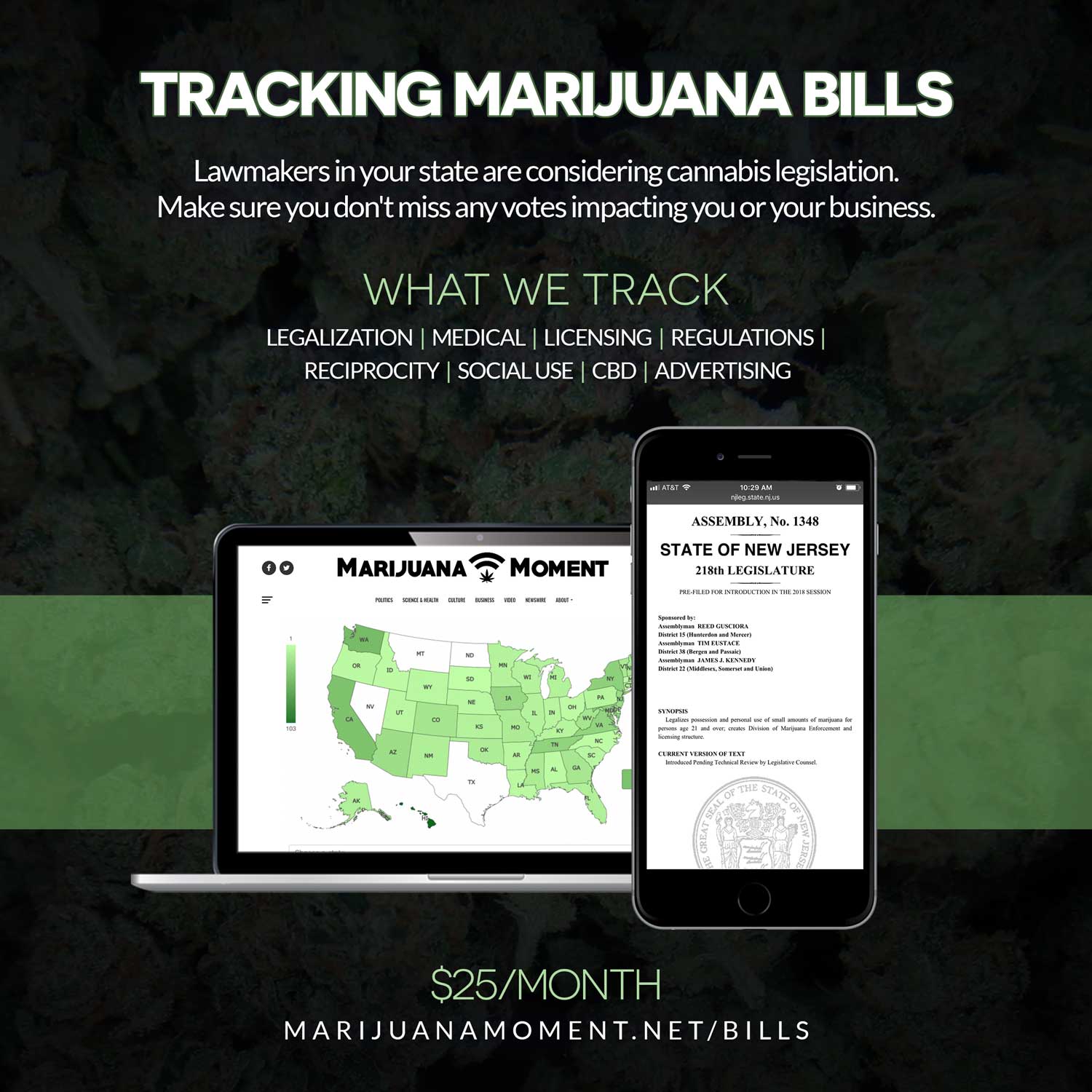
Learn more about our marijuana bill tracker and become a supporter on Patreon to get access.
—
Meanwhile, a new poll from NuggMD found that most cannabis consumers say that state-level hemp product bans that lawmakers are enacting in line with the planned federal recriminalization move are causing them to shift their purchases toward licensed marijuana businesses.
The National Restaurant Association recently sent a letter urging congressional leaders to delay the federal recriminalization of hemp THC beverages and replace it with a regulatory framework that “ensures consumer safety while meeting growing market demand” for the products as an alternative to alcohol.
Major retailer Target, meanwhile, recently moved to expand its sales of hemp THC drinks into more states.