Politics
GOP Senators Argue That Hemp Product Ban Should Take Effect As Scheduled, Raising Alarm About Kids’ Access To THC

A pair of Republican lawmakers took to the Senate floor on Wednesday to urge their colleagues not to delay the federal recriminalization of hemp THC products that is currently scheduled for November.
Sen. Ted Budd (R-NC) said the widespread availability of intoxicating hemp products in states across the country is a “public health crisis” that threatens the lives of children, harms the workforce and undermines military readiness.
“The intoxicating hemp industry wants to make a cheap dollar,” the senator said. “I am appalled at the well-oiled, slick lobbying machine, which is very well connected in this town, by the way, that has chosen to wage this surreptitious war against our efforts to protect American children.”
Hemp derivatives with less than 0.3 percent delta-9 THC on a dry-weight basis were federally legalized under the 2018 Farm Bill that President Donald Trump signed during his first term in office. But late last year, the president signed new legislation containing provisions that will redefine hemp to make it so only products with 0.4 milligrams of total THC per container will remain legal after November 12.
Leaders of the Senate Appropriations Committee recently released the text of a continuing resolution to extend funding for federal agencies through December 11, past the end of the current fiscal year on September 30. Included in the legislation are provisions that will also delay the planned prohibition on most hemp products until December 11—although there is a carve-out that will allow the immediately recriminalization on November 12 of synthetic cannabinoids “that are not capable of being naturally produced by a Cannabis sativa L. plant.”
While the White House supports the delayed ban on THC products, Budd and several GOP cosponsors filed an amendment that seeks to strip those hemp provisions out of the bill and keep the planned prohibition on schedule.
Dispute over the amendment has threatened to hold up passage of the funding bill, potentially delaying senators from leaving town this week for their August recess as hoped.
“I’m not here to obstruct the Senate for the sake of obstruction. I’m here because I have a duty to the millions of parents in North Carolina who have sent me to Washington to be their voice, and above all, to protect their children,” he said. “I’m not going to back down, and I’m not going to stop fighting until we get this right. This is a public health health crisis that deserves this Senate’s immediate attention.
“Our children should never be the testing ground for an industry willing to exploit a loophole in federal law for profit. We need to strip this amendment from the continuing resolution and regulate these harmful substances for exactly what they are, not what the industry wants to call them.”
Budd displayed posters showing THC-infused products meant to mimic major brands like Oreos and Skittles, saying that “the packaging is unmistakably designed to appeal to kids because they use bright colors.”
“You know this this is not some innocent coincidence. You don’t accidentally create packaging for an intoxicating substance that bears a strange resemblance to a recognizable brand,” he argued. “You don’t accidentally make an intoxicating product look something like a child would recognize from a grocery store shelf without reasonable intent. This is marketing by design, and it’s designed it’s designed to evade the law.”
The GOP senator said there are “horrifying consequences” of the products’ availability, claiming that he has met with families of children who have died after they “became addicted to these disguised substances.”
“There are young people who no longer walk this earth. They will never graduate. They will never go to college. They will never start a career. They will never get married. They will never have children, and they will never get the chance to experience the life that was ahead of them because these dangerous substances robbed them of their future.”
“THC can have very serious consequences for adults” as well, Budd said. “It can trigger psychosis, addiction, manic episodes, bipolar relapse, depression, anxiety, and suicidal ideation… It’s also impacting our workforce. Able-bodied adults—they’re unable to hold jobs that require them to take a drug test. Stores near military bases sell these products to men and women in the armed services, making them ineligible for military service.”
The senator said he is “willing to have a larger conversation about marijuana.”
“We may not agree, but I’ll have the conversation. But I want to make one thing really, really clear: making THC intoxicating substances readily accessible to our kids is an entirely different issue from the medical marijuana movement,” he said. “So, if substances cause intoxication like marijuana, then it should be regulated as such, not given a free pass as hemp. There is no loophole worth putting a child’s well-being at risk.”
“Let me be clear to my colleagues: I’m not going to back down on this. I’m not going to waver. I’m not going to stop until this life-threatening loophole is closed permanently. And we’re going to have this fight before the end of this Congress. And I can assure you that I’m not going to stop fighting to protect American children, and I’ve already had numerous conversations with the White House about this issue.”
Three sources with knowledge of discussions around the issue told Marijuana Moment that Trump personally called Budd this week in an attempt to get him to back off the push to keep the hemp ban on track for November, but a spokesperson for the senator later clarified that there was “not an explicit ask made to Sen. Budd to drop the amendment” by the president.
The spokesperson said that the hemp issue “certainly came up” during what he described as a “very friendly” discussion between Budd and Trump that also touched on number of other topics.
Separately on Wednesday, Sen. Pete Ricketts (R-NE), who is cosponsoring the amendment with Budd to keep the hemp product ban on schedule, also spoke about the issue on the Senate floor.
“We have a drug problem in this country today, and right now there is an industry that is targeting our children with look-alike products,” he said. “This is a serious health risk problem.”
“These high THC products, disguised as candy, could get into the hands of young children and poison them. It has done so already,” Ricketts said. “Let’s stop this right now, because we know know when THC gets into young people’s minds, it can reduce their IQs, lead to mental health issues such as suicidal ideation, anxiety, depression. This drug is bad for young people. So let’s close this loophole and keep it closed.”
Also this week, dueling coalitions of police, military veterans and industry groups sent letters pushing Congress in different directions on whether the planned federal recriminalization of hemp THC products should move forward as scheduled or be delayed.
A bipartisan coalition of 35 state and territory attorneys general sent a letter calling on Congress not to reverse the hemp THC product ban, saying that lawmakers’ move to enact the forthcoming prohibition “protected consumers, provided much-needed regulatory clarity, and preserved legitimate industrial, agricultural, and nonintoxicating hemp markets.”
In June, the House of Representatives passed its own version of a continuing resolution to keep federal agencies funded into December, but it did not have any provisions to alter the planned hemp product ban. As such, if the Senate passes its new provision it would then still need approval by the other chamber before being sent to the president.
Meanwhile, a number of lawmakers from both chambers and both parties have filed or are circulating a growing number of bills to prevent the scheduled federal recriminalization of hemp THC drinks and other products later this year. Until now, none of those proposals have gained traction with congressional leaders.
For example, Rep. James Comer (R-KY), who chairs the House Oversight and Government Reform Committee, is circulating legislation that would delay a planned federal ban on hemp THC products and institute some regulations—including packaging requirements, testing rules and age limits.
Separately, Rep. Andy Barr (R-KY), filed a lengthier proposal to prevent the federal recriminalization of hemp THC products and put in place a number of regulations for manufacturing, labeling, sales and taxation of hemp-derived products, including an age limit of 21.
A press release from the congressman’s office claimed that the White House supports the legislation, which is cosponsored by Rep. Angie Craig (D-MN), but the administration has not specifically endorsed it despite generally calling for hemp regulations and backing a prior similar amendment filed by Barr.
Trump and White House officials have in recent weeks repeatedly pressed Congress to delay, alter or reverse the ban.
In a letter to House Speaker Mike Johnson (R-LA) in June, for example, White House Office of Management and Budget (OMB) Director Russell Vought said the Trump administration wants lawmakers to “ensure the fair treatment of hemp products”—specifically citing Barr’s earlier amendment to keep many hemp products legal while adding regulations and taxes.
The administration “welcomes the opportunity to work with the Congress to, at a minimum, update the statutory definition of final hemp-derived cannabinoid products to allow Americans to benefit from access to appropriate full-spectrum CBD products,” OMB separately said in June, “while preserving the Congress’s intent to restrict the sale of products that pose serious health risks.”
Also in April, the president himself urged congressional lawmakers to again redefine hemp to avoid recriminalization of full-spectrum CBD products.
“I am calling on Congress to update the Law to ensure that Americans can continue to access the full-spectrum CBD products they have come to rely on, and that help them, while preserving Congress’s intent to restrict the sale of products that pose Health risks,” Trump said in a Truth Social post.
“We must get this done RIGHT and FAST, especially for those who saw that CBD helps them,” he said. “Plus, I am told it will also help our GREAT FARMERS, who we love, and will always be there for.”
Industry advocates say that the law as enacted last year not only threatens to prohibit intoxicating and synthetic cannabinoid products but also stands to remove popular full-spectrum CBD products that many Americans use therapeutically from the market.
“ONE in FIVE adults used it in the past year, and many say it improved their chronic pain enormously,” the president said in his social media post, adding that hemp-derived CBD “has made a HUGE difference for so many people.”
He also referenced a new initiative the administration launched in April to cover up to $500 worth of hemp-derived products each year for eligible Medicare patients. The program being implemented by the Centers for Medicare & Medicaid Services (CMS) focuses largely on CBD but also allows products to have up to 3 milligrams of total THC per serving. A federal judge granted the government’s motion to dismiss marijuana legalization opponents’ lawsuit challenging the initiative, but that is being appealed.
“In December, I signed a very important Executive Order calling for Research and Innovation for Hemp-derived CBD,” Trump said. “Our wonderful Dr. Mehmet Oz moved fast to follow the directive in the Executive Order, and launched a model for some Seniors earlier this month. But more must be done!”
“Please get it done, and SOON,” the president said in reference to a congressional fix for the broad recriminalization set to take effect in November. “Thank you for your attention to this matter!”
The Wine & Spirits Wholesalers of America (WSWA), an alcohol industry trade association issued praise for Barr’s bipartisan hemp regulation bill, but said the measure’s tax provisions require “continued discussion.”
Hemp policy observers expect to see a Senate companion bill to Barr’s proposal filed soon, likely from Sens. Tim Sheehy (R-MT) and Amy Klobuchar (D-MN).
Sheehy recently cited hemp legislation as an area where Republicans and Democrats can work together in an otherwise “hyperpartisan time.”
—
Marijuana Moment is tracking hundreds of cannabis, psychedelics and drug policy bills in state legislatures and Congress this year. Patreon supporters pledging at least $25/month get access to our interactive maps, charts and hearing calendar so they don’t miss any developments.
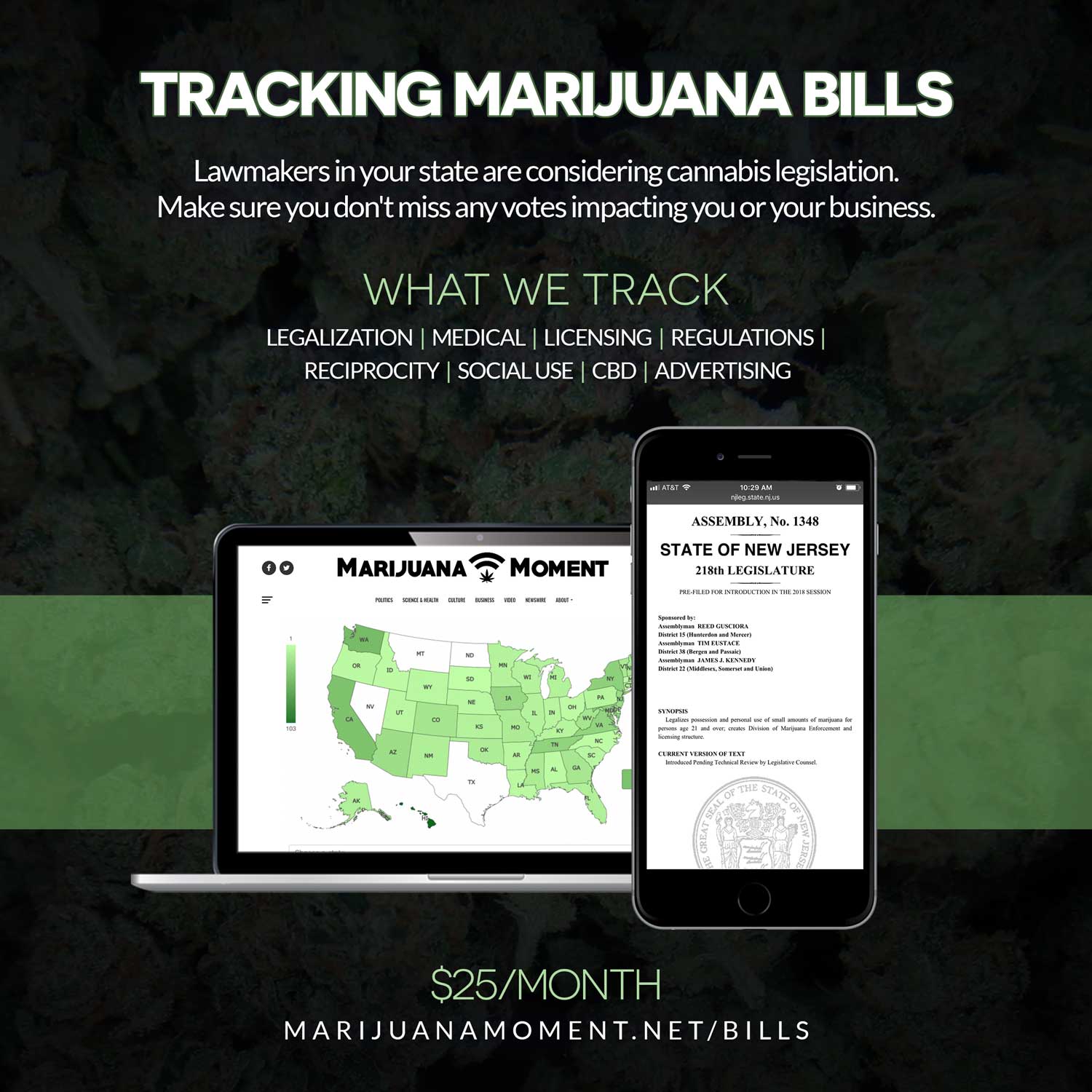
Learn more about our marijuana bill tracker and become a supporter on Patreon to get access.
—
Meanwhile, a new poll from NuggMD found that most cannabis consumers say that state-level hemp product bans that lawmakers are enacting in line with the planned federal recriminalization move are causing them to shift their purchases toward licensed marijuana businesses.
The National Restaurant Association recently sent a letter urging congressional leaders to delay the federal recriminalization of hemp THC beverages and replace it with a regulatory framework that “ensures consumer safety while meeting growing market demand” for the products as an alternative to alcohol.
Major retailer Target, meanwhile, recently moved to expand its sales of hemp THC drinks into more states.
Photo courtesy of Kimzy Nanney.