Politics
GOP Lawmakers And Anti-Marijuana Groups Want Rescheduling ‘Carve-Out’ To Codify THC Testing Rules For Safety-Sensitive Workers

Two GOP congressional lawmakers are joining prohibitionist organizations in their call for a “carve-out” to the Trump administration’s medical marijuana rescheduling action by affirming that safety-sensitive transportation workers could still be penalized for testing positive for THC.
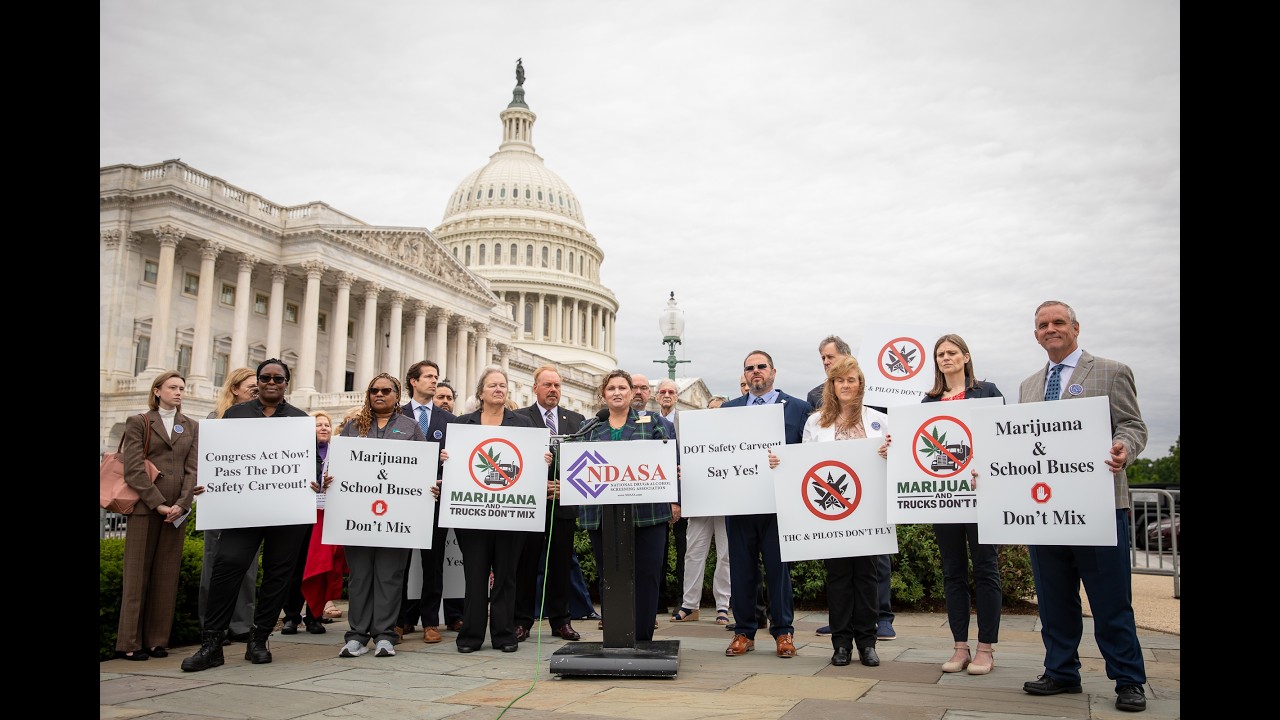
At a press conference outside the Capitol on Thursday, anti-cannabis Reps. Andy Harris (R-MD) and Pete Sessions (R-TX)—along with representatives of Smart Approaches to Marijuana (SAM) and the National Drug and Alcohol Screening Association (NDASA)—criticized the move to reclassify medical cannabis dispensed to patients under state laws as a Schedule III drug.
The congressmen and prohibitionist activists argued that the policy change means a 1986 executive order on the federal workforce that President Ronald Reagan signed defining illegal drugs as Schedule I and II drugs under the Controlled Substances Act (CSA) would be effectively nullified when it comes to marijuana use by truck drivers, airline pilots and other workers regulated by the U.S. Department of Transportation (DOT).
To that end, the lawmakers said they intend to introduce a bill to codify a “carve-out” to the rescheduling rule to ensure that DOT-certified drivers continue to be tested for cannabis. That’s despite the fact that DOT itself recently clarified that its drug testing policies are not affected by the Schedule III reclassification.
“Look, we understand there are a lot of Americans who feel that it’s perfectly all right to have medical marijuana—recreational marijuana—without realizing what the implications of that are,” Harris said on Thursday.
Rescheduling “will have to have some kind of testing guidelines to make certain that those people who function within the economy in safety-related professions” can be tested, he said. “The American public should be certain that that person is not under the influence of marijuana, because it slipped through a regulatory crack.”
“That’s in fact what we need to deal with,” he said. “Congress needs to make certain that, if and when marijuana is rescheduled, that we make certain we can test—and, again, this is to provide certainty to the American public that someone who is using marijuana is not operating something that makes the public unsafe. it’s just that simple.”
The congressman’s “if and when” aside alluded to the fact that rescheduling of marijuana beyond state-sanctioned medical cannabis will be evaluated under an expedited administrative hearing process beginning next month.
“I think the American public will agree that that’s a clear red line that needs to be drawn,” Harris said, thanking NDASA “for bringing this to the attention of the American people, because it is a critically important issue, and, again, I believe when the American public understands it, they will firmly stand with us to say, ‘No, this testing has to occur.'”
Prior to the administrative rescheduling action, Harris argued in December that the president didn’t have the authority to unilaterally reschedule marijuana via executive order. But while lawmakers could overrule any move to enact the reform, he still acknowledged that it would be a “heavy lift” in the Republican-controlled Congress.
Sessions, for his part, echoed his colleague’s points, asserting that the situation they’re raising “is more than just a red alert on behalf of public safety—it is a re-enunciation that marijuana is an addictive, dangerous product that impacts not only children but anyone who uses it.”
“The marijuana issue is not going to go away, because safety—safety for children, safety for women and safety for those who operate in public transportation area—are affected by this,” he said.
“Andy Harris and I have for many years spoken about not just the psychosis and the dangers to mental health, but we have spoken about the dangers of people who use it in their everyday lives,” Sessions said. “Today is more than a chance for us to say we need to make sure public safety is okay. We need to make sure that we impact federal law.”
“Too many states have moved forward on this issue and have thousands of people who are residents of their states who use marijuana on a regular basis, who interact with the public and who do so in a public way of public transportation—school busses, public busses that take place, and also trains and airplanes,” he said.
“I disagree with the reclassification. As Elton John said, our fascination in America with marijuana is one of the most disappointing things that he has ever seen America do. This fascination with marijuana, I think, is done to help support drug cartels and people who want to addict this country—not only our children, but the future of this country. It impacts employment, impacts workers and impacts our ability to think straight. So I’m pleased to be with you today and join in to make sure that the American people understand that Congress must act, must make sure that those people who are involved in public transportation…are included in the testing process.”
Again, while the congressmen and their allies remarked on the situation as if the rescheduling action is automatically upending DOT safety and drug testing guidelines, the department itself has affirmed that’s not the case.
“Marijuana use is not compatible with safety-sensitive functions,” the agency said in a notice this month. “Currently, there is no instance when [medical review officers] could verify a laboratory-confirmed marijuana positive drug test result as ‘negative’ when an employee claims the positive was caused by a State licensed marijuana product.”
Regardless, DOT’s former director of the Office of Drug & Alcohol Policy & Compliance, Patrice Kelly, also participated in the press conference to promote the call for a codified “safety carve-out,” arguing that the department’s “regulated testing for marijuana is about to end” with congressional intervention.
“The safety carve-out would also continue marijuana testing and deterrence for federal employees, such as air traffic controllers, such as those who carry guns and those who are entrusted with our national secrets through their security clearances,” Kelly said.
If the administration moves to fully reschedule marijuana, she said, “there is a solution for those of us who recognize what is happening—and for those of us who are not yet aware.”
“The solution is an immediate and clear safety carve-out that preserves the status quo by granting [the Department of Health and Human Services] authority to continue to test for and certify laboratories to test for marijuana,” Kelly said. “The safety carve-out also must preserve marijuana testing and, thereby, deterrence for federal employees—especially air traffic controllers and all commercial transportation safety-sensitive employees currently under the drug testing regulations of the U.S. DOT and the Coast Guard.”
“Transportation safety is a fundamental right of every person in this nation. Transportation safety impacts our rights to life, liberty and the pursuit of happiness. Transportation safety is a non-partisan issue. It is a necessity in urban, suburban and rural areas. Think of school busses, airline flights, ferry boats, liquid natural gas operators [and] tractor trailers on the roadway next to your car next time you drive on the highway… Please ask your congressional members and U.S. senators to support the safety carve-out now.”
While a bill has not been formally introduced, a NDASA representative speaking at Thursday’s event suggested a draft version is currently being circulated among lawmakers.
Meanwhile, although it is widely accepted that safety-sensitive transportation workers should not perform their jobs under the influence of marijuana or other substances, legalization supporters point out that cannabis metabolites can stay in a person’s system for weeks after use and still be detected on drug tests even when there is no impairment.
SAM and NDASA’s partnership in the call-to-action isn’t especially surprising. The two leading anti-marijuana organizations separately joined together for a lawsuit challenging the federal cannabis rescheduling action announced by the Department of Justice last month—using a law firm at which a former Trump administration attorney general is a partner.
DOT, for its part, has stood out among federal agencies for its stance that rescheduling marijuana doesn’t change much for its policies.
In December, when President Donald Trump issued an executive order directing the Department of Justice to complete the process of rescheduling cannabis “in the most expeditious manner,” the transportation agency posted an advisory saying that all safety-sensitive workers must still comply with federal drug testing requirements.
At the time, DOT didn’t quite specify what would change if marijuana was ultimately rescheduled, but the department’s latest notice makes clear its view that state-legal medical cannabis under Schedule III is still no excuse for a positive drug test despite the Trump administration’s federal change.
Last October, Transportation Secretary Sean Duffy suggested Trump was “getting pressure” to reschedule cannabis—arguing that marijuana is “really addictive” and saying that policy reform around the issue sends a “dangerous” message.
“At a time when culture is pushing and celebrating the use of marijuana, we’re not talking about the risk,” Duffy said.
Then-Transportation Secretary Pete Buttigieig said in 2024 that placing cannabis in Schedule III wouldn’t affect drug testing policies for commercial truckers, noting that the department specifically lists marijuana as substance to screen.
“Our understanding of the rescheduling of marijuana from Schedule I to schedule III is that it would not alter DOT’s marijuana testing requirements with respect to the regulated community,” the Biden administration official said. “For private individuals who are performing safety-sensitive functions subject to drug testing, marijuana is identified by name, not by reference to one of those classes. So even if it moves in its classification, we do not believe that that would have a direct impact on that authority.”