Politics
Congressional Committee Directs Federal Agencies To Study State Marijuana Laws

A key congressional committee issued a directive this week for federal agencies to study the “adequacy” of state marijuana laws and to assess methods for “preventing diversion of state legal cannabis product into jurisdictions that do not permit the use of cannabis.”
The House Appropriations Committee on Wednesday approved spending legislation and related reports, one of which contains the marijuana provisions.
The draft report attached to the Fiscal Year 2027 Financial Services and General Government (FSGG) bill says the panel “recognizes that over 20 States and territories now permit the adult use cannabis, while over 35 States and territories permit the use of cannabis for medicinal purposes.”
It directs the Treasury Department’s Alcohol and Tobacco Tax and Trade Bureau (TTB) to “coordinate an assessment of the adequacy of State marijuana regulatory frameworks, including commonalities and novel approaches to enforcement and oversight.”
The committee has approved similar cannabis provisions in past years, but it’s not clear if TTB has ever filed a resulting marijuana policy report with lawmakers.
Here’s the full language of the current directive approved by the committee this week:
“Cannabis Regulatory Framework.—The Committee recognizes that over 20 States and territories now permit the adult use cannabis, while over 35 States and territories permit the use of cannabis for medicinal purposes. The Committee directs TTB in coordination with the entire Department, and other agencies, which may have relevant regulatory expertise, to coordinate an assessment of the adequacy of State marijuana regulatory frameworks, including commonalities and novel approaches to enforcement and oversight. The assessment shall include recommendations to improve data sharing and coordination between State and Federal authorities. The Department is directed brief the Committee on the findings of the assessment within one year of enactment of this Act.”
This year’s report also includes a new cannabis-related passage directing TTB and other agencies to assess ways to prevent diversion of marijuana from legal markets to states that maintain prohibition.
It reads:
“Diversion Prevention.—The Committee urges DOJ, in coordination with the broader Department, TTB, and other agencies that may have relevant regulatory expertise, to coordinate an assessment of the most effective methods of preventing diversion of state legal cannabis product into jurisdictions that do not permit the use of cannabis.”
In an amendment adopted in a voice vote on Tuesday, the panel also added report language urging the White House Office of National Drug Control Policy (ONDCP) to ensure that High Intensity Drug Trafficking Areas programs get enough resources to combat illicit cannabis growing and other priorities.
It says:
“Allocation of Resources.-The Committee encourages ONDCP to ensure appropriate resources are allocated to HIDTA regions combatting significant methamphetamine and weapons trafficking and illegal marijuana cultivation to promote funding parity for intelligence, training, and support programs.”
The directive for federal agencies to study the adequacy of state cannabis laws mirrors what was included in reports attached to appropriations bills covering FSGG and Commerce, Justice, Science, and Related Agencies (CJS) in several prior sessions.
It is also similar in intent to a standalone bill from House FSGG Appropriations Subcommittee Chairman Dave Joyce (R-OH), co-chair of the Congressional Cannabis Caucus.
That legislation would lay the groundwork for federal marijuana legalization, directing the attorney general to create a commission charged with making recommendations on a regulatory system for cannabis.
The underlying FSGG bill, meanwhile, includes a longstanding provision continuing to block Washington, D.C. from legalizing and regulating recreational marijuana sales.
While local lawmakers have found ways to work around that policy to some extent by significantly expanding access to an existing medical marijuana program, advocates view the rider—championed by prohibitionist Rep. Andy Harris (R-MD)—as a troubling infringement on D.C.’s autonomy.
“SEC. 809. (a) None of the Federal funds contained in this Act may be used to enact or carry out any law, rule, or regulation to legalize or otherwise reduce penalties associated with the possession, use, or distribution of any Schedule I substance under the Controlled Substances Act (21 U.S.C. 801 et seq.) or any tetrahydrocannabinols derivative.
(b) No funds available for obligation or expenditure by the District of Columbia government under any authority may be used to enact any law, rule, or regulation to legalize or otherwise reduce penalties associated with the possession, use, or distribution of any Schedule I substance under the Controlled Substances Act (21 U.S.C 801 et seq.) or any tetrahydrocannabinols derivative for recreational purposes.”
Rep. Eleanor Holmes Norton (D-DC) decried the bill’s inclusion of the cannabis rider and other that seek to interfere with local policymaking.
“Although I am unsurprised at the number and scope of anti-D.C. home rule riders in the D.C. appropriations bill as passed out of Committee, I continue to be outraged at the entitlement shown by members of Congress who represent far-away districts yet think it’s appropriate to impose their policy preferences on 700,000 D.C. residents,” she said in a press release. “By loading this legislation with anti-home-rule riders, from stripping away reproductive healthcare access to meddling in our local public safety and education laws, Republican members are dictating how D.C. residents live, spend their own local tax dollars, and govern themselves.
“These members were not elected by D.C. residents, yet they continue to treat the District like their own playground to rule as they please,” she said. “This bill should serve as a stark reminder of why D.C. statehood is not just a political goal, but a moral imperative to end this ongoing cycle of paternalism and disenfranchisement.”
The White House last year called the District’s move to enact local marijuana reform an example of a “failed” policy that “opened the door to disorder.”
President Donald Trump’s budget request that he released earlier this month similarly proposed to continue the Harris rider preventing adult-use marijuana sales in D.C.
—
Marijuana Moment is tracking hundreds of cannabis, psychedelics and drug policy bills in state legislatures and Congress this year. Patreon supporters pledging at least $25/month get access to our interactive maps, charts and hearing calendar so they don’t miss any developments.
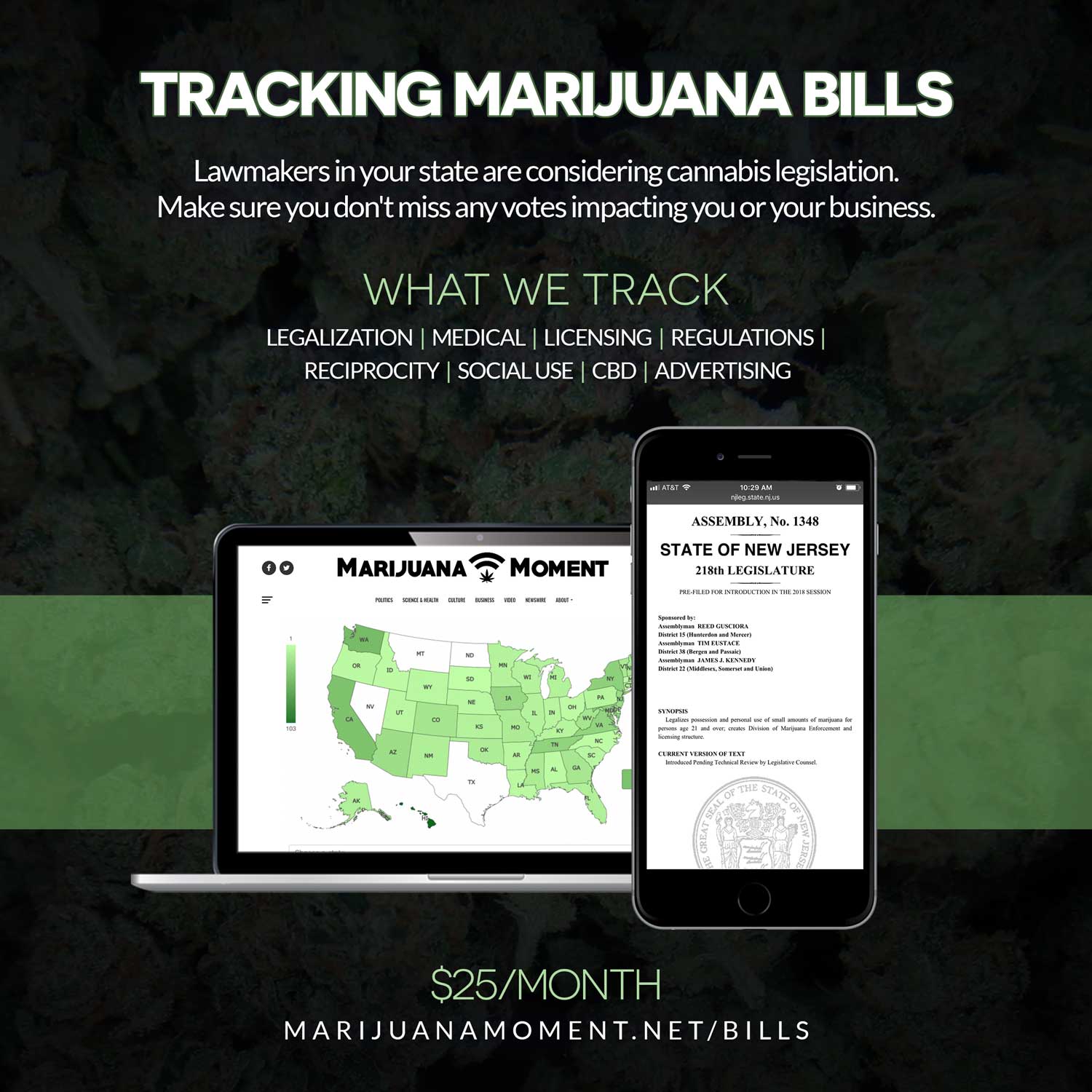
Learn more about our marijuana bill tracker and become a supporter on Patreon to get access.
—
Meanwhile on Capitol Hill, House Minority Leader Hakeem Jeffries (D-NY) said this week that there is enough support within Congress to pass comprehensive federal marijuana reform—if only Republican leaders would allow a vote.
“I’m hopeful that we can find a legislative path forward,” Jeffries said. “This does seem to exist as a bipartisan issue, particularly amongst younger generations of Republicans and the entirety of the House Democratic Caucus, and we know that the votes do exist to act legislatively.”
Separately, bipartisan lawmakers have also filed several pieces of legislation to delay or reverse the broad federal recriminalization of hemp THC products that is set to take effect in November.
The Department of Justice on Thursday announced that it is moving forward with federal rescheduling of marijuana.