Politics
Wisconsin Senators Approve GOP-Led Medical Marijuana Bill As Democrats Push Broader Recreational Legalization

Wisconsin senators have approved a bill to legalize medical marijuana in the state as other legislators push for broader adult-use legalization.
The Senate Health Committee on Thursday advanced the medical cannabis legislation from Senate President Mary Felzkowski (R) and Sen. Patrick Testin (R) in a 4-1 vote. This comes months after the panel held an initial hearing on the GOP-led proposal, which was introduced last October.
Wisconsin’s GOP Assembly speaker said last year that he hoped lawmakers in the state could “find a consensus” on legislation to legalize medical marijuana. But he added that the cannabis bill filed by his Republican leadership counterpart in the Senate was “unlikely” to pass his chamber because it is “way too broad and way too wide-ranging.”
Assembly Speaker Robin Vos (R) also said last month that President Donald Trump made the “wrong” choice to order the rescheduling of marijuana—which he called a “dangerous drug”—but he said the upside is that research barriers may be lifted in a way that demonstrates medical cannabis can be effectively used in a limited way as an alternative to prescription medications.
However, the speaker said he thinks “we are not there” in terms of having enough votes to advance even a medical cannabis bill through his chamber at this point, despite characterizing himself as a supporter of patients’ access to marijuana “for almost a decade now.”
Here are the key provisions of the Senate president’s medical marijuana bill.
- Qualifying conditions for patients would include cancer, HIV/AIDS, post-traumatic stress disorder, seizures or epilepsy, glaucoma, severe chronic pain, severe muscle spasms, severe chronic nausea, Alzheimer’s disease, Parkinson’s disease, amyotrophic lateral sclerosis, multiple sclerosis, inflammatory bowel disease, chronic motor or vocal tic disorder, Tourette syndrome and any terminal illness with a probable life expectancy of less than one year.
- Allowable forms of medical cannabis products would include concentrates, oils, tinctures, edibles, pills, topical forms, gels, creams, vapors, patches, liquids and forms administered by a nebulizer. Cannabis in a form that could be smoked would not be allowed.
- Home cultivation would not be allowed.
- Patients could designate up to three caregivers who could purchase and possess medical cannabis products on the their behalf.
- Patient and caregiver registrations would last for two years and could then be renewed. The annual fee would be $20, and people could have their registrations rescinded for being convicted of a felony or for violating certain drug law.
- Dispensaries would be required to employ pharmacists who would need to consult with patients or caregivers and recommend a daily dosage. A patient getting medical marijuana for the first time could get up to a 30-day supply and on subsequent visits could receive up to a 90-day supply.
- Patients’ use of medical cannabis would need to be recorded in the state’s Prescription Drug Monitoring Program.
- The bill would establish parental rights and housing discrimination protections for medical cannabis patients and caregivers, but it would allow employers to fire or refuse to hire workers based on their use of medical marijuana.
- Patients and caregivers could only possess medical cannabis at their own residences or when traveling between dispensaries and their homes. There would be a $25 civil penalty for failing to carry a registry ID card when possessing medical marijuana or for possessing cannabis at locations other than those specified as being allowed.
- Medical cannabis products would be exempt from sales taxes.
- The state would license cultivation, processing, laboratory and dispensary businesses, subject to certain residency and eligibility requirements and annual fees and penalties for violations.
- A new Office of Medical Cannabis Regulation would be established under the Department of Health Services to oversee the patient and caregiver registry and dispensaries. Its director would be appointed by the governor.
- The Department of Agriculture, Trade and Consumer Protection would oversee and regulate cannabis cultivation, processing and testing.
- Localities would not be able to regulate medical cannabis businesses or restrict their zoning.
In the background, Wisconsin Democratic lawmakers recently unveiled a new bill to legalize marijuana in the state—though its prospects of passage remain dubious with Republicans still in control of both chambers of the legislature.
“Legalization of cannabis is not radical. What’s radical is continuing a system that destroys lives, drains resources and ignores the will of the people,” Rep. Darrin Madison (D) said during a press conference on Monday. “Wisconsin’s ready.”
With just under a year before voters elect their next governor, the majority of the current candidates have made clear that they will support efforts to legalize marijuana—in part to fund public programs such as increased access to broadband.
A poll released last June by Marquette Law School found that two in three Wisconsin voters support legalizing marijuana.
The survey found that support for cannabis reform has generally increased over time since the institution first started tracking public opinion on legalization in 2013, with 67 percent of voters now backing the policy change. That’s 17 percentage points higher than the 2013 results.
Underscoring the importance of party control, the state’s Republican-controlled Senate and Assembly this summer rejected another attempt to legalize marijuana, defeating amendments to budget legislation that would have ended prohibition in the state and established new medical and recreational cannabis programs.
Evers has routinely attempted to change that policy as part of his budget requests—and Democratic leaders have similarly pushed for reform.
Republicans in the legislature also cut the marijuana provisions from a state budget proposal in May, as they’ve done in past sessions.
Despite Republicans’ move to cut legalization from the budget legislation, party leaders recently acknowledged that the debate over medical marijuana legalization is “not going to go away,” and there’s hope it can be resolved this session.
Meanwhile, a Republican candidate for governor of Wisconsin said in July that he was “open to considering different opportunities” when it comes to legalizing medical or adult-use marijuana in the state, though he has provided little in the way of specifics so far.
On the Democratic side, current Gov. Tony Evers (D), who supports legalizing cannabis, is not seeking re-election. But he said last June that if his party can take control of the legislature, the state can “finally” legalize marijuana so that residents don’t have to go to neighboring Illinois to visit its adult-use market.
—
Marijuana Moment is tracking hundreds of cannabis, psychedelics and drug policy bills in state legislatures and Congress this year. Patreon supporters pledging at least $25/month get access to our interactive maps, charts and hearing calendar so they don’t miss any developments.
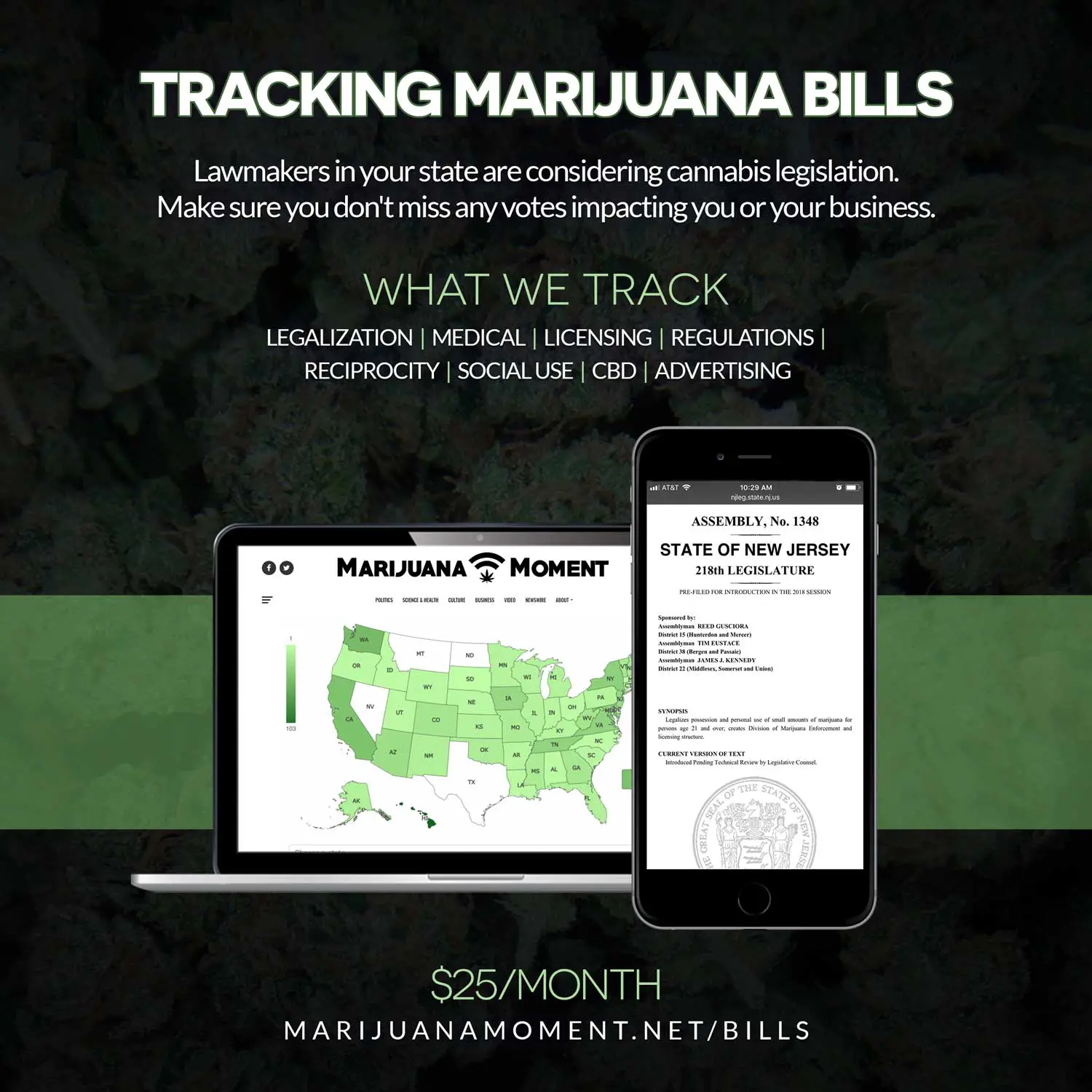
Learn more about our marijuana bill tracker and become a supporter on Patreon to get access.
—
There have been repeated attempts to legalize medical marijuana in the legislature over recent years, including the introduction of legislation from the Assembly speaker that called for a limited program facilitated through state-run dispensaries. That proved controversial among his Republican colleagues, however, and it ultimately stalled out.
Evers previewed his plan to include marijuana legalization in his budget last January, while also arguing that residents of the state should be allowed to propose new laws by putting binding questions on the ballot—citing the fact that issues such as cannabis reform enjoy sizable bipartisan support while the GOP-controlled legislature has repeatedly refused to act.
Previously, in 2022, the governor signed an executive order to convene a special legislative session with the specific goal of giving people the right to put citizen initiatives on the ballot, raising hopes among advocates that cannabis legalization could eventually be decided by voters. The GOP legislature did not adopt the proposal, however.
Evers said in late 2024 that marijuana reform is one of several key priorities the state should pursue in the 2025 session, as lawmakers work with a budget surplus.
Days after he made the remarks, a survey found the reform would be welcomed by voters in rural parts of the state. Nearly two thirds (65 percent) said they support legalizing cannabis.
Last May, the governor said he was “hopeful” that the November 2024 election would lead to Democratic control of the legislature, in part because he argued it would position the state to finally legalize cannabis.
“We’ve been working hard over the last five years, several budgets, to make that happen,” he said at the time. “I know we’re surrounded by states with recreational marijuana, and we’re going to continue to do it.”
A Wisconsin Democratic Assemblymember tried to force a vote on a medical cannabis compromise proposal in 2024, as an amendment to an unrelated kratom bill, but he told Marijuana Moment he suspects leadership intentionally pulled that legislation from the agenda at the last minute to avoid a showdown on the issue.
Meanwhile, the state Department of Revenue released a fiscal estimate of the economic impact of a legalization bill from then-Sen. Melissa Agard (D) in 2023, projecting that the reform would generate nearly $170 million annually in tax revenue.
A legislative analysis requested by lawmakers estimated that Wisconsin residents spent more than $121 million on cannabis in Illinois alone in 2022, contributing $36 million in tax revenue to the neighboring state.
Evers and other Democrats have since at least 2024 insisted that they would be willing to enact a modest medical marijuana program, even if they’d prefer more comprehensive reform.