Politics
State Marijuana Legalization Laws Shield Foreign Cartels And Threaten Public Safety, GOP Senator And Former DEA Official Claim


A GOP senator and former top Drug Enforcement Administration (DEA) official on Tuesday traded thoughts about the state and federal marijuana policy conflict, arguing that legalization laws are enabling foreign cartels to exploit the system in a way that threatens broader public safety.
The discussion took place at a Senate Caucus on International Narcotics Control hearing titled “Dirty Money: Chinese Organized Crime in Latin America.” Sen. John Cornyn (R-TX), chair of the panel, raised the cannabis issue and asserted that Chinese and Mexican cartels in particular using marijuana laws in states like Maine and Oklahoma to mask illicit drug trafficking activities.
Even as marijuana remains a Schedule I drug under the Controlled Substances Act (CSA), “the federal government has turned its gaze elsewhere while states have allegedly passed state [legalization] laws—which I used to think were subject to federal supremacy, but only when the federal government actually enforces the law,” the senator said.
Cornyn asked Ray Donovan, former chief of operations at DEA, about the “consequences” of having foreign operators involved in the cannabis market, particularly under the guise of legitimacy in states that have enacted legalization.
“The consequences have been over time that the black market marijuana production is through the roof with very little scrutiny,” Donovan replied. “We’re seeing billions of dollars in black market marijuana by and large. There are many, many Chinese criminal groups that are now actively engaged in production, distribution, trafficking and money laundering directly attributed to black market and illegal state-legal marijuana networks.”
“The issue I see, senator, is that we have to make this a strategic priority for the Department of Justice to go after these criminal elements, because it is not just about marijuana,” he said. “We see those same groups that are moving billions of dollars in fentanyl [and] methamphetamine money on behalf of the Mexican cartels—these Chinese groups are being untouched.”
Cornyn agreed and said “these cartels, these criminal organizations, are largely commodity agnostic. anywhere they can make money, they’re not necessarily going to stop at quasi-legal marijuana farms in some of the states.”
The former DEA official said he’d take the senator’s point “one step further.”
Cartels “are like any other criminal entity. They will engage in all different types of criminality, to include energy theft, gun trafficking, migrant trafficking, drug trafficking–you name it,” Donovan said. “It’s one-stop shopping for any Mexican cartel. They’re not limited to just drug trafficking.”
The caucus meeting comes about three months after a GOP-led House committee held a hearing focused on Chinese criminal organizations behind large-scale illicit marijuana grows, taking testimony from a group of law enforcement officials and a researcher who each attempted to link the issue to state-level legalization.
—
Marijuana Moment is tracking hundreds of cannabis, psychedelics and drug policy bills in state legislatures and Congress this year. Patreon supporters pledging at least $25/month get access to our interactive maps, charts and hearing calendar so they don’t miss any developments.
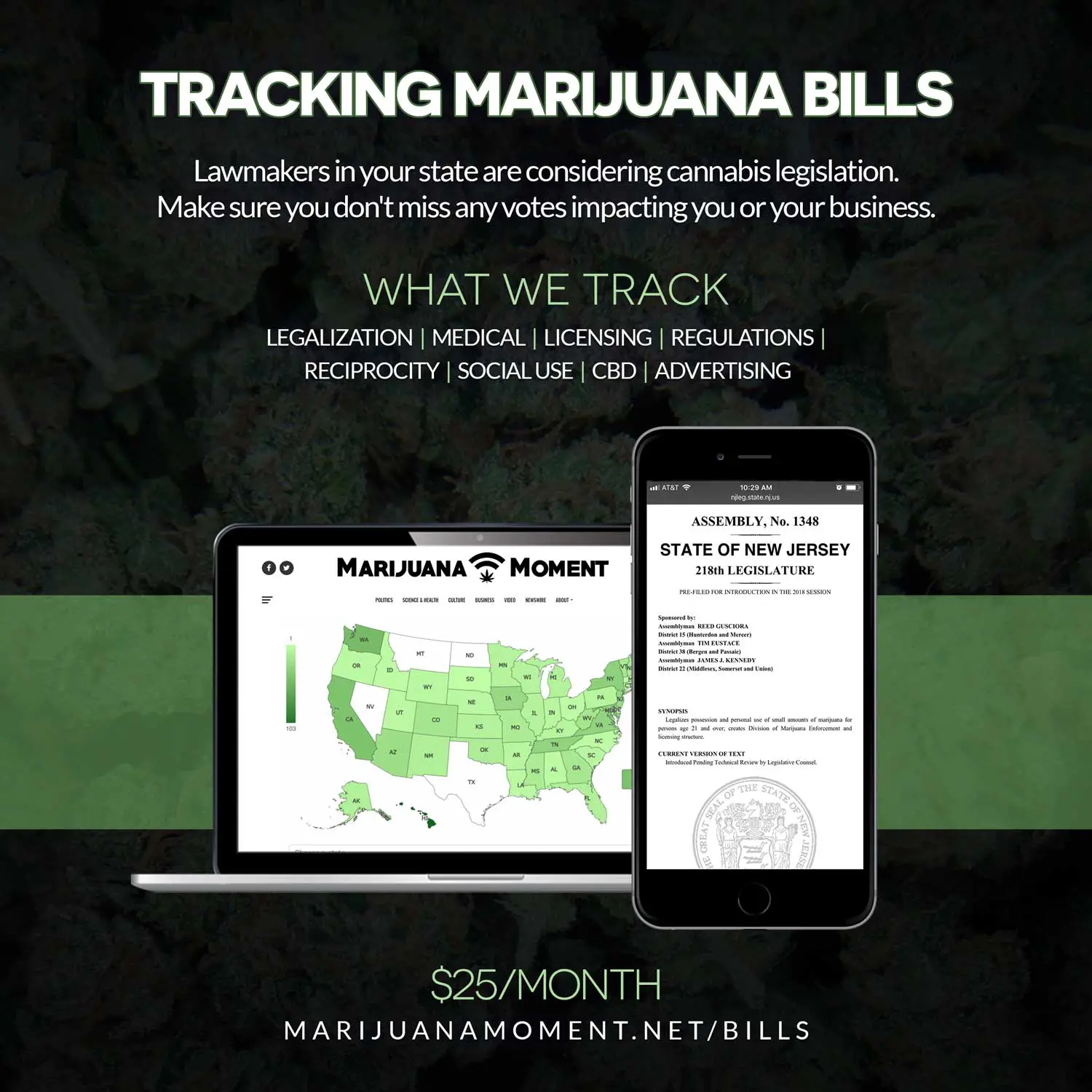
Learn more about our marijuana bill tracker and become a supporter on Patreon to get access.
—
Meanwhile, in a recent report attached to a House spending bill covering Commerce, Justice, Science, and Related Agencies (CJS) bill, members directed federal agencies to investigate illicit marijuana grows–with a specific requirement to look into “any connections or links to Chinese transnational criminal organizations and/or the government of the People’s Republic of China.”
Sen. Chuck Grassley (R-IA) separately claimed in 2024 that there’s been a proliferation of illegal cannabis activity in the U.S. associated with China. And he also said that there were thousands of licensed medial marijuana businesses in Oklahoma “flagged for suspicious activity over the last year had a Chinese connection.”
Sen. Susan Collins (R-ME) has also repeatedly raised concerns with federal officials at hearings about Chinese-linked cannabis grow houses in her state.
Leveraging the increasing attention to the issue, the prohibitionist group Smart Approaches to Marijuana (SAM) put out an ad in July arguing that if President Donald Trump moved forward with a pending cannabis rescheduling proposal, it would empower Chinese cartels.
In 2023, a major marijuana lobbying firm apologized after sending a letter to Senate committee leadership concerning a bipartisan cannabis banking bill that contained “inappropriate” references to investments from China in a “misguided attempt” to push for amendments expanding the legislation.
Photo courtesy of Mike Latimer.