Politics
Pennsylvania Governor Pushes Lawmakers To Legalize Marijuana, Saying ‘Softening’ Of Federal Policy Under Trump Clears The Way


The governor of Pennsylvania is again calling on lawmakers to move forward with marijuana legalization—and he indicated that a proposed “softening ” of federal cannabis laws through rescheduling could bolster the push for reform.
As part of his latest budget request, which was released on Tuesday, Gov. Josh Shapiro (D) said it’s past time for the legislature to deliver an adult-use legalization bill to his desk. Not only would it represent a valuable economic engine for the commonwealth, but it would reflect policy changes that are being enacted in neighboring states and at the federal level, he argued.
The 2026-2027 executive budget notes that the federal government has taken “steps to reform its approach to cannabis,” seemingly referencing a proposal to reclassify cannabis as a Schedule III drug under the Controlled Substances Act (CSA). It’s also the case that “other states put in place responsible regulations.”
“Pennsylvania remains stuck in place, without commonsense protections and losing out on critical tax revenue and new business to neighboring states. All of Pennsylvania’s neighboring states, except for West Virginia, have legal adult use cannabis policies and regulation,” it says. “This budget proposes a regulatory framework to legalize and tax adult use cannabis and provide a real opportunity for Pennsylvania farmers to cultivate a new, legal industry and establish a thriving market for the state.”
“In addition to lost revenue and economic activity to neighboring states, law enforcement agencies and the judicial system are unnecessarily overburdened with cannabis-related arrests and adjudications. The prohibition of cannabis has created an illicit market that fuels violence perpetrated by drug traffickers and gangs seeking to control harmful forms of synthetic marijuana in Pennsylvania communities.”
Shapiro wants to see the legislature quickly deliver a legalization bill to his desk so that it can be implemented on July 1, with sales projected to begin on January 1, 2027. The budget estimates that annual revenue from marijuana taxes would be $200 million once the law is “fully implemented.”
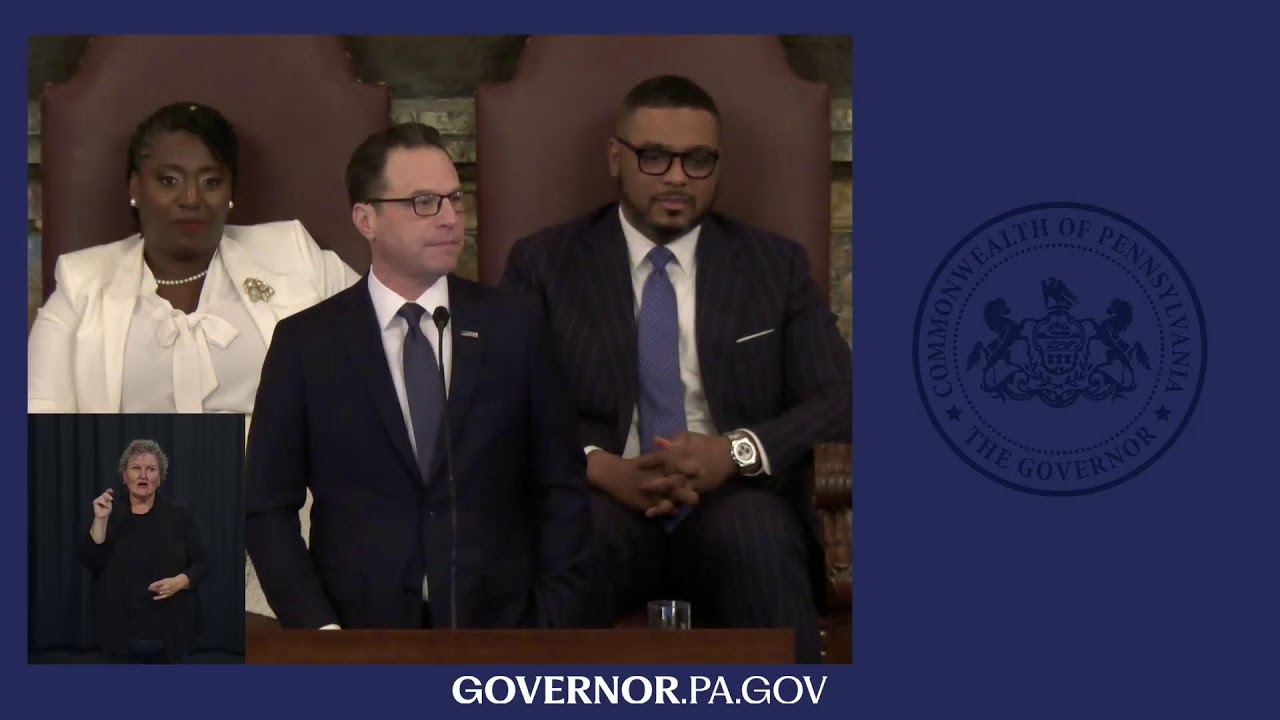
The executive budget reiterates that President Donald Trump “has called for a change in the scheduling of cannabis from a Schedule I drug under the Controlled Substances Act to a Schedule III drug, signaling a softening of the treatment of cannabis across the country.”
Further, the governor said funds generated by an adult-use cannabis market would mean that Pennsylvania would be positioned to “right some of the wrongs done to individuals impacted by archaic laws.”
“In addition to the immediate expungement of the records of those incarcerated for only a possession-related offense attributed to cannabis, the budget proposes to invest $10 million in restorative justice initiatives at the Pennsylvania Commission on Crime and Delinquency,” it says. “The proposal also includes $25 million to assist new small and small diverse businesses attempting to enter the new marketplace through the Department of Agriculture.”
Rather than raise taxes, he said, the proposed budget “continues to cut taxes,” the governor said during a speech to lawmakers on Tuesday.
The budget “doesn’t require a broad-based tax increase today, tomorrow or at any point in the next five years,” he said, adding that “I know some of you try to score political points by saying that it does—but saying that doesn’t make it true.”
“What this budget does do is finally regulate and tax skill games and pass comprehensive cannabis reform,” Shapiro said. “District attorneys from across the Commonwealth are calling on us to regulate skill games and finally provide law enforcement with clear guidance.”
“We’re putting our communities at risk and losing out on billions of dollars in revenue by doing nothing on both,” he continued. “Everyone knows we need to get this done. So let’s come together and finally get it over the finish line.”
According to the executive budget, the first year of implementation would bring in about $36.9 million in tax dollars from a 20 percent wholesale tax on marijuana—rising gradually to $223.8 million by 2030-2031.
Medical marijuana dispensaries that wish to convert to sell cannabis to adult consumers, as well as new recreational marijuana retailers, would need to pay an initial licensing fee of $25 million and an annual renewal fee of $500,000.
Farmers and grower licenses would be subject to a $1,000 initial fee and $1,000 annual renewal fee. Processors and microbusinesses would also have to pay a $25,000 annual renewal fee.
The governor has put legalization in multiple budget requests over recent years, but the policy change has yet to come even as pressure builds amid the ever-expanding state reform movement.
The latest budget request comes weeks after a top Pennsylvania lawmaker said legalizing marijuana is one way to create a “very important” revenue source for the state, and it’s an achievable reform if only legislators could find “the will to do it.”
“It’s very important. When we talk about the needs for schools, for transit, for roads and bridges, we have to have a way to pay for everything—not just today, but in three years, in six years,” House Speaker Joanna McClinton (D) said. “The only way we can do that is by creating new revenue.”
“Some of the ways the governor requested that we create the revenue was through legalizing marijuana, raising the minimum wage, regulating skill games. So we have ways to do it,” the speaker said. “We’ve sent some of those to the Senate, but we haven’t been able to get any of those bills to the governor’s desk.”
To that point, the House passed a marijuana legalization bill last year, with a novel proposal to have sales take place at state-run stores, but it was promptly rejected by the GOP-controlled Senate.
Bipartisan Pennsylvania lawmakers who’ve been working to enact adult-use legalization over recent sessions without success so far have also recently said that President Donald Trump’s federal marijuana rescheduling order could grease the wheels in 2026.
Rep. Dan Frankel (D), chair of the House Health Committee and another champion of reform in the legislature, also said the rescheduling move will “bolster the existing medical marijuana marketplace.”
While there may be some disagreement among lawmakers about rescheduling or broader reform, Trump’s executive order marks a “step toward common-sense drug policy reform,” Sen. Dan Laughlin (R) said.
For what it’s worth, another top GOP senator—Sen. Scott Martin (R), chair of the chamber’s Appropriations Committee—said in December that he was skeptical about the prospects of enacting legalization in the 2026 session, in part because of the federal classification of cannabis that’s now expected to change. Of course, marijuana would still be federally illegal under Schedule III, so it’s unclear if a simple loosening of the law would move the needle enough from his perspective.
—
Marijuana Moment is tracking hundreds of cannabis, psychedelics and drug policy bills in state legislatures and Congress this year. Patreon supporters pledging at least $25/month get access to our interactive maps, charts and hearing calendar so they don’t miss any developments.
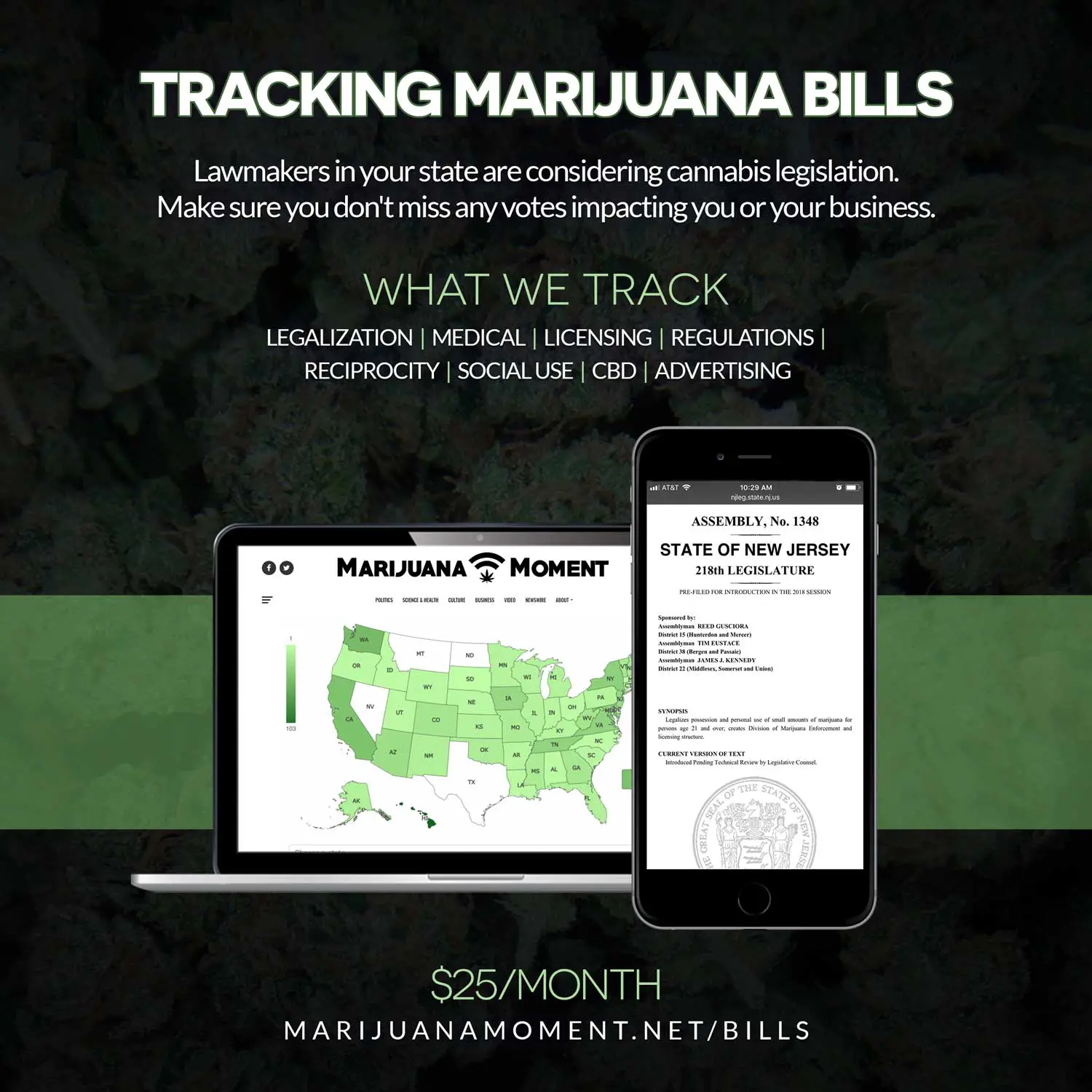
Learn more about our marijuana bill tracker and become a supporter on Patreon to get access.
—
A top aide to Pennsylvania’s governor said in September that lawmakers should stop introducing new competing legalization bills and instead focus on building consensus on the issue—while emphasizing that any measure that advances needs to contain equity provisions if the governor is going to sign it into law.
Laughlin, for his part, said in August that the House “needs to pass the language in my bill and send it to my committee” after which point he “can negotiate with the Senate and the governor.”
The senator separately said recently that supporters are “picking up votes” to enact the reform this session.
Meanwhile, bipartisan Pennsylvania senators in October introduced a bill that would allow terminally ill patients to use of medical marijuana in hospitals.
Separately, the leading Republican candidate in the race to become the next governor of Pennsylvania dodged a question about her stance on legalizing marijuana—saying she doesn’t have a “policy position” on the issue and arguing that the sitting governor’s proposal for reform “way, way overstated” potential revenue.
The candidate, Pennsylvania Treasurer Stacy Garrity (R), pointed to neighboring Ohio, which launched its own adult-use cannabis market this year, saying “they generated about $115 million in revenue.” And while the populations of both states are relatively comparable, Shapiro’s budget projected $536.5 million in cannabis revenue in the first fiscal year of implementation.
She did, however, say that if Pennsylvania moves forward on enacting the reform, she’ll “make sure that it’s banked appropriately.”
Meanwhile, a Pennsylvania Democratic senator recently said that federal marijuana rescheduling would be “very influential” in advancing legalization in his state, giving “political cover” to GOP members on the fence about reform.
Polls have shown bipartisan support for legalization among voters, but the reform has consistently stalled in the legislature, due largely to GOP opposition. But not all Republican members are against the policy change—and one recently said she felt her party should seize the “opportunity to snatch” the issue from Democrats.
Photo courtesy of Philip Steffan.