Politics
Ohio Activists Submit Signatures For Referendum To Block Lawmakers’ Move To Roll Back Marijuana Legalization And Restrict Hemp


Ohio activists announced on Monday that they’ve met an initial signature requirement to launch a campaign aimed at repealing key components of a bill the governor recently signed to scale back the state’s voter-approved marijuana law and ban the sale of consumable hemp products outside of licensed cannabis dispensaries.
Ohioans for Cannabis Choice said they’ve submitted a batch of 1,000 signatures to get the referendum process started. If the signatures are certified by the secretary of state, the campaign will then need to submit a total of about 250,000 signatures to make the ballot.
The proposed referendum would repeal the first three core sections of SB 56, a controversial bill that Gov. Mike DeWine (R) signed into law earlier this month that he says is intended to crack down on the unregulated intoxicating hemp market. But the legislation would do more than restrict the sale of cannabinoid products to dispensaries.
The law also recriminalizes certain marijuana activity that was legalized under the ballot initiative voters approved in 2023, and it’d additionally remove anti-discrimination protections for cannabis consumers that were enacted under that law.
The governor additionally used his line-item veto powers to cancel a section of the bill that would have delayed the implementation of the ban on hemp beverages.
“We’re saying no to SB 56 because it recriminalizes the cannabis industry,” Wesley Bryant, a petitioner with the referendum campaign who owns the cannabis company 420 Craft Beverages, said. “SB 56 is a slap in the face to voters who overwhelmingly voted to legalize cannabis in 2023.”
Advocates and stakeholders strongly protested the now-enacted legislation, arguing that it undermines the will of voters who approved cannabis legalization and would effectively eradicate the state’s hemp industry, as there are low expectations that adults will opt for hemp-based products over marijuana when they visit a dispensary.
The pushback inspired the newly filed referendum—but the path to successfully blocking the law is narrow.
If activists reach the signature threshold by the deadline three months from now, which coincides with the same day the restrictive law is to take effect, SB 56 would not be implemented until voters got a chance to decide on the issue at the ballot.
“In filing our petitions today, we are taking a stand for Ohioans against politicians in Columbus and saying no to the government overreach of SB 56,” Bryant said.
A summary of the referendum states that “Sections 1, 2, and 3 of Am. Sub. S. B. No. 56 enact new provisions and amend and repeal existing provisions of the Ohio Revised Code that relate to the regulation, criminalization, and taxation of cannabis products, such as the sale, use, possession, cultivation, license, classification, transport, and manufacture of marijuana and certain hemp products.”
“If a majority of the voters vote to not approve Sections 1, 2, and 3 of the Act, then the enacted changes will not take effect and the prior version of the affected laws will remain in effect,” it says.
Joey Ellwood, a hemp farmer who signed the referendum petition, said “Ohioans oppose recriminalizing cannabis.”
“And this is just the start,” he said. “Politicians in Columbus won’t stop until marijuana and hemp are completely illegal in Ohio again.”
Andrew Greene, another petitioner who also works at a cannabis distribution center, said “these out-of-touch politicians are hellbent on recriminalizing marijuana and hemp products.”
Advocates have flagged a series of concerns with the law, pointing out, for example, that it would eliminate language in statute providing anti-discrimination protections for people who lawfully use cannabis. That includes protections meant to prevent adverse actions in the context of child custody rights, the ability to qualify for organ transplants and professional licensing.
It would also recriminalize possessing marijuana from any source that isn’t a state-licensed dispensary in Ohio or from a legal homegrow. As such, people could be charged with a crime for carrying cannabis they bought at a legal retailer in neighboring Michigan.
Additionally, it would ban smoking cannabis at outdoor public locations such as bar patios—and it would allow landlords to prohibit vaping marijuana at rented homes. Violating that latter policy, even if it involves vaping in a person’s own backyard at a rental home, would constitute a misdemeanor offense.
The legislation would also replace what had been a proposed regulatory framework for intoxicating hemp that the House had approved with a broad prohibition on sales outside marijuana dispensaries following a recent federal move to recriminalize such products.
Under the law, hemp items with more than 0.4 mg of total THC per container, or those containing synthetic cannabinoids, could no longer be sold outside of a licensed marijuana dispensary setting. That would align with a recently enacted federal hemp law included in an appropriations package signed by President Donald Trump.
The federal law imposing a ban on most consumable hemp products has a one-year implementation window, however, and it appears the Ohio legislation would take effect sooner. As passed by the legislature, a temporary regulatory program for hemp beverages would have stayed in place in Ohio until December 31, 2026, but that provision was vetoed by the governor.
The law also includes language stipulating that, if the federal government moves to legalize hemp with higher THC content, it’s the intent of the Ohio legislature to review that policy change and consider potential state-level reforms to regulate such products.
The bill signing came months after DeWine issued emergency rules prohibiting the sale of intoxicating hemp products for 90 days, with instructions to the legislature to consider permanent regulations. A county judge has enjoined the state from enforcing that policy in response to a legal challenge.
—
Marijuana Moment is tracking hundreds of cannabis, psychedelics and drug policy bills in state legislatures and Congress this year. Patreon supporters pledging at least $25/month get access to our interactive maps, charts and hearing calendar so they don’t miss any developments.
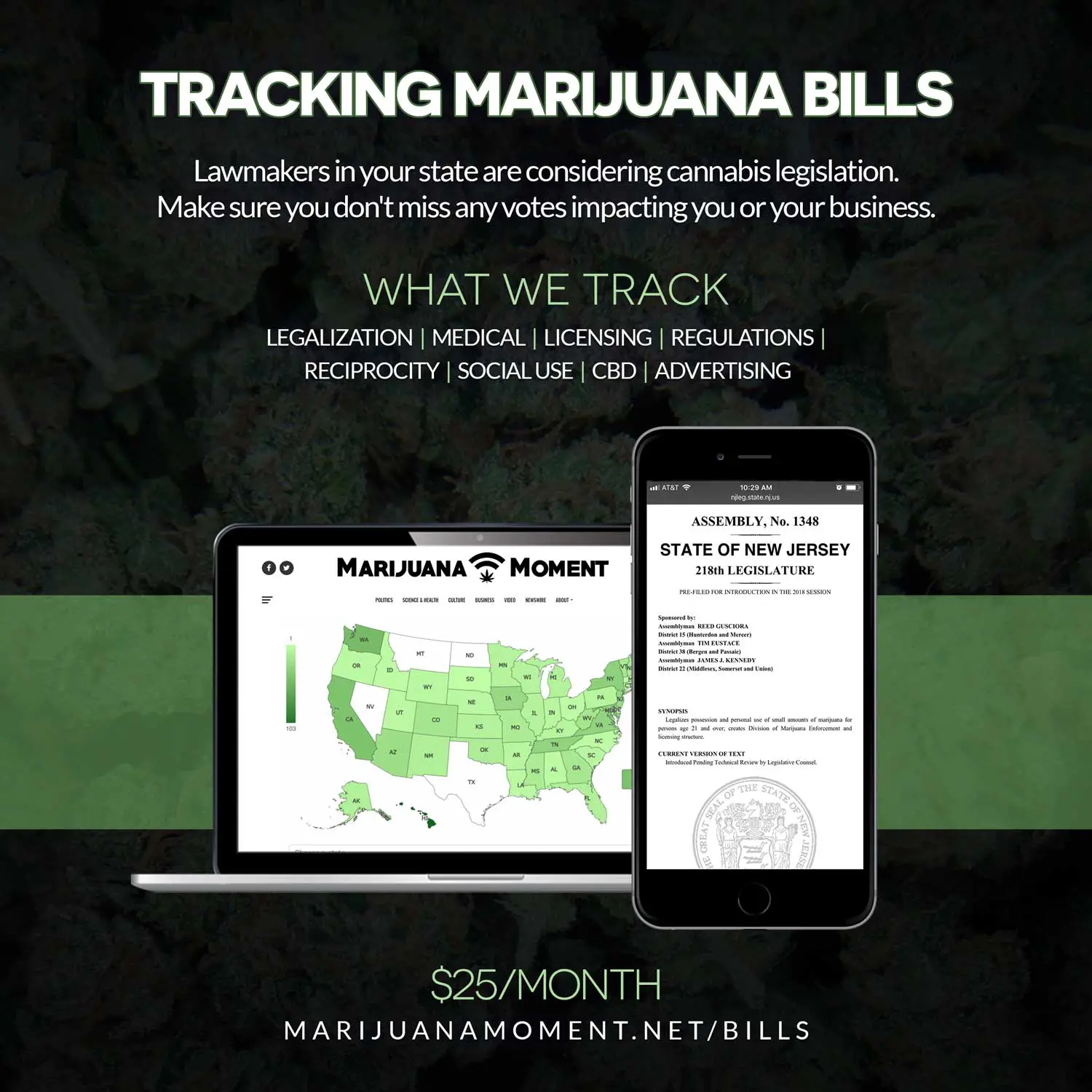
Learn more about our marijuana bill tracker and become a supporter on Patreon to get access.
—
Meanwhile, in September, the Ohio Department of Cannabis Control (DCC) filed proposed rules to build upon the state’s marijuana legalization law, laying out plans to update regulations on labeling and packaging requirements.
The proposal came weeks after Ohio medical and adult-use marijuana sales officially crossed $3 billion, data from the state Department of Commerce (DOC) shows.
The state sold about $703 million in recreational cannabis in the law’s first year of implementation, according to DCC data.
In March, a survey of 38 municipalities by the Ohio State University’s (OSU) Moritz College of Law found that local leaders were “unequivocally opposed” to earlier proposals that would have stripped the planned funding.
Meanwhile in Ohio, adults as of June are able to buy more than double the amount of marijuana than they were under previous limits, with state officials determining that the market can sustainably supply both medical cannabis patients and adult consumers.
The governor in March separately announced his desire to reallocate marijuana tax revenue to support police training, local jails and behavioral health services. He said funding police training was a top priority, even if that wasn’t included in what voters passed in 2023.
Photo courtesy of Brian Shamblen.