Politics
Newly Revealed Biden Marijuana Guidance Rescinded By Trump DOJ Told Prosecutors To Be ‘Extremely Cautious’ About Cannabis Cases


Former President Joe Biden didn’t just issue mass pardons for federal marijuana possession offenses during his term—his administration also ordered U.S. prosecutors to be “extremely cautious” about how to handle future cannabis cases, according to a previously unpublished guidance memo obtained by Marijuana Moment that has since been rescinded under the Trump administration.
The guidance, issued on February 26, 2024—which also had specific implications for medical cannabis patients in legal states and federal laws on gun possession by marijuana consumers—wasn’t publicized even as the then-president was campaigning for a second term that year. That’s despite Biden repeatedly touting the cannabis pardons and his directive for a federal review into marijuana that resulted in a recommendation to reschedule the plant.
But last month, the U.S. Attorney’s Office for the District of Wyoming disclosed that the guidance was rescinded in September, and it said cases involving marijuana would consequently be “rigorously” enforced on federal land.
In response to a Freedom of Information Act (FOIA) request, DOJ provided Marijuana Moment with the initial guidance and the notice of the rescission under President Donald Trump on Wednesday.
The Biden administration memo advised prosecutors about the scope of the pardons, noting limitations of the clemency action and stressing that, while a pardon represents formal forgiveness for low-level cannabis cases that took place on or before December 22, 2023, U.S. attorneys should generally “oppose motions seeking to expunge records related to pardoned marijuana possession convictions.”
On multiple occasions, Biden misrepresented that part of the relief by suggesting that pardons would be accompanied by expungements of past records.
But those limitations notwithstanding, the guidance did advise federal attorneys that they “should move to dismiss all [marijuana] charges that are subject to the pardon proclamation”—and that they were further required to report to higher-ups in the Justice Department before pursuing certain additional cannabis-related cases.
“Because marijuana remains illegal under federal law, U.S. Attorneys retain the discretion to prosecute cases involving simple possession, use, or attempted possession of marijuana against individuals whose conduct was not covered by the pardon proclamation,” the document says. But, it continues, “U.S. Attorneys should be extremely cautious and measured in the exercise of this discretion.”
“Effective immediately, all charges of simple possession of marijuana and other charges where the underlying criminal conduct involves simple possession, use, or attempted possession of marijuana…may only be pursued with the approval of the U.S. Attorney or a supervisory AUSA designated by the U.S. Attorney,” the guidance states.
That discretionary policy and reporting requirement was explicitly rescinded in a more recent notice from Francey Hakes, director of the Executive Office for United States Attorneys (EOUSA) under the Trump administration, that was distributed to federal prosecutors on September 29 of this year, for reasons that remain unclear.
Here’s what Trump’s DOJ said regarding the Biden-era guidance:
“EOUSA issued the February 26, 2024 memorandum Department Guidance Regarding the Impact of the President’s Recent Proclamation Pardoning Certain Marijuana Offenses which provided that approval of the United States Attorney (USA) or a supervisory AUSA designated by the USA was required for initiation of all charges of simple possession of marijuana and other charges where the underlying conduct involved simple possession, use, or attempted possession of marijuana. The Memorandum also required that all such charging decisions must be reported immediately to EOUSA’s Controlled Substances Coordinator within 72 hours. This charging guidance and reporting requirement is hereby rescinded, effective immediately.”
The Biden guidance, meanwhile, also specified that the pardon proclamation “does not expunge prior convictions.”
“With the limited exception of certain individuals who may be eligible for expungement under 18 U.S.C. § 3607, U.S. Attorneys should oppose motions seeking to expunge records related to pardoned marijuana possession convictions,” it says, adding that another key limitation of the clemency action is the fact that cannabis remains federally illegal, so prosecutors could pursue simple possession cases that occurred after the proclamation was issued.
“The proclamation does not pardon any other offenses and does not impact the ability to prosecute other crimes related to marijuana or other controlled substances. U.S. Attorneys may continue to charge defendants with simple possession of other controlled substances and other marijuana-related offenses, such as possession of marijuana with intent to distribute or distribution of marijuana, in violation of 21 U.S.C. § 841(a)(1), and crimes related to impaired driving caused by marijuana use or public intoxication… U.S. Attorneys may also bring cases for marijuana possession, attempted possession, or use involving conduct that occurred after December 22, 2023, or was otherwise not covered by the pardon proclamation, but should do so with great caution and appropriate supervisory approval.”
But the enhanced reporting requirements for prosecutions involving low-level cannabis cases stands out as an example of administrative reform—a policy change the Biden administration curiously declined to capitalize on months before the November 2024 election.
Mike Liszewski, the principal of Enact Consulting, told Marijuana Moment after reviewing the memo that he sees “two important takeaways” from the original document and the fact that it has now been rescinded.
“First, by the previous DOJ issuing guidance to dismiss marijuana simple possession cases, withdraw associated warrants and fees, and discourage future prosecutions, Biden’s December 2023 pardon proclamation had further reaching impacts in terms of criminal justice reform than we originally thought,” he said. “It strikes me as political malpractice for the Biden administration not to have publicized this guidance at the time it was issued.”
“Second, by this current DOJ rescinding the guidance discouraging marijuana simple possession prosecutions, it shows that this administration is seeking to more aggressively prosecute people who use marijuana,” Liszewski said. “Notably, the DOJ’s current position on prosecuting simple marijuana possession offenses seems to be at odds with President Trump’s campaign statements in support of Florida’s 2024 adult-use ballot measure.”
Weldon Angelos, the founder of The Weldon Project who received a presidential pardon for a cannabis-related conviction during Trump’s first term, told Marijuana Moment that the newly disclosed documents “show how shaky federal marijuana policy still is.”
“One administration quietly told prosecutors to slow down on simple possession cases, and the next wiped that safeguard out with a single memo—even though President Trump campaigned on marijuana reform and said people shouldn’t be arrested for small amounts of cannabis,” he said. “That kind of whiplash is exactly why we need real, bipartisan reform that doesn’t vanish every time DOJ changes direction.”
When contacted by Marijuana Moment on Wednesday, a spokesperson for the Justice Department declined to comment about the reasoning for the rescission of the guidance.
Another notable section of the Biden guidance seems to make a policy distinction for people who use cannabis for medical versus recreational purposes, specifically as it concerns the use of marijuana constituting a violation of the conditions of pretrial release, probation and supervised relief.
“Violations of conditions of supervision that are based on the medicinal use of marijuana by an individual who lives in a state that authorizes medicinal use, and who has a valid, state-issued medical marijuana license or permit might not warrant the revocation of release conditions in all situations,” the document says.
“Accordingly, if the U.S. Probation Office files a violation of supervised release or probation petition based on a defendant’s personal use of marijuana for medicinal purposes in conformity with state law, U.S. Attorneys have the discretion to recommend alternatives to incarceration as an appropriate penalty,” it says.
It’s not immediately clear why that distinction for medical cannabis patients, as opposed to adult-use marijuana consumers was made, but it’s possible it’s related to a longstanding congressional spending bill rider that prohibits DOJ from using its funds to interfere in the implementation of state medical cannabis programs. There’s no equivalent rider in place for recreational marijuana laws.
Additionally, the memo touches on prosecutions of cases involving marijuana and firearms—a subject that’s been litigated in federal courts across the country in recent years, with the U.S. Supreme Court recently saying it will take up a case on the issue.
It states that prosecutors “may pursue charges under 18 U.S.C. § 922(g)(3) or 18 U.S.C. § 922(d)(3) based on the unlawful use of, or addiction to, marijuana because the proclamation does not change the fact that marijuana use violates federal law.”
However, in order to “mitigate potential litigation risk,” U.S. attorneys “should be cautious before proceeding under these firearms provisions and consult with EOUSA’s Controlled Substances Coordinator prior to doing so.” That seems to be something of an admission of the legal vulnerability of the hotly contested statute.
The U.S. attorney for Wyoming, Darin Smith, said last month that the recent rescission reenforces his office’s intent to use “every prosecutorial tool available to hold offenders accountable.”
“The U.S. Attorney’s Office for the District of Wyoming remains steadfast in its mission to uphold the rule of law, including the enforcement of federal statutes prohibiting the possession of marijuana and other controlled substances,” he said.
The federal prosecutor’s message adds to the uncertainty around how the current administration views its enforcement role as federal and state cannabis laws continue to conflict.
For example, the notice from Smith’s office comes just one day after Trump signed a key spending bill that contains provisions to ban consumable hemp products with THC—a move that industry stakeholders say would eradicate the market that’s emerged since the president signed the 2018 Farm Bill legalizing the crop during his first term.
Then there’s the ongoing marijuana rescheduling process that the president said in late August would be decided within a matter of weeks.
That still hasn’t come to fruition—and a White House spokesperson told Marijuana Moment last month that “there is a process ongoing regarding the Notice of Proposed Rulemaking on rescheduling marijuana from May 2024 and all policy and legal requirements and implications are being considered.”
—
Marijuana Moment is tracking hundreds of cannabis, psychedelics and drug policy bills in state legislatures and Congress this year. Patreon supporters pledging at least $25/month get access to our interactive maps, charts and hearing calendar so they don’t miss any developments.
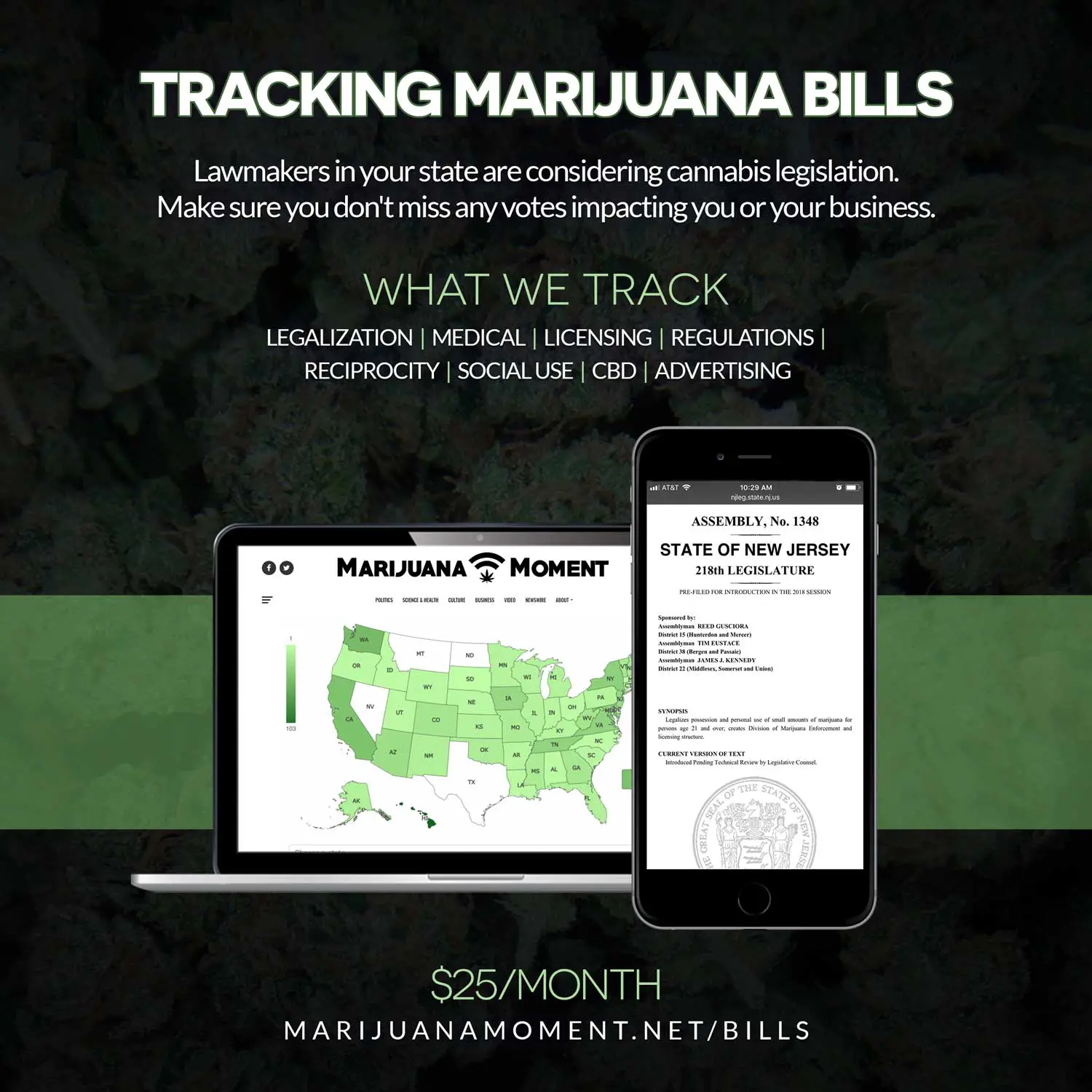
Learn more about our marijuana bill tracker and become a supporter on Patreon to get access.
—
Trump endorsed rescheduling—as well as marijuana industry banking access and a Florida adult-use legalization initiative that ultimately failed—on the campaign trail ahead of his election to a second term. But when he was pressed on the status of the rescheduling process in mid-August, he was less clear about his personal stance.
The administration was “only looking at that” reform, and it’s too “early” to say how the issue will be decided, he said at the time, adding that “it’s a very complicated subject.”
Meanwhile, top White House staffers under the Biden administration recently shed new light on the mass marijuana pardon and cannabis rescheduling process they helped facilitate, revealing the extent to which they were involved in broader clemency actions that are now under scrutiny by GOP leaders.
Also, as the marijuana rescheduling proposal awaits action, some GOP members of Congress have been urging Trump to move forward with the reform—with one lawmaker taking a jab at Biden by joking that it’s possible the prior administration “must have not been able to find the autopen in time” to complete the cannabis reform process it initiated.
Separately, the president in October posted a video on his Truth Social platform promoting the health benefits of cannabis—suggesting that covering CBD under Medicare would be “the most important senior health initiative of the century.”
Read the cannabis enforcement guidance and rescission notice below: