Politics
New Florida Bill Would Protect Medical Marijuana Patients’ Parental Rights, Including Custody And Visitation

A Florida lawmaker has introduced a bill that would protect the parental rights of medical cannabis patients, preventing them from losing custody of their children for using their medicine in accordance with state law.
“A court may not deny or otherwise restrict a parent’s custody of a child or the parent’s visitation rights or parenting time with a child based solely on the parent’s status as a qualified patient,” the bill text states. “There is no presumption of neglect or child endangerment based solely on the parent’s status as a qualified patient.”
“In determining the best interests of the child with respect to custody or dependency, this section applies,” it continues.
The legislation, if enacted, would take effect on July 1.
“I remember speaking with someone last year and the year before regarding public employees potentially listing their jobs even if they have a medical marijuana card and recently heard about parents getting [the Department of Children and Families] called on them,” Nixon told Florida Politics.
“Those in leadership won’t look out for working families by providing adequate health insurance,” she said. “At least easing their pain physically without the possibility of them losing their kids is the least we can do.”
A Senate version of the bill was pre-filed last year by Sen. Tina Scott Polsky (D), who is also seeking to add employment protections for registered medical cannabis patients in the state.
In the background, a campaign is working against the clock to collect enough signatures to again put the question of adult-use marijuana legalization to voters at the ballot. But there have been complications.
Most recently, the Republican attorney general of Florida and several business and anti-marijuana groups urged the state Supreme Court to block the legalization initiative, calling it “fatally flawed” and unconstitutional.
The parties generally contend that the proposal is written in a way that’s affirmatively misleading, runs counter to federal law prohibiting cannabis and violates the state’s single subject rule for ballot initiatives.
The attorney general’s office last month asked the state Supreme Court to review the constitutionality of the legalization initiative. The court accepted the request and set a schedule for state officials and the cannabis campaign to file briefs this month. Proponents of the measure have until January 12 to submit response briefs, then the opposition has until January 20 to reply.
The briefs were filed days after Smart and Safe Florida filed a new lawsuit against state officials, alleging that they improperly directed the invalidation of about 71,000 signatures as a turn-in deadline approaches.
The campaign has been fighting several legal battles this cycle to ensure that its initiative is able to qualify for ballot placement.
The latest lawsuit, filed in the Leon County circuit court, claims Secretary of State Cord Byrd (R) directed county election officials to invalidate about 42,000 signatures from so-called “inactive” voters and roughly 29,000 signatures collected by out-of-state petitioners.
This comes after another court upheld a previous decision to strike about 200,000 signatures that the state said were invalid because the petitions didn’t include the full text of the proposed initiative. The campaign contested the legal interpretation, but it declined to appeal the decision based on their confidence they’d collected enough signatures to make up the difference.
Now, with a February 1 deadline to submit 880,062 valid signatures just about a month away, Smart & Safe Florida is signaling that the additional invalidations could jeopardize their chances of making the ballot. Currently, the state has validated 675,307 signatures.
Florida Gov. Ron DeSantis (R) campaigned heavily against an earlier version of the legalization proposal, which received a majority of voters last year but not enough to meet the 60 percent threshold required to pass a constitutional amendment. Former Attorney General Ashley Moody (R) unsuccessfully contested the prior initiative in the courts.
In March, meanwhile, two Democratic members of Congress representing Florida asked the federal government to investigate what they described as “potentially unlawful diversion” of millions in state Medicaid funds via a group with ties to DeSantis. The money was used to fight against a citizen ballot initiative, vehemently opposed by the governor, that would have legalized marijuana for adults.
The lawmakers’ letter followed allegations that a $10 million donation from a state legal settlement was improperly made to the Hope Florida Foundation, which later sent the money to two political nonprofits, which in turn sent $8.5 million to a campaign opposing Amendment 3.
The governor said last February that the newest marijuana legalization measure is in “big time trouble” with the state Supreme Court, predicting it would be blocked from going before voters this year.
“There’s a lot of different perspectives on on marijuana,” DeSantis said. “It should not be in our Constitution. If you feel strongly about it, you have elections for the legislature. Go back candidates that you believe will be able to deliver what your vision is on that.”
“But when you put these things in the Constitution—and I think, I mean, the way they wrote, there’s all kinds of things going on in here. I think it’s going to have big time trouble getting through the Florida Supreme Court,” he said.
In 2023, the governor accurately predicted that the 2024 cannabis measure from the campaign would survive a legal challenge from the state attorney general. It’s not entirely clear why he feels this version would face a different outcome.
While there’s uncertainty around how the state’s highest court will navigate the measure, a poll released last February showed overwhelming bipartisan voter support for the reform—with 67 percent of Florida voters backing legalization, including 82 percent of Democrats, 66 percent of independents and 55 percent of Republicans.
—
Marijuana Moment is tracking hundreds of cannabis, psychedelics and drug policy bills in state legislatures and Congress this year. Patreon supporters pledging at least $25/month get access to our interactive maps, charts and hearing calendar so they don’t miss any developments.
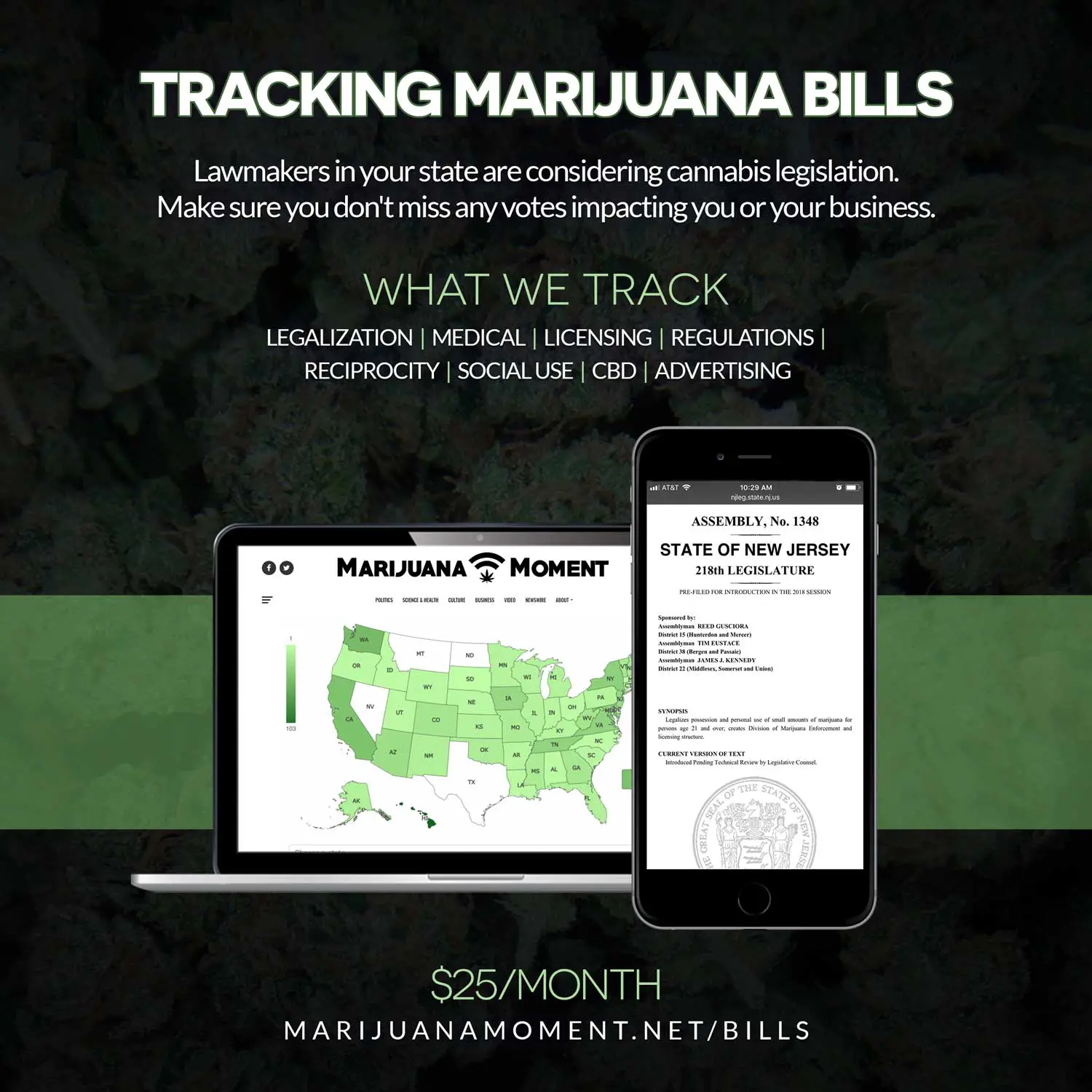
Learn more about our marijuana bill tracker and become a supporter on Patreon to get access.
—
Meanwhile, another recently filed bill in Florida would make it so patients could lose their medical cannabis registrations if they are found with an open container of marijuana or hemp products inside vehicles.
A pro-legalization GOP state lawmaker separately filed legislation to amend state law to codify that the public use of marijuana is prohibited.
Rep. Alex Andrade (R), the sponsor, said last year that embracing cannabis reform is a way for the Republican party to secure more votes from young people.
Last month, a Florida Republican senator filed a bill to expand the state’s medical marijuana program, in part by increasing supply limits for patients and waiving registration fees for honorably discharged military veterans. A similar version of legislation was introduced in the House.
Other recently filed bills in the legislature for 2026 would more incrementally reduce medical cannabis patient registration fees for military veterans and clarify that smoking or vaping marijuana in public places is prohibited.
Meanwhile, a Florida Democratic senator introduced legislation for the 2026 session that would legalize home cultivation of marijuana for registered medical cannabis patients in the state.
Separately, Florida medical marijuana officials are actively revoking the registrations of patients and caregivers with drug-related criminal records. The policy is part of broad budget legislation signed into law last year by DeSantis. The provisions in question direct the state Department of Health (DOH) to cancel registrations of medical marijuana patients and caregivers if they’re convicted of—or plead guilty or no contest to—criminal drug charges.