Politics
Most Americans Back Legalizing Marijuana, But Trump Voters Not On Board, Conservative Group’s Poll Shows Amid Rescheduling Rumors


As President Donald Trump prepares to announce a decision on marijuana rescheduling, a new poll from a religious conservative research firm again shows that a majority of Americans are ready for legalizing cannabis altogether. Trump voters, however, are largely not on board with the change—with the exception of younger ones.
The survey—conducted by YouGov on behalf of the Ethics and Public Policy Center (EPPC)—was detailed in a post published by one of the organization’s lead researchers on his Family Matters blog last week. Overall, it found that 57 percent of respondents either “somewhat” or “strongly” support cannabis legalization.
A demographic breakdown of age and political affiliation showed some familiar divides on the issue, with a majority of people aged 46 and older who voted for Trump in the last election (53 percent) oppose legalization. However, a 49 percent plurality of Trump voters 18-45 said they do back the reform.
Among people who voted for former Vice President Kamala Harris in the last election, however, there was a somewhat unusual finding: More people in the older cohort (87 percent) said they support legalization than those in the younger cohort (71 percent).
Asked about the net effect of legalization on society, 68 percent of younger Harris voters said it leads to “more social benefits than costs,” and an even larger majority (82 percent) of older Harris voters said the same.
By contrast, a majority of both younger and older Trump voters (59 percent and 67 percent, respectively) said legalization is associated with “more social costs than benefits.”
Adults 18-45 without children were more supportive of ending prohibition at 60 percent, compared to 52 percent who are parents, the poll found.
“This offers a sketch for what a new political coalition interested in curbing the excesses of our rapid entry into a world of widespread medical marijuana might look like,” EPPC’s Patrick Brown said, adding that if the Trump administration does move to reschedule marijuana, “conservatives and well-meaning liberals shouldn’t accept a new reality of capitalism-fueled marijuana availability without a fight.”
“The concerns about what widespread weed could mean for children’s health—and young adults’ long-term outcomes—won’t have gone away, regardless of the profit motives involved,” he said.
While this poll does show a partisan split on the issue with most Republicans against legalization, other independent surveys over recent years have signaled that ending prohibition is an increasingly bipartisan issue. That said, support among GOP voters dipped somewhat over the last year, according to a recent Gallup poll.
A separate research firm associated with Trump survey of registered voters did recently show that a majority of Republicans back a variety of cannabis reforms, including rescheduling, states’ rights to legalize and marijuana industry access to banking services and stock exchanges.
Sources familiar with the administration’s potentially imminent decision on marijuana reform haven’t been suggesting that the president intends to legalize marijuana, however. The proposal to move cannabis from Schedule I to Schedule III of the Controlled Substances Act (CSA) would mean it’d still be federally prohibited. But marijuana businesses could then start taking federal tax deductions, and it could help reduce certain research barriers associated with Schedule I drugs.
There was also reporting this week indicating that the executive order on rescheduling that the president is expected to issue may also contain additional components touching on cannabis business banking access and Medicare coverage for CBD.
On Monday, Trump said he is “very strongly” considering rescheduling cannabis in part to ease restrictions on research into its effects.
Opponents of the policy change have stepped up their efforts to dissuade the administration from moving forward, arguing that a reclassification to Schedule III will further normalize marijuana use even though it would not federally legalize the plant. Rescheduling would, however, let marijuana businesses take federal tax deductions while reducing certain research barriers associated with Schedule I drugs.
Rep. Andy Harris (R-MD), one of the more vocal prohibitionists in Congress, said this week that Trump doesn’t have the authority to unilaterally reschedule marijuana via executive order. But while lawmakers could overrule any administrative move to enact the reform, it would be a “heavy lift” in the Republican-controlled Congress, he acknowledged.
Meanwhile, multiple top congressional Democrats are making the case that the modest reform would not go far enough—including Sen. Ron Wyden (R-OR) who said the move is only an attempt by the president to “gaslight” voters into thinking he legalized cannabis to boost his “pathetic” approval ratings.
A major drug testing industry organization separately said it’s “sounding the alarm” amid the reports Trump may soon finalize the rescheduling proposal, arguing that the policy change would “have catastrophic consequences for the safety of the United States workforce and transportation sectors.”
—
Marijuana Moment is tracking hundreds of cannabis, psychedelics and drug policy bills in state legislatures and Congress this year. Patreon supporters pledging at least $25/month get access to our interactive maps, charts and hearing calendar so they don’t miss any developments.
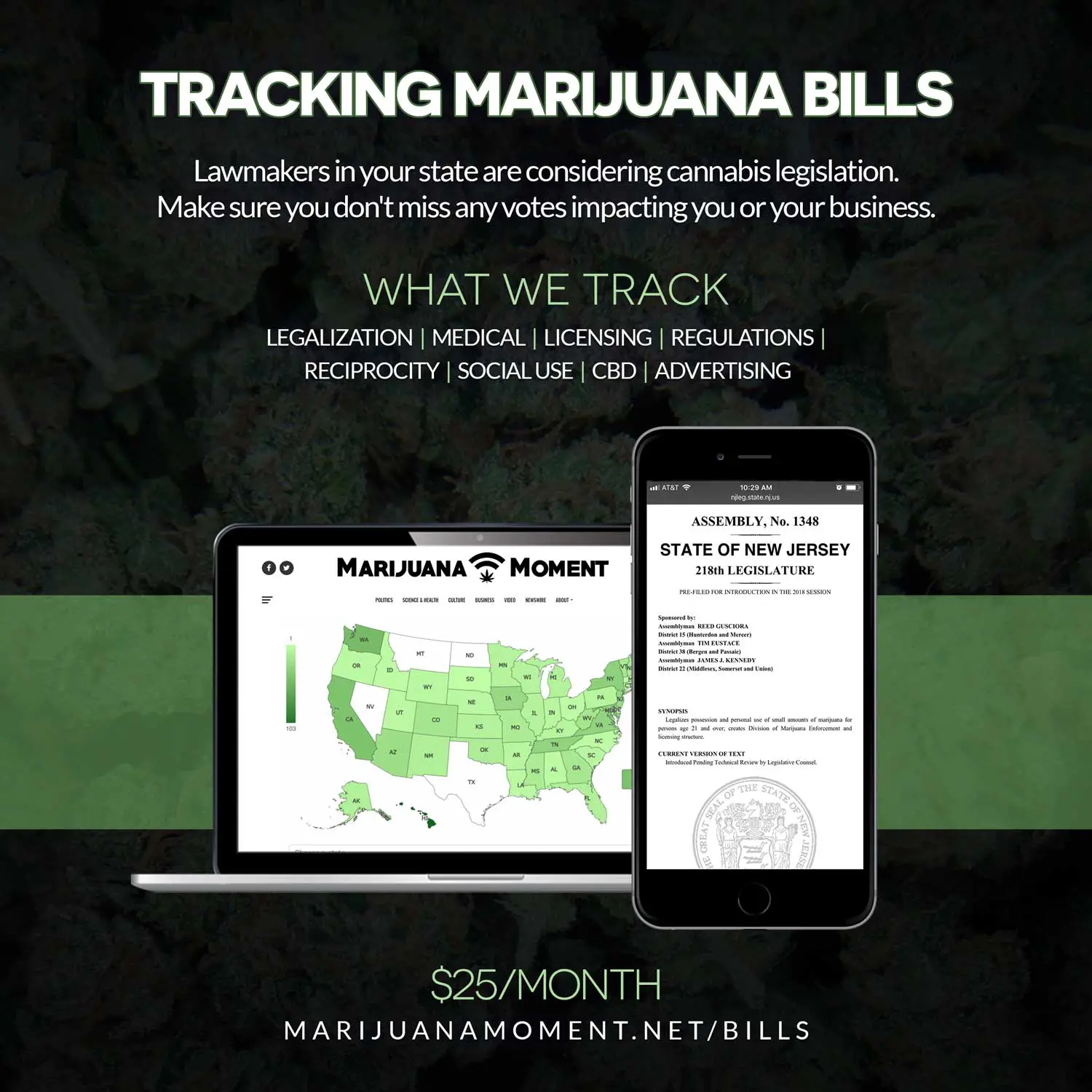
Learn more about our marijuana bill tracker and become a supporter on Patreon to get access.
—
or what it’s worth, a White House spokesperson told Marijuana Moment last week that no actions have been finalized so far.
Bipartisan congressional lawmakers have been weighing in on the potential rescheduling decision over the past week—with Democrats like Rep. Alex Ocasio-Cortez (D-NY) calling the reform a “no-brainer” and others like Rep. Andy Harris (R-MD) pushing back against the proposal.
The Washington Post reported last week that Trump was planning to issue an executive order directing federal agencies to move ahead with cannabis rescheduling.
The outlet also said the president met earlier this week in the Oval Office with marijuana industry executives, Health and Human Services Secretary Robert F. Kennedy Jr. and Centers for Medicare and Medicaid Services Administrator Mehmet Oz. During that meeting, Trump phoned Johnson, the House speaker, who expressed his opposition to rescheduling cannabis,
If the administration does ultimately enact rescheduling, it would mark one of the most significant developments in federal marijuana policy since its prohibition a half a century ago, with a Schedule III reclassification recognizing that marijuana has medical value and a lower abuse potential compared to other Schedule I drugs like heroin.
Photo courtesy of Mike Latimer.