Politics
Massachusetts Officials Will Review Complaint That Anti-Marijuana Campaign ‘Fraudulently’ Collected Signatures For Ballot Initiative


Massachusetts election officials have scheduled a hearing to investigate a complaint challenging the signature gathering process for a proposed ballot initiative to roll back the state’s marijuana law.
This comes about two weeks after the Secretary of the Commonwealth’s Elections Division confirmed that the anti-cannabis campaign collected enough valid signatures to send the measure to lawmakers for consideration ahead of potentially being placed on the November ballot.
Opponents of the initiative submitted a complaint to the secretary’s office last week, arguing that the campaign “obtained signatures fraudulently.” The State Ballot Law Commission has now put a pre-hearing conference on the calendar for January 12, and a formal hearing will take place on January 13.
“Paid signature gatherers at Trader Joe’s in Hanover, Market Basket facilities in Plymouth, Whole Foods in Weymouth and in parking lots around Gillette Stadium in Foxborough have misled voters with respect to what they were signing and thus obtained signatures fraudulently,” the filing states.
“Among the misleading statements were assertions that the law proposed on the petition blanks they were signing would get fentanyl off the streets, provide affordable housing in their communities or fund public parks,” the filing, which was first reported by State House News Service, says. “Each of these assertions would be apt with respect to one or more of the other initiative petitions approved by the Attorney General, but have nothing to do with Initiative Petition 1E.”
“The paid signature gatherers in question often provided voters only the backside of Petition 1E to those whose signatures they obtained. The backside does not bear the summary of the proposed law. All those circulating the signatures for payment were assigned numbers that would enable them to be identified and collected signatures from multiple cities and towns.”
“All signatures collected in the manner described above, whether by the particular individuals who gathered signatures at the locations described above or by other circulators are the subject of this objection,” the complaint, filed by attorney Thomas Kiley, concludes.
Wendy Wakeman, the chair committee backing the anti-cannabis proposal, told State House News Service that petitions were “collected with integrity.”
“We stand by the number,” she said.
Secretary of the Commonwealth William Galvin (D) said that the complaints are “based on the people who now are in retail cannabis businesses.”
“They’ve got to come up with enough signatures knocked off to disqualify the petition. It has to be based on evidence, it can’t be assertions. So it’s going to be a challenge,” he said. “You’re talking tens of thousands of signatures, to come up with enough that are going to be disqualified in a short period of time, because the Ballot Law Commission is time limited, 10 days, I think. So good luck. I hope they have a nice time.”
The state last month certified 78,301 signatures for the petition, titled “An Act to Restore a Sensible Marijuana Policy.”
The initiative would still let adults 21 and older possess and gift up to an ounce of cannabis, but it would repeal provisions of the voter-approved legalization law allowing for commercial sales and home cultivation by adults. The medical cannabis program would remain intact under the measure.
As detailed in the recent complaint, the campaign has been marred with controversy over allegedly misleading signature gathering tactics. There have been claims that paid petitioners used fake cover letters for other ballot measures on issues like affordable housing and same-day voter registration.
The state attorney general’s office has confirmed it’s received complaints to that end. And an association of state marijuana businesses urged voters to report to local officials if they observe any instances of “fraudulent message” or other deceitful petitioning tactics. The campaign has denied the allegations.
Massachusetts Attorney General Andrea Campbell’s (D) office—which cleared the campaign for signature gathering in September—has stressed to voters the importance of reading their summary, which is required to go at the top of the signature form, before signing any petitions.
The Massachusetts legislature received the initiative for consideration on Wednesday when the 2026 session kicked off. Unless it’s invalidated, lawmakers have until May 5 to act on the proposal. If they choose not to enact it legislatively, the campaign would need to go through another round of petitioning and get at least 12,429 certified signatures by July 1 to make the November ballot.
Meanwhile, the head of Massachusetts’s marijuana regulatory agency recently suggested that the measure to effectively recriminalize recreational cannabis sales could imperil tax revenue that’s being used to support substance misuse treatment efforts and other public programs.
Whether the cannabis measures make the cut is yet to be seen. Voters approved legalization at the ballot in 2016, with sales launching two years later. And the past decade has seen the market evolve and expand. As of August, Massachusetts officials reported more than $8 billion in adult-use marijuana sales.
Meanwhile, Massachusetts lawmakers recently assembled a bicameral conference committee to reach a deal on a bill that would double the legal marijuana possession limit for adults and revise the regulatory framework for the state’s adult-use cannabis market.
Last month, state regulators also finalized rules for marijuana social consumption loungues.
—
Marijuana Moment is tracking hundreds of cannabis, psychedelics and drug policy bills in state legislatures and Congress this year. Patreon supporters pledging at least $25/month get access to our interactive maps, charts and hearing calendar so they don’t miss any developments.
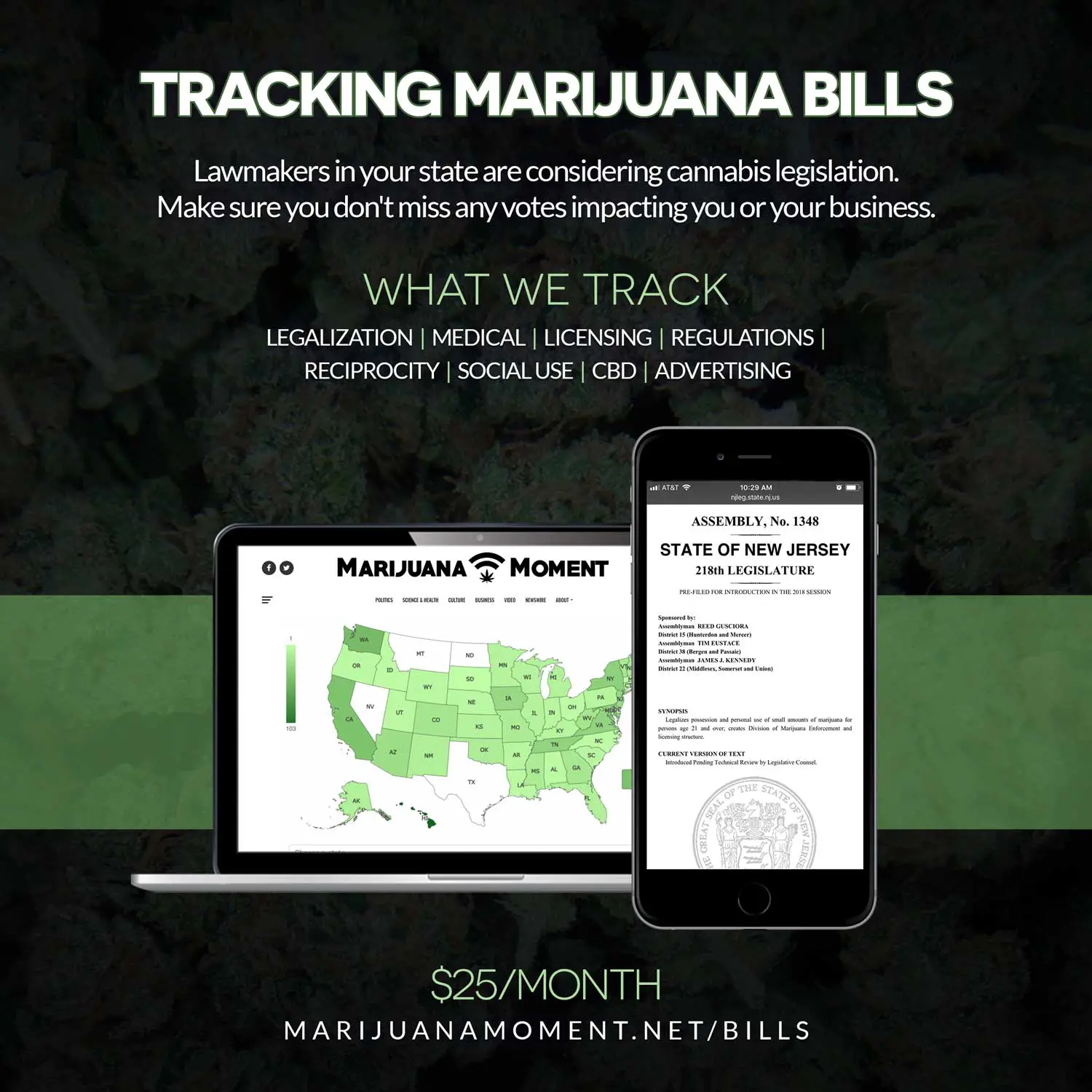
Learn more about our marijuana bill tracker and become a supporter on Patreon to get access.
—
The state Cannabis Control Commission (CCC) recently launched an online platform aimed at helping people find jobs, workplace training and networking opportunities in the state’s legal cannabis industry.
State lawmakers have also been considering setting tighter restrictions on intoxicating hemp-derived products and a plan to allow individual entities to control a larger number of cannabis establishments.
Also in Massachusetts, legislators who were working on a state budget butted heads with CCC officials, who’ve said they can’t make critical technology improvements without more money from the legislature.
Massachusetts lawmakers additionally approved a bill to establish a pilot program for the regulated therapeutic use of psychedelics. And two committees have separately held hearings to discuss additional psilocybin-related measures.
Photo courtesy of Chris Wallis // Side Pocket Images.