Politics
Marijuana Isn’t ‘Chill’ And Is Actually More Dangerous Than Alcohol, Anti-Legalization Groups Tell Supreme Court In Brief For Gun Rights Case

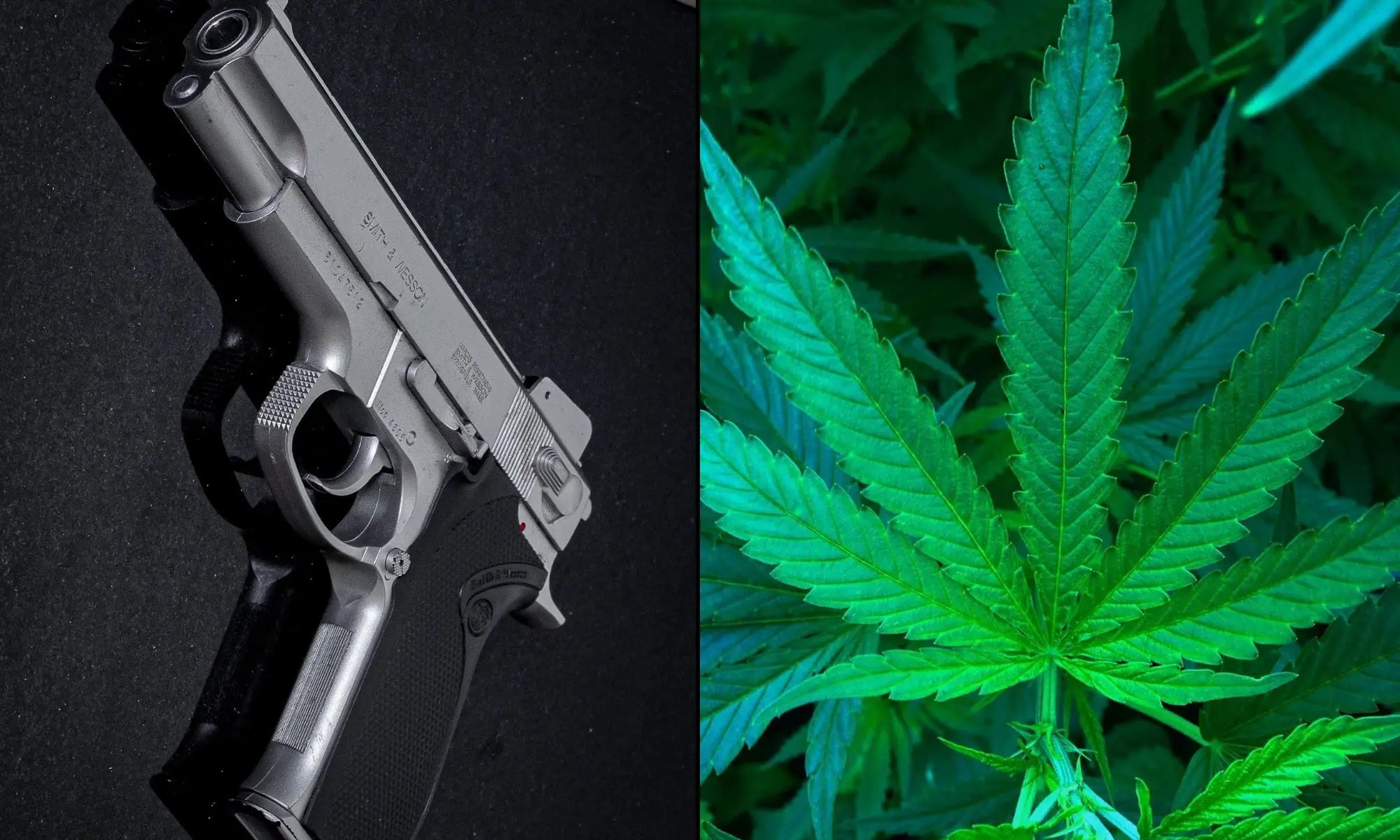
A coalition of anti-marijuana organizations is urging the U.S. Supreme Court to side with the federal government by upholding the constitutionality of a federal ban on gun ownership by people who use cannabis—which they claim is associated with violence and psychosis.
In an amicus brief submitted to justices on Monday for a marijuana and firearms case, U.S. v. Hemani, Smart Approaches to Marijuana (SAM) and 21 other prohibitionist groups said that while cannabis is “marketed as a ‘chill’ drug by its peddlers,” today’s product has “become increasingly known for its relationship with violence.”
“Given the shared national work amici are doing to stop the flow of drugs and their harms to society, they have a strong interest in laws restricting drug users’ access to firearms,” the brief said. “The evidence is clear: today’s highly potent marijuana causes psychosis, schizophrenia, other forms of severe mental illness, and violent behavior.”
It added that if the federal statute known as 922(g)(3) is deemed unconstitutional—as multiple federal courts have determined in the lead-up to SCOTUS taking the Hemani case—would “magnify these harms exponentially and devastate America’s families.”
The overarching argument of the brief is the idea that marijuana is strongly linked to mental illness, which may make a more compelling reason to maintain the gun ban given the need to establish a historical, legal analogue going back to the country’s founding under recent Supreme Court precedent.
“Marijuana is thus strongly associated with long-lasting mental illness,” it said. “This court has already recognized that mental illness is a compelling reason to restrict gun ownership.”
But the prohibitionist organizations’ brief raised eyebrows for another reason: It claimed marijuana use is more dangerous to society and a person’s mental health than alcohol, despite conflicting data from studies the filing did not cite.
“Unlike alcohol use, marijuana use has long had a documented, causal relationship with schizophrenia and psychosis,” it said. “Alcohol’s relationship with mental distress typically ends when the user is no longer feeling its effects. Marijuana’s relationship with mental illness is often only getting started there: When regular marijuana users develop cases of schizophrenia or psychosis, these ailments often endure.”
The point echoes a recent filing from the Justice Department itself in Hemani, with U.S. Solicitor General D. John Sauer advising justices that people who use illegal drugs “pose a greater danger” than those who drink alcohol.
In addition to SAM, the new brief was also signed by Americans Against Legalizing Marijuana, Cannabis Industry Victims Educating Litigators, CADCA, Drug Watch International Inc., Drug Free America Foundation, Save Our Society from Drugs, National Families in Action and 14 other groups.
“The state-level legalization of marijuana has spawned big business, with large corporations competing to create stronger products designed to addict users,” they said. “As marijuana has become a competitive, commercialized product, its potency has soared, leading to substantial harm to public health and safety.”
“The drug has thus become much more deleterious to mental health: Marijuana use is now a leading risk factor for schizophrenia, psychosis, and other forms of mental illness,” the brief continues. “Marijuana is now also a common denominator in many instances of gun violence. Because of marijuana’s causal relationship with an increased risk of mental illness and violence, this Court should affirm the federal prohibition on drug users owning firearms.”
The DOJ and amicus briefs were filed as rumors swell that President Donald Trump intends to issue an executive order directing federal agencies to reclassify marijuana, moving it from Schedule I to Schedule III of the Controlled Substances Act (CSA). Whether that happens is yet to be seen.
Meanwhile, the Biden administration was evidently concerned about potential legal liability in federal cases for people convicted of violating gun laws simply by being a cannabis consumer who possessed a firearm, documents recently obtained by Marijuana Moment show.
The previously unpublished 2024 guidance from former President Joe Biden’s Justice Department generally cautioned U.S. attorneys to use discretion in prosecuting federal cannabis cases, particularly for offenses that qualified people for pardons during his term. But one section seems especially relevant as the Supreme Court takes on a case challenging the constitutionality of the current federal gun statute.
With respect to Hemani, in a separate August filing for the case, the Justice Department also emphasized that “the question presented is the subject of a multi-sided and growing circuit conflict.” In seeking the court’s grant of cert, the solicitor general also noted that the defendant is a joint American and Pakistani citizen with alleged ties to Iranian entities hostile to the U.S., putting him the FBI’s radar.
Now that the Supreme Court has agreed to take up Hemani, if justices declare 922(g)(3) constitutional, such a ruling could could mean government wins in the remaining cases. The high court last month denied a petition for cert in U.S. v. Cooper, while leaving pending decisions on U.S. v. Daniels and U.S. v. Sam.
The court also recently denied a petition for cert in another gun and marijuana case, U.S. v. Baxter, but that wasn’t especially surprising as both DOJ and the defendants advised against further pursing the matter after a lower court reinstated his conviction for being an unlawful user of a controlled substance in possession of a firearm.
Meanwhile, in recent interviews with Marijuana Moment, several Republican senators shared their views on the federal ban on gun possession by people who use marijuana—with one saying that if alcohol drinkers can lawfully buy and use firearms, the same standard should apply to cannabis consumers.
Separately, the U.S. Court of Appeals for the Tenth Circuit earlier this year sided with a federal district court that dismissed an indictment against Jared Michael Harrison, who was charged in Oklahoma in 2022 after police discovered cannabis and a handgun in his vehicle during a traffic stop.
The case has now been remanded to that lower court, which determined that the current statute banning “unlawful” users of marijuana from possessing firearms violates the Second Amendment of the Constitution.
The lower court largely based his initial decision on an interpretation of a Supreme Court ruling in which the justices generally created a higher standard for policies that seek to impose restrictions on gun rights.
Separately, in the U.S. Court of Appeals for the Eleventh District, judges recently ruled in favor of medical cannabis patients who want to exercise their Second Amendment rights to possess firearms.
As a recent report from the Congressional Research Service (CRS) explained the current legal landscape, a growing number of federal courts are now “finding constitutional problems in the application of at least some parts” of the firearms prohibition.
In a recent ruling, a three-judge panel for the U.S. Court of Appeals for the Eighth Circuit vacated a defendant’s conviction and remanded the case back to a district court, noting that a retrial before a jury may be necessary to determine whether cannabis in fact caused the defendant to be dangerous or pose a credible threat to others.
The Third Circuit separately said in a published opinion that district courts must make “individualized judgments” to determine whether 922(g)(3) is constitutional as applied to particular defendants.
A federal court in October agreed to delay proceedings in a years-long Florida-based case challenging the constitutionality of the ban on gun ownership by people who use medical marijuana, with the Justice Department arguing that the Supreme Court’s recent decision to take up Hemani warrants a stay in the lower court.
—
Marijuana Moment is tracking hundreds of cannabis, psychedelics and drug policy bills in state legislatures and Congress this year. Patreon supporters pledging at least $25/month get access to our interactive maps, charts and hearing calendar so they don’t miss any developments.
Learn more about our marijuana bill tracker and become a supporter on Patreon to get access.
—
Earlier this year, a federal judge in Rhode Island ruled that the ban was unconstitutional as applied to two defendants, writing that the government failed to establish that the “sweeping” prohibition against gun ownership by marijuana users was grounded in historical precedent.
A federal judge in El Paso separately ruled late last year that the government’s ongoing ban on gun ownership by habitual marijuana users is unconstitutional in the case of a defendant who earlier pleaded guilty to the criminal charge. The court allowed the man to withdraw the plea and ordered that the indictment against him be dismissed.
DOJ has claimed in multiple federal cases over the past several years that the statute banning cannabis consumers from owning or possessing guns is constitutional because it’s consistent with the nation’s history of disarming “dangerous” individuals.
In 2023, for example, the Justice Department told the U.S. Court of Appeals for the Third Circuit that historical precedent “comfortably” supports the restriction. Cannabis consumers with guns pose a unique danger to society, the Biden administration claimed, in part because they’re “unlikely” to store their weapon properly.
Meanwhile, some states have passed their own laws either further restricting or attempting to preserve gun rights as they relate to marijuana.
Recently a Pennsylvania lawmaker introduced a bill meant to remove state barriers to medical marijuana patients carrying firearms.
Colorado activists also attempted to qualify an initiative for November’s ballot that would have protected the Second Amendment rights of marijuana consumers in that state, but the campaign’s signature-gathering drive ultimately fell short.
As 2024 drew to a close, the ATF issued a warning to Kentucky residents that, if they choose to participate in the state’s medical marijuana program that’s set to launch imminently, they will be prohibited from buying or possessing firearms under federal law.
The official said that while people who already own firearms aren’t “expected to” turn them over if they become state-legal cannabis patients, those who “wish to follow federal law and not be in violation of it” must “make the decision to divest themselves of those firearms.”
Since then, bipartisan state lawmakers have introduced legislation that would urge Kentucky’s representatives in Congress to amend federal law to clarify that users of medical marijuana may legally possess firearms, though no action has since been taken on that bill.
Kentucky Gov. Andy Beshear (D) said in January that he supported the legislature’s effort to urge the state’s congressional delegation to call for federal reforms to protect the Second Amendment rights of medical marijuana patients, but the governor added that he’d like to see even more sweeping change on the federal level.