Politics
GOP Congressman Says Trump ‘Technically’ Can’t Reschedule Marijuana On His Own, But Reversing It In Congress Would Be A ‘Heavy Lift’

A GOP congressman says President Donald Trump doesn’t have the authority to unilaterally reschedule marijuana via executive order. But while lawmakers could overrule any administrative move to enact the reform, it would be a “heavy lift” in the Republican-controlled Congress, he acknowledged.
Rep. Andy Harris (R-MD)—a staunch prohibitionist who recently helped secure provisions in a spending bill Trump signed that would effectively recriminalize hemp—shared his views about the marijuana rescheduling proposal and limitations of a Schedule III reclassification under the Controlled Substances Act (CSA) on Tuesday during a webinar organized by the National Drug and Alcohol Screening Association (NDASA).
Harris adamantly opposes the potential rescheduling action, arguing that it would further normalize marijuana use and do little to expand research opportunities to examine the plant’s health benefits or risks. And he said the president was mistaken when he said on Monday that reclassification is necessary to conduct the research.
The congressman also argued that Trump is “technically” wrong if he’s under the impression he can move marijuana from Schedule I to Schedule III with a stroke of the pen on an executive order. Rescheduling wouldn’t legalize marijuana, but it’d be a historically symbolic recognition that cannabis holds medical value, while enabling marijuana businesses to take federal tax deductions available to other industries.
“He can tell any agencies to make every effort” by executive order Harris acknowledged, “but I’m not sure that it’s legal for the president to do it.”
“Obviously the executive branch can do it without congressional input. We could always override it, but that would be a heavy lift,” he said.
Harris also touted the fact that he’s “led the charge against recreational marijuana in the District of Columbia for over 10 years,” primarily by ensuring the continuing annual renewal of an appropriations rider barring Washington, D.C. from using its tax dollars to legalize marijuana sales, despite voters approving legalization over a decade ago.
“I don’t believe that it’s a safe drug to have out there,” he said, adding that the process of getting a medical marijuana recommendation that permits access at the state level is a “scam” and “we don’t really need to reschedule it.”
While the president said a Schedule III reclassification would bolster research into cannabis, Harris said he’s worked across the aisle with Democrats such as former Rep. Earl Blumenauer (D-OR), a key champion of legalization, to address the study barriers issue through separate legislation they passed and which was signed into law by President Joe Biden.
Blumenauer “thinks that if you do all the research, you’re going to show all these great things marijuana does medically,” Harris said. “I think, if you do the research, you’ll find out there’s very little that marijuana is actually a first-line or even a second-line drug.”
“To use doing research as an excuse to go from schedule one to schedule three is just not fair. It’s not accurate. You can do all the research you want on Schedule I,” he said. However, that’s not strictly true, as researchers interested in studying Schedule I drug must obtain Drug Enforcement Administration (DEA) approval to use or import those substances and follow other more stringent reporting requirements that even the head of the National Institute on Drug Abuse (NIDA) has described as excessively burdensome.
“We have to join arms in this and say, rescheduling ‘is just not right’ and ‘not a good decision for the health of America,'” Harris said. “That’s the bottom line. I think there is no evidence that it’s good, and there’s plenty of evidence now that chronic use of marijuana—especially in teenage years, especially before the brain is fully formed—is probably just a bad idea, and encouraging in any way, shape or form, such as reducing the scheduling, just has no basis in science or medical fact.”
“I’m hoping that there is some pushback from within the administration by calmer, cooler heads saying, ‘time out—let’s think this through very carefully. Let’s get the experts in from the administration.’ And I don’t mean the marijuana industry, because we know their famous meetings with the president, with people who make a lot of money in that industry. I mean the scientists like [NIDA Director Nora Volkow] to sit down and to talk some sense into the people who would otherwise consider this.”
Meanwhile, another GOP congressman said on Monday that Trump would be “wrong” to move forward with the plan to reschedule marijuana, which he described as a “gateway drug” that leads to the use of “harder substances”—despite numerous studies contradicting that theory.
Though speculation about an imminent action has been swirling this month, it remains to be seen whether Trump will ultimately fulfill his campaign promise to move cannabis to Schedule III. He endorsed the reform—as well as industry banking access and a Florida adult-use legalization initiative—on the campaign trail last year. But he’s since been largely silent on the issue since taking office during his second term, unless prompted by reporters.
Meanwhile, multiple top congressional Democrats are making the case that the modest reform would not go far enough—including Sen. Ron Wyden (R-OR) who said the move is only an attempt by the president to “gaslight” voters into thinking he legalized cannabis to boost his “pathetic” approval ratings.
A major drug testing industry organization separately said it’s “sounding the alarm” amid the reports Trump may soon finalize the rescheduling proposal, arguing that the policy change would “have catastrophic consequences for the safety of the United States workforce and transportation sectors.”
—
Marijuana Moment is tracking hundreds of cannabis, psychedelics and drug policy bills in state legislatures and Congress this year. Patreon supporters pledging at least $25/month get access to our interactive maps, charts and hearing calendar so they don’t miss any developments.
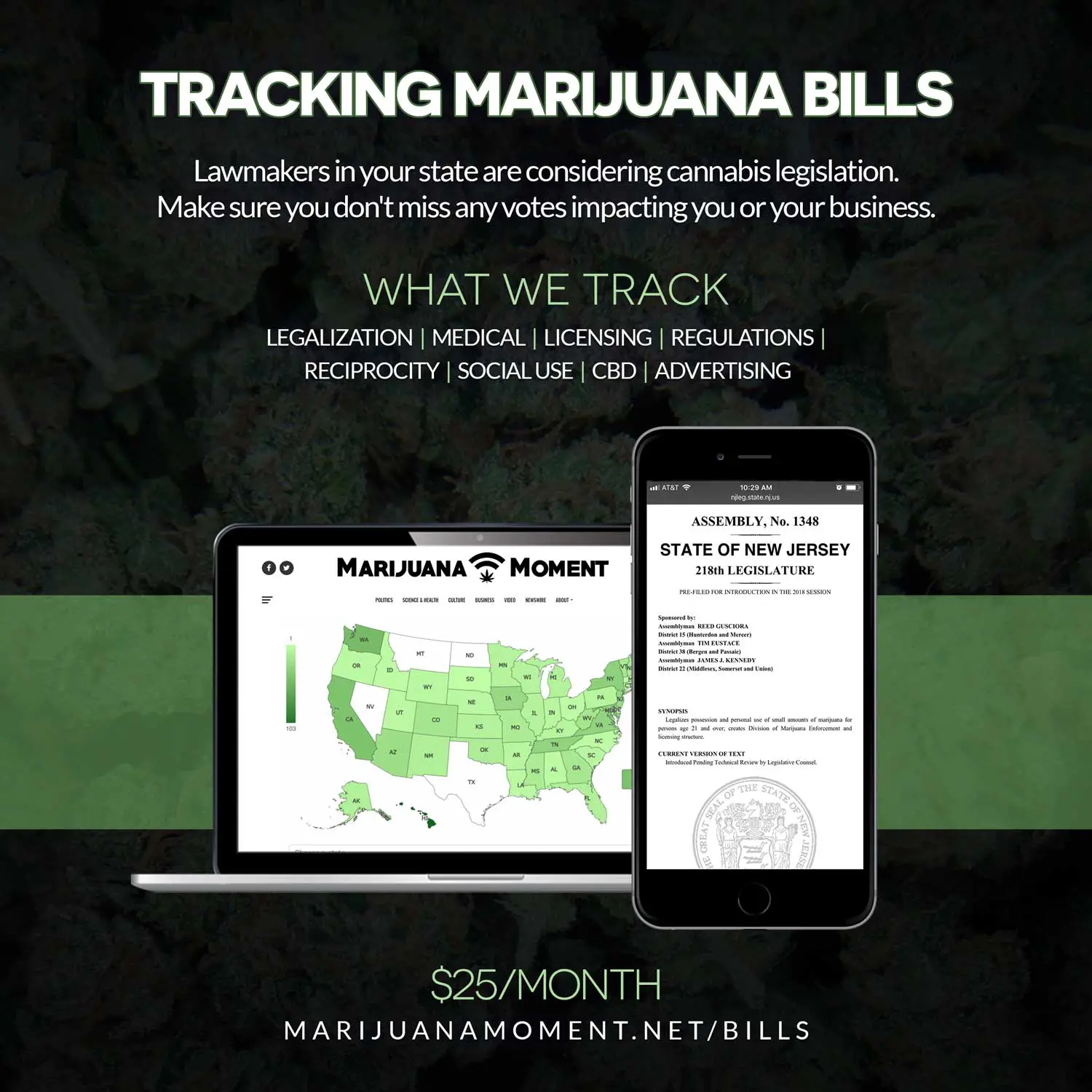
Learn more about our marijuana bill tracker and become a supporter on Patreon to get access.
—
Cannabis industry stakeholders are holding out hope that the reform will be achieved as soon as possible, but opponents—including NDASA and Smart Approaches to Marijuana (SAM)—are working to dissuade the administration before a final decision is made.
For what it’s worth, a White House spokesperson told Marijuana Moment last week that no actions have been finalized so far.
Bipartisan congressional lawmakers have been weighing in on the potential rescheduling decision over the past week—with Democrats like Rep. Alex Ocasio-Cortez (D-NY) calling the reform a “no-brainer” and others like Rep. Andy Harris (R-MD) pushing back against the proposal.
The Washington Post reported last week that Trump was planning to issue an executive order directing federal agencies to move ahead with cannabis rescheduling.
The outlet also said the president met earlier this week in the Oval Office with marijuana industry executives, Health and Human Services Secretary Robert F. Kennedy Jr. and Centers for Medicare and Medicaid Services Administrator Mehmet Oz. During that meeting, Trump phoned Johnson, the House speaker, who expressed his opposition to rescheduling cannabis,
If the administration does ultimately enact rescheduling, it would mark one of the most significant developments in federal marijuana policy since its prohibition a half a century ago, with a Schedule III reclassification recognizing that marijuana has medical value and a lower abuse potential compared to other Schedule I drugs like heroin.
Photo courtesy of Philip Steffan.