Politics
Florida Marijuana Campaign Asks Supreme Court To Restore 71,000 Legalization Ballot Signatures State Officials Tossed

A Florida campaign hasn’t thrown in the towel just yet on its proposal to put marijuana legalization on the November ballot, with an appeal concerning the invalidation of about 71,000 signatures now before the state Supreme Court.
While the court recently agreed to close a separate case involving a legal review into the ballot measure from Smart & Safe Florida, it’s now been handed another case challenging the earlier mass signature invalidation.
The state’s First District Court of Appeal submitted a notice to invoke discretionary jurisdiction and notice of appeal to the Florida Supreme Court on Monday, opening back up the possibility that voters could decide on legalization at the polls later this year. That’s contingent on justices accepting the case and the campaign prevailing, of course.
Smart & Safe Florida “contends that approximately 70,000 petitions designated as invalid should be counted towards the number of signed petitions required for ballot placement,” the notice states. “Smart & Safe Florida invokes the discretionary jurisdiction of the Florida Supreme Court to review the decision of this court rendered January 23, 2026. The decision expressly affects a class of constitutional or state officers.”
Back in December, advocates filed a lawsuit in the Leon County circuit court, claiming Secretary of State Cord Byrd (R) unlawfully directed county election officials to invalidate about 42,000 signatures from so-called “inactive” voters and roughly 29,000 signatures collected by out-of-state petitioners.
That lawsuit came after another court upheld a previous decision to strike about 200,000 signatures that the state said were invalid because the petitions didn’t include the full text of the proposed initiative. The campaign contested the legal interpretation, but it declined to appeal the decision based on their confidence they’d collected enough signatures to make up the difference.
Smart & Safe Florida has generally disputed the secretary of state’s signature count, asserting the campaign submitted over 1.4 million petitions—hundreds of thousands more than the 880,062 valid signatures required to go before voters.
In a recent filing with the Supreme Court, Attorney General James Uthmeier (R) said his office was withdrawing its earlier request for a legal review in the constitutionality of the proposed cannabis initiative because the state claimed the campaign submitted an insufficient number of signed petitions. The last count, according to the secretary of state’s office, was 783,592 validated signatures.
In its reply brief, Smart & Safe Florida said the secretary of state’s office made a determination that the campaign didn’t satisfy requirements for ballot placement based on a “conclusion that the Sponsor failed to meet the requisite signature threshold in light of the invalidations that the Sponsor is contesting.”
Ahead of the signature turn-in, Florida’s attorney general and several business and anti-marijuana groups urged the state Supreme Court to block the cannabis initiative, calling it “fatally flawed” and unconstitutional.
The Florida Chamber of Commerce, Florida Legal Foundation and Judge Frank Shepherd filed a separate joint brief stating that the parties remain “especially vigilant about the abuse of the citizen initiative process by out-of-state interests that think of Florida as just another market and the citizen initiative process as just another means of exploiting that market.”
The Florida Chamber of Commerce has consistently opposed attempts to move forward with adult-use legalization, even as its own polling has shown majority support for the reform.
The campaign fought several legal battles this cycle to ensure that its initiative is able to qualify for ballot placement.
Last month, the state attorney general’s office opened dozens of criminal investigations and submitted subpoenas requesting records from Smart & Safe Florida and its contractors and subcontractors over alleged fraud related to the petitioning effort.
Activists said in November that they’d collected more than one million signatures to put the cannabis measure on the ballot, but it’s also challenged officials at the state Supreme Court level over delays the certification process, arguing that the review of the ballot content and summary should have moving forward months ago when it reached an initial signature threshold. The state then agreed to move forward with the processing.
Gov. Ron DeSantis (R) campaigned heavily against an earlier version of the legalization proposal, which received a majority of voters in 2024 but not enough to meet the 60 percent threshold required to pass a constitutional amendment. Former Attorney General Ashley Moody (R) unsuccessfully contested the prior initiative in the courts.
Last March, meanwhile, two Democratic members of Congress representing Florida asked the federal government to investigate what they described as “potentially unlawful diversion” of millions in state Medicaid funds via a group with ties to DeSantis. The money was used to fight against a citizen ballot initiative, vehemently opposed by the governor, that would have legalized marijuana for adults.
The lawmakers’ letter followed allegations that a $10 million donation from a state legal settlement was improperly made to the Hope Florida Foundation, which later sent the money to two political nonprofits, which in turn sent $8.5 million to a campaign opposing Amendment 3.
The governor said last February that the newest marijuana legalization measure is in “big time trouble” with the state Supreme Court, predicting it would be blocked from going before voters this year.
“There’s a lot of different perspectives on on marijuana,” DeSantis said. “It should not be in our Constitution. If you feel strongly about it, you have elections for the legislature. Go back candidates that you believe will be able to deliver what your vision is on that.”
“But when you put these things in the Constitution—and I think, I mean, the way they wrote, there’s all kinds of things going on in here. I think it’s going to have big time trouble getting through the Florida Supreme Court,” he said.
The latest initiative was filed with the secretary of state’s office just months after the initial version failed during the November 2024 election—despite an endorsement from President Donald Trump.
Smart & Safe Florida expressed optimism that the revised version would succeed in 2026. The campaign—which in the last election cycle received tens of millions of dollars from cannabis industry stakeholders, principally the multi-state operator Trulieve—incorporated certain changes into the new version that seem responsive to criticism opponents raised during the 2024 push.
For example, it now specifically states that the “smoking and vaping of marijuana in any public place is prohibited.”Another section asserts that the legislature would need to approve rules dealing with the “regulation of the time, place, and manner of the public consumption of marijuana.”
In 2023, the governor accurately predicted that the 2024 cannabis measure from the campaign would survive a legal challenge from the state attorney general. It’s not entirely clear why he feels this version would face a different outcome.
While there’s uncertainty around how the state’s highest court will navigate the measure, a poll released last February showed overwhelming bipartisan voter support for the reform—with 67 percent of Florida voters backing legalization, including 82 percent of Democrats, 66 percent of independents and 55 percent of Republicans.
—
Marijuana Moment is tracking hundreds of cannabis, psychedelics and drug policy bills in state legislatures and Congress this year. Patreon supporters pledging at least $25/month get access to our interactive maps, charts and hearing calendar so they don’t miss any developments.
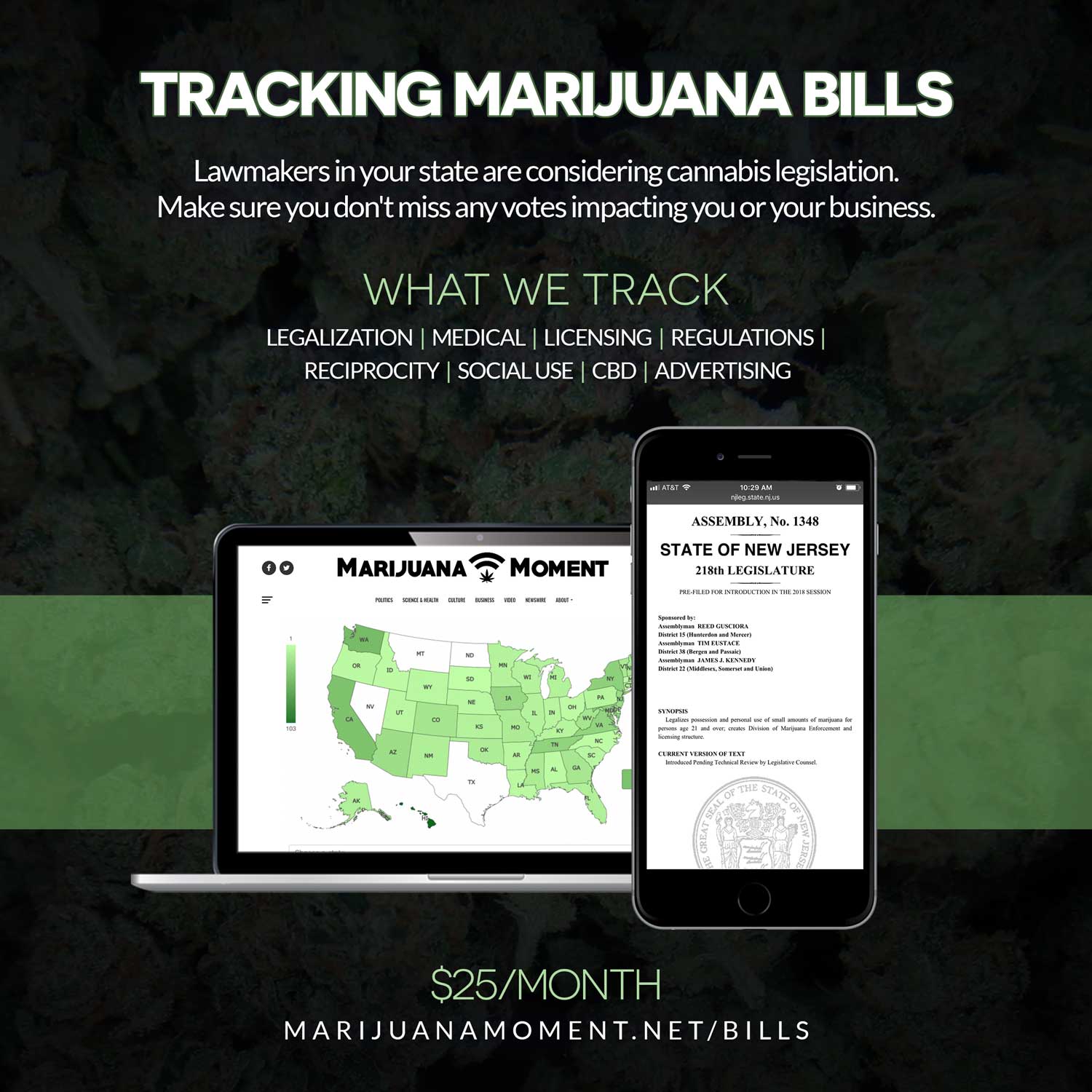
Learn more about our marijuana bill tracker and become a supporter on Patreon to get access.
—
In the background, a recent poll from a Trump-affiliated research firm found that nearly 9 in 10 Florida voters say they should have the right to decide to legalize marijuana in the state.
Meanwhile, last week, Florida senators approved an amended bill to increase the amount of medical marijuana a registered patient can buy and slash the fee for medical cannabis identification cards for military veterans.
The vote came after the Senate Regulated Industries Committee passed separate legislation to ban smoking or vaping marijuana in public places. Rep. Alex Andrade (R) is sponsoring a similar bill to ban public cannabis smoking in the House.
Here’s an overview of other pending Florida marijuana bills:
- A House lawmaker is sponsoring a bill to legalize recreational marijuana that also aims to break up what he calls “monopolies” in the state’s current medical cannabis program by revising the business licensing structure.
- Another representative’s bill would protect the parental rights of medical cannabis patients, preventing them from losing custody of their children for using their medicine in accordance with state law.
- A senator is sponsoring a bill to legalize home cultivation of marijuana for registered medical cannabis patients in the state.
Photo elements courtesy of rawpixel and Philip Steffan.