Politics
Florida GOP Senator’s Bill Would Expand Medical Marijuana Law By Waiving Fees For Veterans And Making Patient Cards Last Twice As Long

A Florida Republican senator has filed a bill to expand the state’s medical marijuana program, in part by increasing supply limits for patients and waiving registration fees for honorably discharged military veterans.
The legislation from Sen. Alexis Calatayud (R), filed for the 2026 session on Tuesday, would also make it so medical cannabis registrations could last up to two years instead of the current 30 weeks.
Another section of the bill stipulates that doctors could certify patients to receive up to 10 70-day supply limits of smokable medical marijuana, rather than three. They could also issue up to 20 35-day supply limits instead of the current six.
A similar version of legislation was introduced in the House by Rep. Bill Partington (R) earlier this month.
That bill additionally called for reciprocity in the program, requiring regulators to create a process to issue medical cannabis registration cards to “nonresidents who are actively enrolled in the medical cannabis program of another jurisdiction recognized by the department within 1 business day.” It specifies that “a visiting qualified patient may engage in all conduct authorized for a qualified patient.”
It would also allow doctors to recommend cannabis to any patient who has a condition for which they have been prescribed opioids.
Another provision of the House bill absent from the new Senate version would allow doctors to recommend medical cannabis via telehealth without a physical examination—expanding a current policy that allows renewals, but not initial certifications, to be conducted remotely.
Other recently filed bills in the legislature for 2026 would reduce medical cannabis patient registration fees for military veterans and clarify that smoking or vaping marijuana in public places is prohibited.
Meanwhile, a Florida Democratic senator introduced legislation for the 2026 session that would legalize home cultivation of marijuana for registered medical cannabis patients in the state.
The proposal would permit qualified patients who are at least 21 years old to cultivate up to six flowering plants for personal, therapeutic use. Those patients could also buy seeds and clones from licensed dispensaries.
If enacted into law, the bill would become law on July 1, 2026. A similar proposal was introduced at the beginning of this year by Sen. Joe Gruters (R), who is now chairman of the Republican National Committee, but it did not advance.
Gruters and Kim Rivers—the CEO of Trulieve, a medical marijuana company that provided the bulk of funding for an unsuccessful cannabis legalization ballot initiative last year—also met with President Donald Trump ahead of his endorsement of the constitutional amendment, as well as federal rescheduling and industry banking access.
The campaign behind that initiative, Smart & Safe Florida, recently said it’s collected more than one million signatures to put a new version of the legalization measure on the 2026 ballot. But the signature gathering process has hit multiple snags that have led to litigation, including a new lawsuit filed by activists challenging the state’s decision to invalidate another 71,000 signatures over issues related to “inactive” voters and out-of-state petitioners.
This comes after another court upheld a previous decision to strike about 200,000 signatures that the state said were invalid because the petitions didn’t include the full text of the proposed initiative. The campaign contested the legal interpretation, but it declined to appeal the decision based on their confidence they’d collected enough signatures to make up the difference.
Now, with a February 1 deadline to submit 880,062 valid signatures just about a month away, Smart & Safe Florida is signaling that the additional invalidations could jeopardize their chances of making the ballot. Currently, the state has validated 675,307 signatures.
Meanwhile, earlier this month, Florida’s attorney general asked the state Supreme Court to review the constitutionality of the legalization initiative. The court accepted the request and set a schedule for state officials and the cannabis campaign to file briefs next month.
Florida Gov. Ron DeSantis (R) campaigned heavily against an earlier version of the legalization proposal, which received a majority of voters last year but not enough to meet the 60 percent threshold required to pass a constitutional amendment. Former Attorney General Ashley Moody (R) unsuccessfully contested the prior initiative in the courts.
In March, meanwhile, two Democratic members of Congress representing Florida asked the federal government to investigate what they described as “potentially unlawful diversion” of millions in state Medicaid funds via a group with ties to Gov. Ron DeSantis (R). The money was used to fight against a citizen ballot initiative, vehemently opposed by the governor, that would have legalized marijuana for adults.
—
Marijuana Moment is tracking hundreds of cannabis, psychedelics and drug policy bills in state legislatures and Congress this year. Patreon supporters pledging at least $25/month get access to our interactive maps, charts and hearing calendar so they don’t miss any developments.
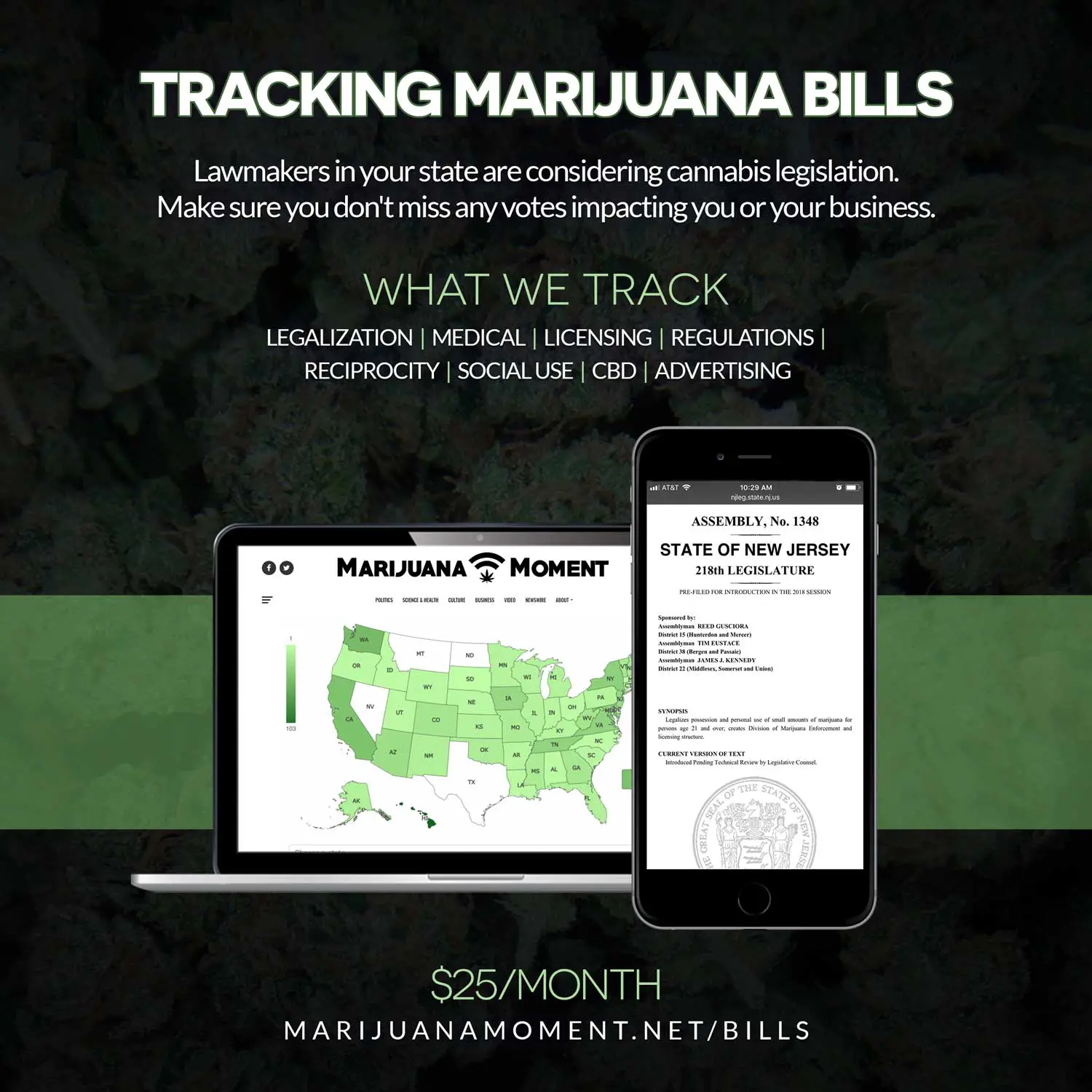
Learn more about our marijuana bill tracker and become a supporter on Patreon to get access.
—
In the background, a recent poll from a Trump-affiliated research firm found that nearly 9 in 10 Florida voters say they should have the right to decide to legalize marijuana in the state.
Meanwhile, a pro-legalization GOP state lawmaker recently filed a bill to amend state law to codify that the public use of marijuana is prohibited.
Rep. Alex Andrade (R), the sponsor, said earlier this year that embracing cannabis reform is a way for the Republican party to secure more votes from young people.
Separately, Florida medical marijuana officials are actively revoking the registrations of patients and caregivers with drug-related criminal records. The policy is part of broad budget legislation signed into law earlier this year by DeSantis. The provisions in question direct the state Department of Health (DOH) to cancel registrations of medical marijuana patients and caregivers if they’re convicted of—or plead guilty or no contest to—criminal drug charges.
Photo courtesy of Brian Shamblen.