Politics
Florida GOP Lawmaker Files Medical Marijuana Expansion Bill Allowing Patients To Qualify If They’ve Been Prescribed Opioids

A Florida Republican lawmaker has introduced a bill to expand the state’s medical marijuana program in a number of ways, including by allowing doctors to recommend cannabis to any patient who has a condition for which they have been prescribed opioids.
The legislation from Rep. Bill Partington (R), filed for the 2026 session on Wednesday, would also make it so medical marijuana registrations could last up to two years instead of the current 30 weeks, and it’d waive patient registration fees for honorably discharged military veterans.
Under the proposal, doctors would additionally be able to recommend medical cannabis via telehealth without a physical examination—expanding a current policy that allows renewals, but not initial certifications, to be conducted remotely.
There are also reciprocity provisions built into the measure, requiring regulators to create a process to issue medical cannabis registration cards to “nonresidents who are actively enrolled in the medical cannabis program of another jurisdiction recognized by the department within 1 business day.” It specifies that “a visiting qualified patient may engage in all conduct authorized for a qualified patient.”
Another section of the bill stipulates that doctors could certify patients to receive up to 10 70-day supply limits of smokable medical marijuana, rather than three. They could also issue up to 20 35-day supply limits instead of the current six.
The measure is being filed just days after a Florida Democratic senator introduced legislation for the 2026 session that would legalize home cultivation of marijuana for registered medical cannabis patients in the state.
The proposal would permit qualified patients who are at least 21 years old to cultivate up to six flowering plants for personal, therapeutic use. Those patients could also buy seeds and clones from licensed dispensaries.
If enacted into law, the bill would become law on July 1, 2026. A similar proposal was introduced at the beginning of this year by Sen. Joe Gruters (R), who is now chairman of the Republican National Committee, but it did not advance.
Gruters and Kim Rivers—the CEO of Trulieve, a medical marijuana company that provided the bulk of funding for an unsuccessful cannabis legalization ballot initiative last year—also met with Preident Donald Trump ahead of his endorsement of the constitutional amendment, as well as federal rescheduling and industry banking access.
Notably, Amendment 3 would not have legalized home cultivation of marijuana—a detail seized on by some critics of the industry-backed proposal.
The campaign behind that initiative, Smart & Safe Florida, recently said it’s collected more than one million signatures to put a new version of the legalization measure on the 2026 ballot—and so it voluntarily declined to appeal a legal case in which a judge allowed state officials to invalidate about 200,000 petitions over a largely procedural issue.
Smart & Safe filed a separate lawsuit with the state Supreme Court over another issue last month, alleging that officials are violating election laws by stalling a required review process for the measure without justification. The state has since agreed to move forward with the processing.
A federal judge in August separately delivered a win to the campaign—granting “complete relief” from provisions of a law the governor signed to impose other serious restrictions on signature gathering.
In March, meanwhile, two Democratic members of Congress representing Florida asked the federal government to investigate what they described as “potentially unlawful diversion” of millions in state Medicaid funds via a group with ties to Gov. Ron DeSantis (R). The money was used to fight against a citizen ballot initiative, vehemently opposed by the governor, that would have legalized marijuana for adults.
The lawmakers’ letter followed allegations that a $10 million donation from a state legal settlement was improperly made to the Hope Florida Foundation, which later sent the money to two political nonprofits, which in turn sent $8.5 million to a campaign opposing Amendment 3.
The governor said in February that the newest marijuana legalization measure is in “big time trouble” with the state Supreme Court, predicting it will be blocked from going before voters next year.
“There’s a lot of different perspectives on on marijuana,” DeSantis said. “It should not be in our Constitution. If you feel strongly about it, you have elections for the legislature. Go back candidates that you believe will be able to deliver what your vision is on that.”
“But when you put these things in the Constitution—and I think, I mean, the way they wrote, there’s all kinds of things going on in here. I think it’s going to have big time trouble getting through the Florida Supreme Court,” he said.
The latest initiative was filed with the secretary of state’s office just months after the initial version failed during the November 2024 election—despite an endorsement from President Donald Trump.
Smart & Safe Florida is hoping the revised version will succeed in 2026. The campaign—which in the last election cycle received tens of millions of dollars from cannabis industry stakeholders, principally the multi-state operator Trulieve—incorporated certain changes into the new version that seem responsive to criticism opponents raised during the 2024 push.
For example, it now specifically states that the “smoking and vaping of marijuana in any public place is prohibited.”Another section asserts that the legislature would need to approve rules dealing with the “regulation of the time, place, and manner of the public consumption of marijuana.”
Last year, the governor accurately predicted that the 2024 cannabis measure from the campaign would survive a legal challenge from the state attorney general. It’s not entirely clear why he feels this version would face a different outcome.
While there’s uncertainty around how the state’s highest court will navigate the measure, a poll released in February showed overwhelming bipartisan voter support for the reform—with 67 percent of Florida voters backing legalization, including 82 percent of Democrats, 66 percent of independents and 55 percent of Republicans.
—
Marijuana Moment is tracking hundreds of cannabis, psychedelics and drug policy bills in state legislatures and Congress this year. Patreon supporters pledging at least $25/month get access to our interactive maps, charts and hearing calendar so they don’t miss any developments.
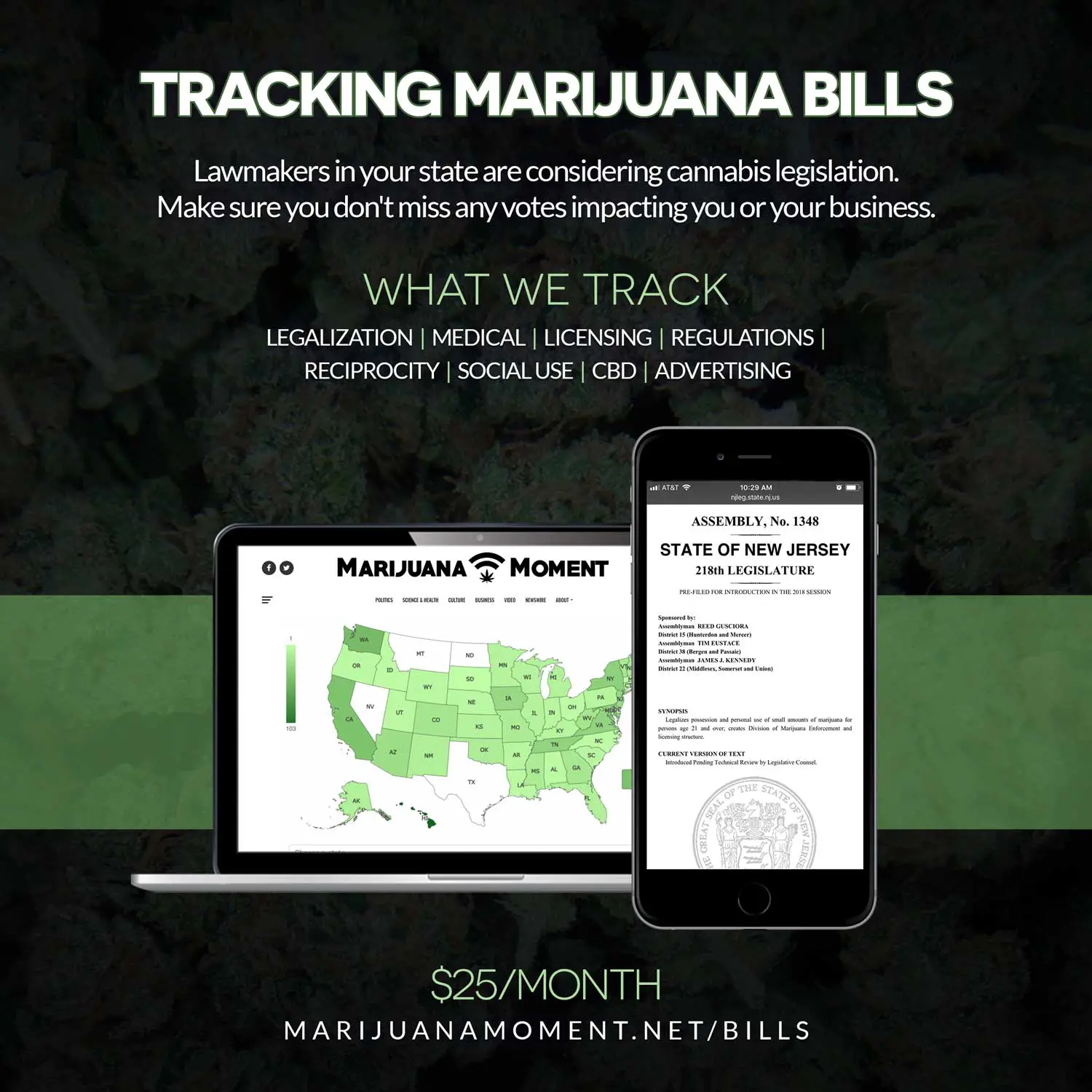
Learn more about our marijuana bill tracker and become a supporter on Patreon to get access.
—
In the background, a recent poll from a Trump-affiliated research firm found that nearly 9 in 10 Florida voters say they should have the right to decide to legalize marijuana in the state.
Meanwhile, a pro-legalization GOP state lawmaker recently filed a bill to amend state law to codify that the public use of marijuana is prohibited.
Rep. Alex Andrade (R), the sponsor, said earlier this year that embracing cannabis reform is a way for the Republican party to secure more votes from young people.
Separately, Florida medical marijuana officials are actively revoking the registrations of patients and caregivers with drug-related criminal records. The policy is part of broad budget legislation signed into law earlier this year by DeSantis. The provisions in question direct the state Department of Health (DOH) to cancel registrations of medical marijuana patients and caregivers if they’re convicted of—or plead guilty or no contest to—criminal drug charges.