Politics
Congressional Leaders Agree To Keep Blocking Washington, D.C. From Legalizing Marijuana Sales

Congressional leaders have reached a deal on another spending bill—and this one would continue to block Washington, D.C. from legalizing recreational marijuana sales while also warning local officials about approving cannabis dispensaries near schools.
The appropriations legislation and attached reports, covering Financial Services and General Government (FSGG) as well as National Security, Department of State, and Related Programs Appropriations Act for Fiscal Year 2026, was released on Sunday. It also contains a section directing federal officials to submit a report on Chinese-linked drug syndicates that operate illicit cannabis grows.
The District has long been barred from allowing regulated adult-use marijuana sales under a spending bill rider led by Rep. Andy Harris (R-MD), despite voters approving legalization of possession and personal cultivation in 2014.
Leaders of the House and Senate Appropriations Committees evidently didn’t see reason to shift away from that policy.
Here’s the text of the D.C. sales rider:
“SEC. 809. (a) None of the Federal funds contained in this Act may be used to enact or carry out any law, rule, or regulation to legalize or otherwise reduce penalties associated with the possession, use, or distribution of any schedule I substance under the Controlled Substances Act (21 U.S.C. 801 et seq.) or any tetrahydrocannabinols derivative.
(b) No funds available for obligation or expenditure by the District of Columbia government under any authority may be used to enact any law, rule, or regulation to legalize or otherwise reduce penalties associated with the possession, use, or distribution of any schedule I substance under the Controlled Substances Act (21 U.S.C. 801 et seq.) or any tetrahydrocannabinols derivative for recreational purposes.”
The language may ultimately be rendered moot, however, if the Trump administration moves forward with an order from the president to expeditiously reclassify cannabis as a Schedule III substance under the Controlled Substances Act (CSA).
In a report published in 2024, the Congressional Research Service (CRS) said that while federal cannabis prohibition would still be the law of the land even if it’s rescheduled, the reform “would permit the District government, as a matter of local law, to authorize the commercial sale of recreational marijuana, establish market regulations, and levy marijuana taxes, among other policy options.”
There is a complication, however, because the congressional rider also stipulates that the District of Columbia can’t use funds to legalize or reduce penalties for “any tetrahydrocannabinols derivative.” But that term isn’t clearly defined in the rider or anywhere else in federal law.
Meanwhile, the FSGG report attached to the new spending bill also reminds D.C. officials that cannabis remains federally prohibited, and there are enhanced penalties for manufacturing or distributing marijuana within 1,000 feet of various public and private entities like schools and playgrounds.
Here’s that D.C.-specific language:
“Marijuana Dispensary Proximity to Schools.-The agreement reminds the District of Columbia that the distribution, manufacturing, and sale of marijuana remains illegal under Federal law, which includes enhanced penalties for such distribution within one thousand feet of a public or private elementary, vocational, or secondary school or public or private college, junior college, or university, or a playground, among other real property where children frequent.”
Another section of the report for the National Security and State bill—which is set to be considered by the House Rules Committee on Wednesday before potentially moving to the floor—concerns illegal drug syndicates based out of the People’s Republic of China (PRC).
Here’s what that section says:
“PRC-linked Criminal Drug Syndicates.-Not later than 45 days after the date of enactment of the Act, the Secretary of State, in consultation with the heads of other relevant Federal agencies, shall submit a report to the appropriate congressional committees regarding PRC-linked criminal syndicates or nationals who may be directly or indirectly involved in illegal drug and money laundering operations in the United States, including in Maine, California, and Oregon. The information should include, as relevant, information on the involvement of officials of the Government of the PRC and PRC-linked syndicates operating in Southeast Asia.”
While the provision doesn’t mention marijuana specifically, it seems intended to target illicit Chinese cannabis operators, which were also the focus of a House subcommittee hearing last September. Much of the talk about the issue has centered around Maine, California and Oregon, as referenced in the report section.
“Vision becomes direction with appropriations. It is where policy is given force, priorities are focused, and American mandates are implemented,” House Appropriations Committee Chairman Tom Cole (R-OK) said in a press release about the overall legislation. “With this package, we are advancing President Trump’s vision of a golden age defined by security, responsibility, and growth.”
“Our financial system will be protected, small businesses and entrepreneurs supported, and consumer freedom safeguarded. We shield our nation across every front—strengthening cyber defenses and dismantling the financial and criminal networks that enable terrorism, drug trafficking, and bad actors,” he said.
Senate Appropriations Committee Chair Susan Collins (R-ME) said the “fiscally responsible package would realign U.S. foreign assistance and make America safer and stronger on the world stage.”
“The bill also supports federal, state and local law enforcement in their efforts to fight drug trafficking and money-laundering, and it provides funding for our federal judiciary and construction and repairs at our nation’s courthouses, federal buildings, and land ports of entry,” she said.
The appropriations deal was unveiled just days after the House passed a separate spending package that would continue protecting state medical marijuana programs from federal intervention—while excluding a provision that previously advanced to block the Justice Department from rescheduling cannabis. That proposal now heads to the Senate for consideration.
—
Marijuana Moment is tracking hundreds of cannabis, psychedelics and drug policy bills in state legislatures and Congress this year. Patreon supporters pledging at least $25/month get access to our interactive maps, charts and hearing calendar so they don’t miss any developments.
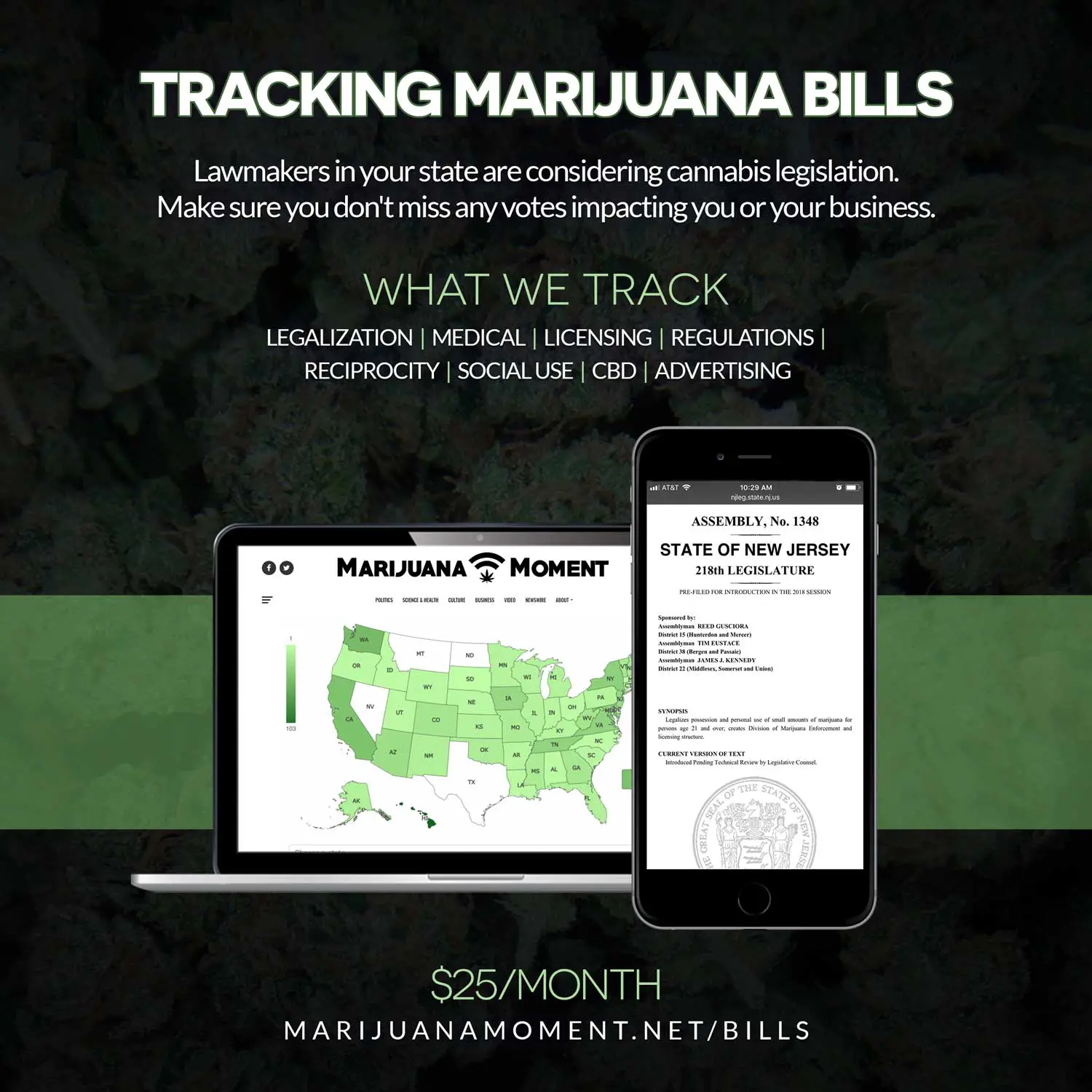
Learn more about our marijuana bill tracker and become a supporter on Patreon to get access.
—
GOP senators have separately tried to block the administration from rescheduling cannabis as part of a standalone bill filed in 2023, but that proposal did not receive a hearing or vote.
Meanwhile, last week, the Drug Enforcement Administration (DEA) said the marijuana rescheduling appeal process “remains pending” despite President Donald Trump’s recent executive order directing the attorney general to finalize the process of moving cannabis to Schedule III.
Advocates may welcome the exclusion of the rescheduling provision and inclusion of medical marijuana protections in the CJS bill, but many cannabis stakeholders have protested Trump’s signing of a separate appropriations measure in November that includes provisions to ban most consumable hemp products.
Photo courtesy of Chris Wallis // Side Pocket Images.