Politics
4 In 5 Marijuana Consumers Oppose Hemp THC Ban Trump Signed Ahead Of Rescheduling And CBD Access Order, Poll Shows

Four in five marijuana consumers say they oppose the recriminalization of hemp THC products under a spending bill President Donald Trump signed into law in November—weeks before he issued a cannabis rescheduling order and took steps to protect access to full-spectrum CBD.
The current law as enacted, however, would redefine hemp in a way that industry stakeholders argue would effectively eradicate the sector that Trump legitimized during his first term when hemp was federally legalized under the 2018 Farm Bill.
Though there’s been some splintering between marijuana and hemp interests over the THC ban, which is set to take effect next November, an overwhelming majority of cannabis consumers (82 percent) say they’re against the pending policy change.
That’s according to a new poll from the cannabis telehealth platform NuggMD, which asked marijuana users to weigh in on the hemp THC recriminalization provisions of the law.
Just 4 percent of respondents said they support the ban, while 15 percent said they don’t have an opinion about the policy.
| Q: “The president recently signed legislation that re-criminalizes hemp-derived THC, which was made legal in 2018. Do you support or oppose this policy?” | ||
| n: | % | |
| I oppose the policy. THC from hemp should be legal. | 365 | 81.5% |
| I don’t have an opinion on the policy. | 67 | 15.0% |
| I support the policy. THC from hemp should be prohibited. | 16 | 3.6% |
The survey involved interviews with 448 cannabis consumers who live in state-legal markets from December 4-14, with a +/-4.63 percentage point margin of error.
The poll was conducted weeks before Trump signed an executive order directing the attorney general to complete the process of moving marijuana from Schedule I to Schedule III of the Controlled Substances Act (CSA).
Part of that announcement also hold implications for the forthcoming hemp law. The president’s executive order also urged Congress to examine updating the definition of hemp to ensure that full-spectrum CBD is accessible to patients.
A further redefinition of hemp would be part of a novel proposal to allow Medicare recipients to access non-intoxicating CBD that’d be covered under the federal health care plan.
To effectuate that, the Centers for Medicare & Medicaid Services (CMS) will be announcing “a model that will allow a number of CMS beneficiaries to benefit from receiving CBD under doctor recommendation at no cost,” a White House official said during a briefing that Marijuana Moment first reported leaked details from ahead of the signing event.
“The December 18 Executive Order on cannabis makes it clear that the White House has a real CBD agenda,” Andrew Graham, communications director of NuggMD, told Marijuana Moment. “We polled the popularity of Congress’s latest efforts to regulate hemp because, right now, that policy is a major obstacle to that agenda.”
“Cannabis consumers are the primary stakeholders in this policy debate because another ban on hemp THC affects them directly, so their voice belongs in the conversation,” he said. “Beyond that, there is also a practicality question about the ban, because I don’t know how you’d make federal policy that bans THC but does not ban CBD. Given the existing popularity of hemp THC products, this strikes me as a pick-a-lane situation and I won’t pretend to know which side will prevail.”
Trump seemed endorse a more flexible CBD policy over the summer when he shared a video calling for that specific reform while promoting the health benefits of cannabidiol, particularly for seniors.
Meanwhile, a recently filed Republican-led congressional bill would stop the implementation of the hemp ban under the enacted appropriations legislation.
Hemp businesses and industry groups have warned about the potential ramifications of the ban, but despite his support for states’ rights for cannabis and a recent social media post touting the benefits of CBD, Trump signed the underlying spending measure into law without acknowledging the hemp provisions.
GOP political operative Roger Stone said recently that Trump was effectively “forced” by Republican lawmakers to sign the spending bill with the hemp THC ban language.
However, a White House spokesperson said prior to the bill signing that Trump specifically supported the prohibition language.
The Democratic governor of Kentucky said that the hemp industry is an “important” part of the economy that deserves to be regulated at the state level—rather than federally prohibited, as Congress has moved to do.
Also, a leading veterans organization is warning congressional leaders that the newly approved blanket ban on consumable hemp products could inadvertently “slam the door shut” on critical research.
—
Marijuana Moment is tracking hundreds of cannabis, psychedelics and drug policy bills in state legislatures and Congress this year. Patreon supporters pledging at least $25/month get access to our interactive maps, charts and hearing calendar so they don’t miss any developments.
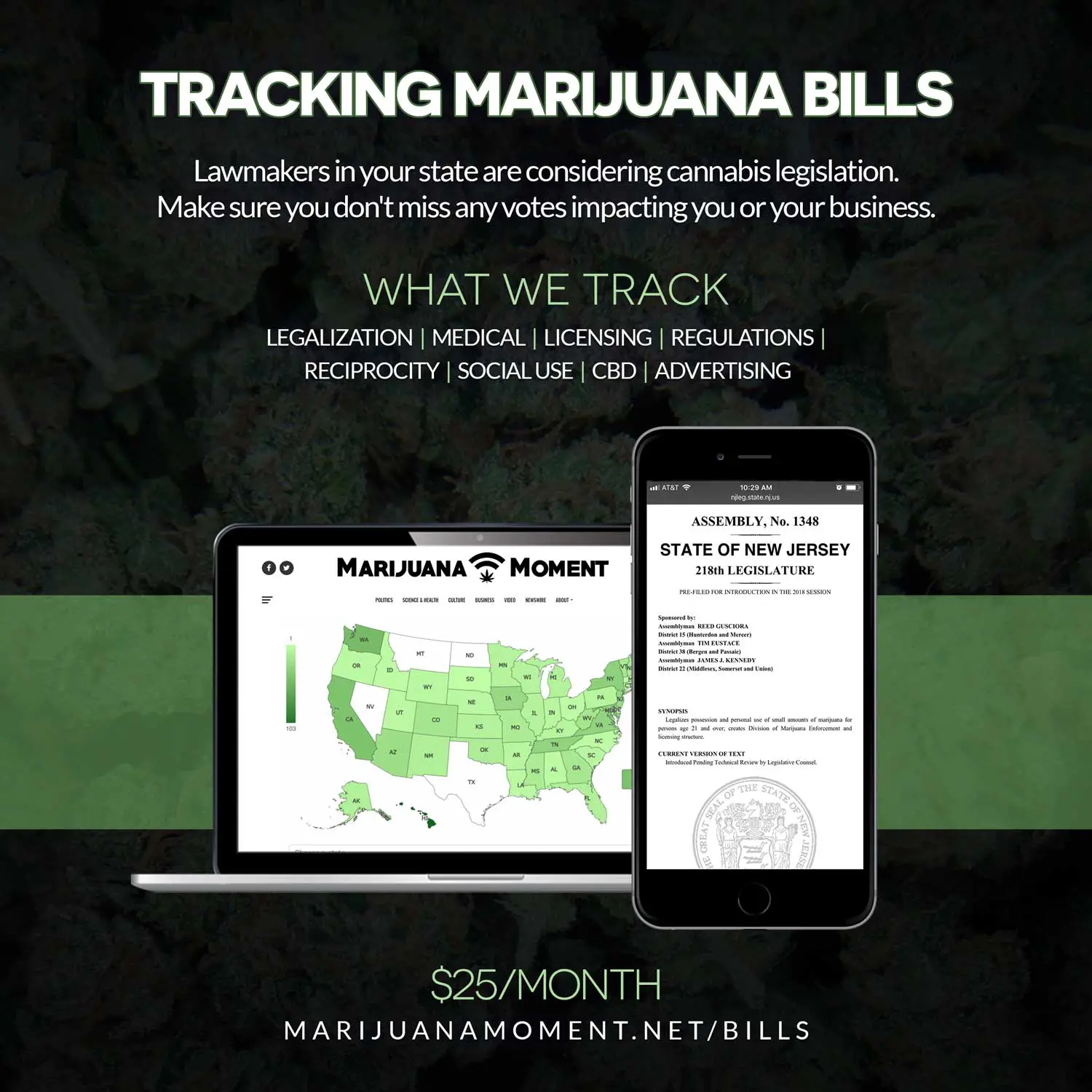
Learn more about our marijuana bill tracker and become a supporter on Patreon to get access.
—
Since 2018, cannabis products have been considered legal hemp if they contain less than 0.3 percent delta-9 THC on a dry weight basis.
The new legislation specifies that, within one year of enactment, the weight will apply to total THC—including delta-8 and other isomers. It will also include “any other cannabinoids that have similar effects (or are marketed to have similar effects) on humans or animals as a tetrahydrocannabinol (as determined by the Secretary of Health and Human Services).”
The new definition of legal hemp will additionally ban “any intermediate hemp-derived cannabinoid products which are marketed or sold as a final product or directly to an end consumer for personal or household use” as well as products containing cannabinoids that are synthesized or manufactured outside of the cannabis plant or not capable of being naturally produced by it.
Legal hemp products will be limited to a total of 0.4 milligrams per container of total THC or any other cannabinoids with similar effects.
Within 90 days of the bill’s enactment, the Food and Drug Administration (FDA) and other agencies will need to publish list of “all cannabinoids known to FDA to be capable of being naturally produced by a Cannabis sativa L. plant, as reflected in peer reviewed literature,” “all tetrahydrocannabinol class cannabinoids known to the agency to be naturally occurring in the plant” and “all other known cannabinoids with similar effects to, or marketed to have similar effects to, tetrahyrocannabinol class cannabinoids.”
The language slightly differs from provisions included in legislation that had previously advanced out of the House and Senate Appropriations panels, which would have banned products containing any “quantifiable” amount of THC, to be determined by the HHS secretary and secretary of agriculture.